

Rooted in Style
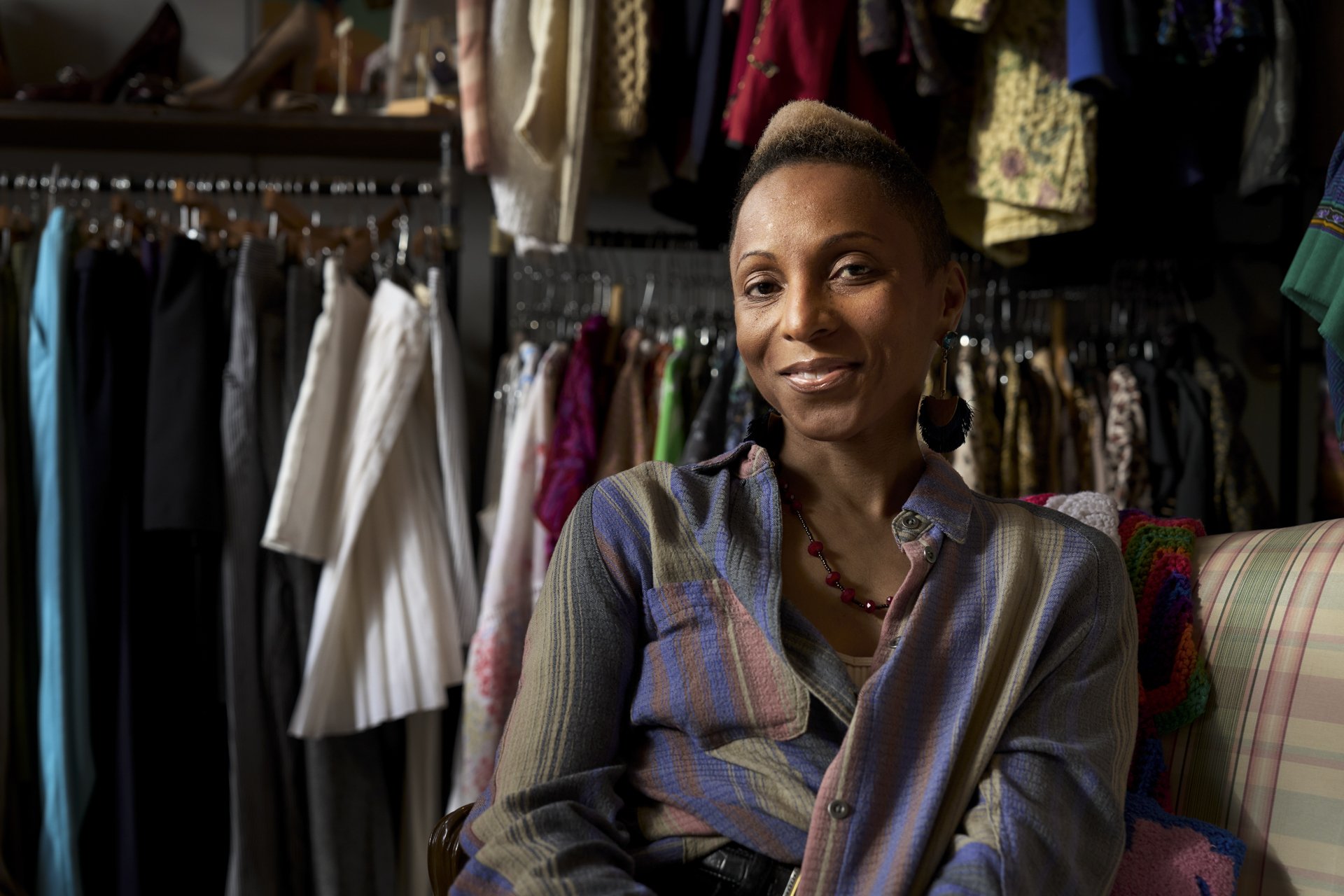
You founded Liberated Roots Co in 2020 as a sustainably focused lifestyle brand that is a celebration of Black culture. What was your inspiration?
I was doing ambassador work for a socially conscious local brand and was a part-time vendor for them at area markets. I’d often have conversations with other vendors and local businesses — especially Black-owned brands — and began to notice that there is a big drain of Black creatives in St. Louis. If they were at the market, they had one foot out the door.
Through helping the brand I was working for, I realized that I had a knack for thrifting and sourcing and just loved it. I found myself thinking about that and also thinking about this creative talent we have here. In the sustainable fashion world, there aren’t a lot of Black-owned businesses, so I asked myself, what if somebody did something about that? What if there was something Black-owned and curated from the Black perspective? What if we told our own stories? So, I created the Liberated Roots Co platform.
You went to law school at Howard University and intended to be a practicing attorney. How did you take such a different path?
I practiced law for about a year or so. At the time, I was a young new lawyer, very much involved with the bar, and served on several boards. Then my son came along. I thought I would just work from home for a year, but then I realized that it is a lot trying to work from home. Because I was a St. Louis transplant — we came here because it’s where my husband was practicing — I had no community, and finding employment was hard. I decided I was going to take a year off, during which time my son and I took field trips and explored St. Louis.
That just kept going, and then when he was 3, he went to preschool part-time; he was kind of a wild child there, but kindergarten was rough, and the reality of having an African-American boy and navigating the school system with this normal and perfect child became a new reality. I didn’t have time to work because the schools were always calling me — so much that I started joking that my job was in-house counsel for the Franks family. All of the energy I would have put into a profession went into navigating my child’s life and protecting and sheltering him. Then his younger brother was born a few years later, and when he was off to kindergarten, my third came along.
Really, it was just following the path of motherhood and being in the position I felt I needed to be in at the time.
What made you feel ready to pursue this new path? Do you feel like it diverges from your original plans out of law school, or is it related in some way?
When I first started thinking about Liberated Roots Co I was busy being a sports mom. Then the (2020 global health crisis) happened, and I was able to slow down and have time to think. The quietness gave me time to sit and develop thoughts and concepts, and some of that thinking was about sustainability in fashion along with some of the stories behind Black-owned brands.
Coming out of law school at Howard, which is the pinnacle of social justice, I always had a political mind and was always thinking of the environment that kids are living in and community justice. I wanted to be part of it. In that sense, Liberated Roots Co is not much of a departure from civil rights law. I am a stylist, curator of a space, collections, and events. All of those are meant to embed seeds of culture that spark confidence, affirmation, and voice. Lawyers influence and design systems. This is doing that, too, but for me it’s a more gentle path. I still have the same mindset — this is just a different outlet for activism.
In what way?
When you think about the stories behind a lot of (sustainably focused) Black-owned brands, everything is a reference to what is already traditional within the African-American diaspora. Necessity was the reason sometimes, but it was also about creativity and resourcefulness with fashion. Going back to the slave era in the U.S., people would take the scraps they were handed and make them fabulous; it was about taking something little and making it grand.
A lot of the businesses you talk to are using traditional ingredients that come from the Motherland, but the common thread is finding a solution because they couldn’t find that solution in the market. It’s about making things and bending them to meet our needs; that takes a lot of creativity and resourcefulness but also awareness of traditions. That’s where “Roots” comes in. Tapping into your roots and heritage to come up with solutions that not only allow you to survive but thrive is where “Liberated” comes from. If you tap into your roots to access your ancestral knowledge, that is the path to joy, freedom, and living authentically wholly.
Do you also see your role as a stylist as an outlet for activism?
When people come into the shop, Roots Oasis, I love the challenge of helping them look their most bold, fearless, and authentic — (taking what’s) on the inside that they’re trying to be (and manifesting it on the outside). Right now, we are in a time of change, and we need people to be courageous and be ready to rattle cages. If you can spark somebody in a way that helps instill in them a sense of, “OK, I am greatness in and of myself,” they will find their voice and step into it. It’s like bringing out a butterfly. I get so many people who say that they are not really into fashion. I am into style, which is basically the capacity to command your appearance and have the inside connect with the outside. There is this aura that people want to exude, and being able to control your aura and aesthetic is where I think the rub is.
Tell us about how you encourage “slow fashion” and sustainable shopping with the “Sip, Shop & Swap” clothing swaps you host at your shop.
A big part of what we do at Liberated Roots Co is encouraging slow fashion and more mindful shopping habits. Through our “Sip, Shop & Swap” community clothing swaps, we create a space for people to refresh their wardrobes in a sustainable way, by swapping accessories and clothing instead of always buying new. These events not only promote sustainability but also build community by bringing people together in a fun, engaging way. They reflect our mission of making fashion both conscious and culturally affirming.
This year, you are one of the organizers of St. Louis Earth Day Festival’s Sustainable Fashion Show. What is your inspiration for the event, and what can people expect?
We’re working with all of these amazing young creatives and the theme of the show is “Natural Co’nsequences.” It’s about Mother Nature being in her villain era — we say she is on a tumultuous pursuit of harmony, and there will be a representation of the five elements that will be about the struggle with and consequences of (a changing climate). Usually when people think about Mother Nature, she’s earthy and calm, but this is Mother Nature furious. She is coming at us with righteous anger, honesty, and integrity about the corruption of the Earth, and she is responding to her unjust treatment, hoping it will inspire people to think about their voice and their roles and to not be afraid.
Tell us about the local designers and creatives featured in the fashion show.
For the upcoming fashion show, titled “Natural Co’nsequences,” Creative Directors Zion Harrell, Aha Sa Djedu, and I will style looks curated from our in-house vintage selection. Additionally, there will be looks created by local designers who align with our values of sustainability and cultural expression. The show will feature 15 independent designers who specialize in cut-and-sew, upcycling, re-working, and printing, showcasing their unique approaches to sustainable fashion. There will also be makeup and some of St. Louis’ most creative hair designs provided by the Whisper Style Team.
Editor’s Note: Liberated Roots Co’s name is styled without a period in “Co.” as Franks believes “leaving off the period symbolizes infinite possibilities.”
How do you think St. Louis inspires your work?
I wasn’t born here, but St. Louis raised me. I feel like I am almost from here, because I have lived through 30 years of St. Louis history and have seen a lot of things come around. What I get to see from the vantage point of being a small local business owner is that I know a lot of people from out of town and get to hear their reflections about how they experience St. Louis. It is all positive.
I felt like, for a while, St. Louis had a self-esteem issue, but I’ve gotten to interact with younger people who grew up in families that might have left the city and raised them in the suburbs. A lot of them are moving back to the city, and they are part of this new wave of creativity. I’m not saying it suddenly got creative; it has always been a hub of Black creativity, but there is a new wave going on, and they are enthusiastic for St. Louis and their community. Their sense of ownership and social responsibility is phenomenal.
I feel like that has been the part that has been unexpected for me — seeing who is getting involved in all of these different creative projects. I feel like I am building something that resonates with them. This side of St. Louis — the young Black creatives that are planting seeds here — is a side of St. Louis that is not being covered. Being able to relate to them and nurture them is part of what keeps me going, even when there are challenges. Liberated Roots Co is the name of the brand; instilling in them a feeling of acceptance and support means you are giving life and sustenance to the younger generation. Their acceptance tells me I am doing something right.