

The future of colorectal cancer screening nationwide is made in St. Louis. Erica Barnell made it possible.
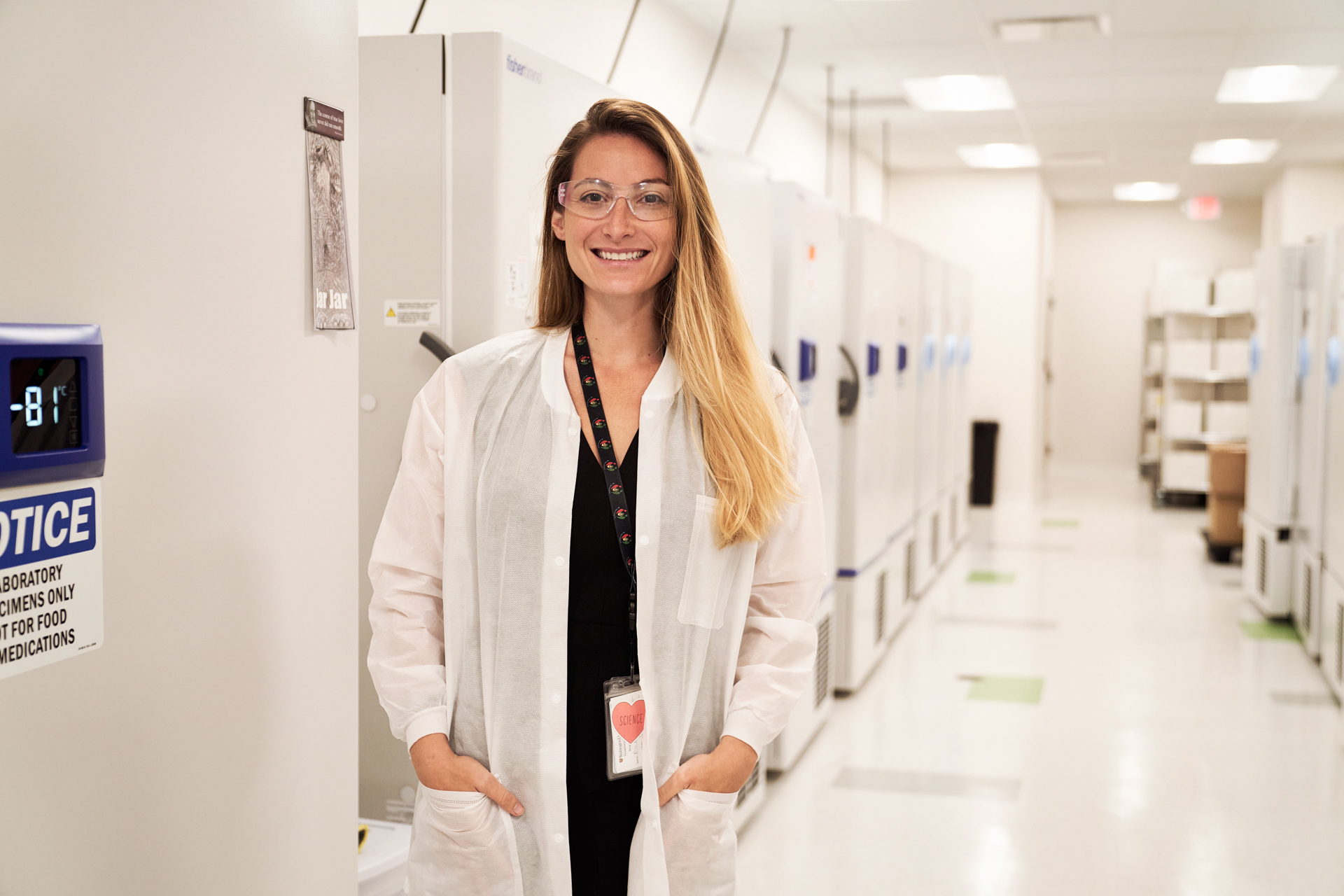
Dr. Erica Barnell and her team at Geneoscopy are celebrating three major milestones in June 2026.
Geneoscopy has grown significantly since we last covered the company in 2021. Tell us about some of the big highlights and milestones you’ve celebrated in the past five years.
It’s been exponential growth across a number of different fronts. As a biotech company, you really have your head down as you’re working towards demonstrating clinical validation and utility. We had been basically working towards FDA approval for eight years, which seems like a very long time. As soon as we received that massive milestone, it became a pivotal moment for the company. We started thinking, “OK, what path do we choose next? What are the next biggest barriers to go from FDA-approved product to getting our advanced screening test in the hands of the patients?”
People can underestimate how much effort and time that takes, but I am proud to say that we’ve really made a ton of progress over the past three years. From guideline inclusion to accessibility, or payer coverage, we have made tremendous progress. In the past year alone, we have received inclusion in the NCCN and ACS guidelines and coverage from the Centers for Medicare & Medicaid Services. This means that all individuals that are on Medicare are now covered with no out-of-pocket costs for our ColoSense test.
While external validation has been incredible, we’ve also been trying to improve the way that the test operates and how we can engage with patients. Last year, we made several modifications to our collection kit to improve patient compliance and close the colorectal cancer screening gap. This included eliminating the most burdensome part out of the collection kit, which requires scraping the sample prior to shipping it back.
It has been rewarding to see all this progress being made and to finally be at a point where we can treat patients and save lives.
Tell us about the new diagnostic tests Geneoscopy is in the process of developing.
We have really ramped up our research and development effort at Geneoscopy over the last few years on pipeline products. To that end, I have been excited to get back to my inflammatory roots, which is where I started as a scientist. We have been collaborating with large academic institutions, including WashU and Northwestern University, as well as several large pharmaceutical companies to evaluate if we can better monitor, diagnose, and predict therapeutic response for patients with inflammatory bowel disease (IBD).
We’ve had precision oncology diagnostics for a really long time, but within the inflammatory space, there is a large unmet need to apply precision medicine to these subjects. My happy place is truly in the lab so it has been very fun for me to get back to research, and hopefully deploy our next test soon.
On June 22, Labcorp announced the nationwide availability of Geneoscopy’s ColoSense test across its extensive network. Tell us about that partnership.
Labcorp just announced that they’re offering our test nationwide, which provides access to a large number of providers and millions of patients. We now have about a 25,000-square-foot CAP and CLIA lab that operates six days a week, so we have massive capacity to process samples. Being able to build our team and infrastructure here in St. Louis, where I was born and raised, has been incredibly rewarding.
It is mind-boggling to think that we could go from hundreds of tests to hundreds of thousands of tests. And that ramp up could happen very quickly. But we have the most dedicated, motivated staff who are genuinely excited to process waste and find cancer. I feel like the luckiest person because I have the best job in the world.
You mentioned earlier that you’ve made improvements to the ColoSense test over the years for patients and providers. Walk us through those changes.
ColoSense is a stool-based test. However, unlike other stool-based tests, which require you to reach down into a bucket or toilet to complete a fecal swab, ColoSense does not require you to handle the sample. You set up the collection, deposit a sample into a bucket, pour the buffer over the sample, and ship it back to the laboratory using a pre-paid label.
Originally, we had designed the kit to require the fecal swab, but when we talked to patients, they said that was the most difficult part to complete. So to mitigate those concerns, we launched an initiative to see if we could remove that from the collection process. About a year ago, the FDA approved a modified version of ColoSense that does not require the fecal swab.
So now, our test makes it really easy for patients to understand how to do the process. This is especially important for patients who have low health literacy or patients who have low dexterity. As such, our test might improve the patient experience and patient compliance.
Colorectal cancer patient populations and guidelines have changed even in the years since you founded Geneoscopy. How is the company helping to need those changing needs?
Our understanding of colorectal cancer has evolved even in the short time since I graduated from medical school. This past January, the American Cancer Society announced that colorectal cancer is now the leading cause of cancer-related deaths for people under 50. We had thought that this disease was associated with aging, something that happened later in life. But now we are seeing this disease occur in late-stages for people in their 40s or even younger.
Despite the rise in incidence, we have seen screening rates stagnate at about 60%. That means that four in every 10 people who need screening for colorectal cancer are not up to date with recommended guidelines.
As the guidelines move away from an invasive colonoscopy-for-all strategy — which we know is not feasible given the resource limitations we have in this country and the compliance limitations we have in our patient population — to a risk stratified approach for screening, this is going to become increasingly important. As guidelines move younger to address the rise in incidence in younger populations, based on that evolution in the field, what we’ve built at Geneoscopy can address some of the problems that we’re seeing in the clinic.
You grew up in St. Louis, and you’ve shared how being able to co-found Geneoscopy alongside your brother Andrew and grow the business in your hometown has been so meaningful to you both. How has your decision to stay and invest in St. Louis helped you and your business succeed?
I think that we might not have been successful in other locations. I was able to complete my education, do my medical training, do my PhD training, and start a company in a three block geographical area. And in most cities, you don’t have that. We were able to build out a CAP, CLIA laboratory affordably, in a really beautiful area, and not expend as much capital as you would in larger, more expensive cities.
Additionally, we have so much talent here, whether it’s from SLU, WashU, Millipore Sigma, or BioSTL and beyond. There’s just so much talent in the St. Louis region.
We were also incredibly successful locally in obtaining funding. We started with grants, angel investors, and local family offices and eventually moved to venture capital and debt funding. A lot of that financial power came from St. Louis. There is so much enthusiasm for young entrepreneurs here.
Importantly, if you ask anybody in St. Louis for anything, they are more than willing to help you themselves or connect you with the right person. That is so rare outside the Midwest. So I really do think that St. Louis was instrumental in the success that we’ve had here and we couldn’t be happier to be here.
You’re a mentor and role model as a scientist and entrepreneur to the next generation of scientists. How does that feel?
As a kid, you go through life and you’re constantly pulling from the community. You’re being raised by your parents, you’re completing your education, and you’re leveraging the resources and opportunities to build your skillset and prime yourself for your career. And I feel that I am now at a pivotal point where I can give back. Since I’m so grateful for everything that St. Louis has afforded me, this is where I want to give back.
I’ve had the incredible opportunity to go to John Burroughs and WashU and speak to the next generation of entrepreneurs and scientists. My goal is to inspire students to take that leap of faith and execute on their ideal. Put themselves out there and experiment. Try something new. When I was growing up, I had so much access to that. To women in science, to alternative paths in medicine, to entrepreneurship, and that was what inspired me.
So just being able to do that here and share my story — being able to give back in that way — has been very meaningful for me.