

If You Can Dream It
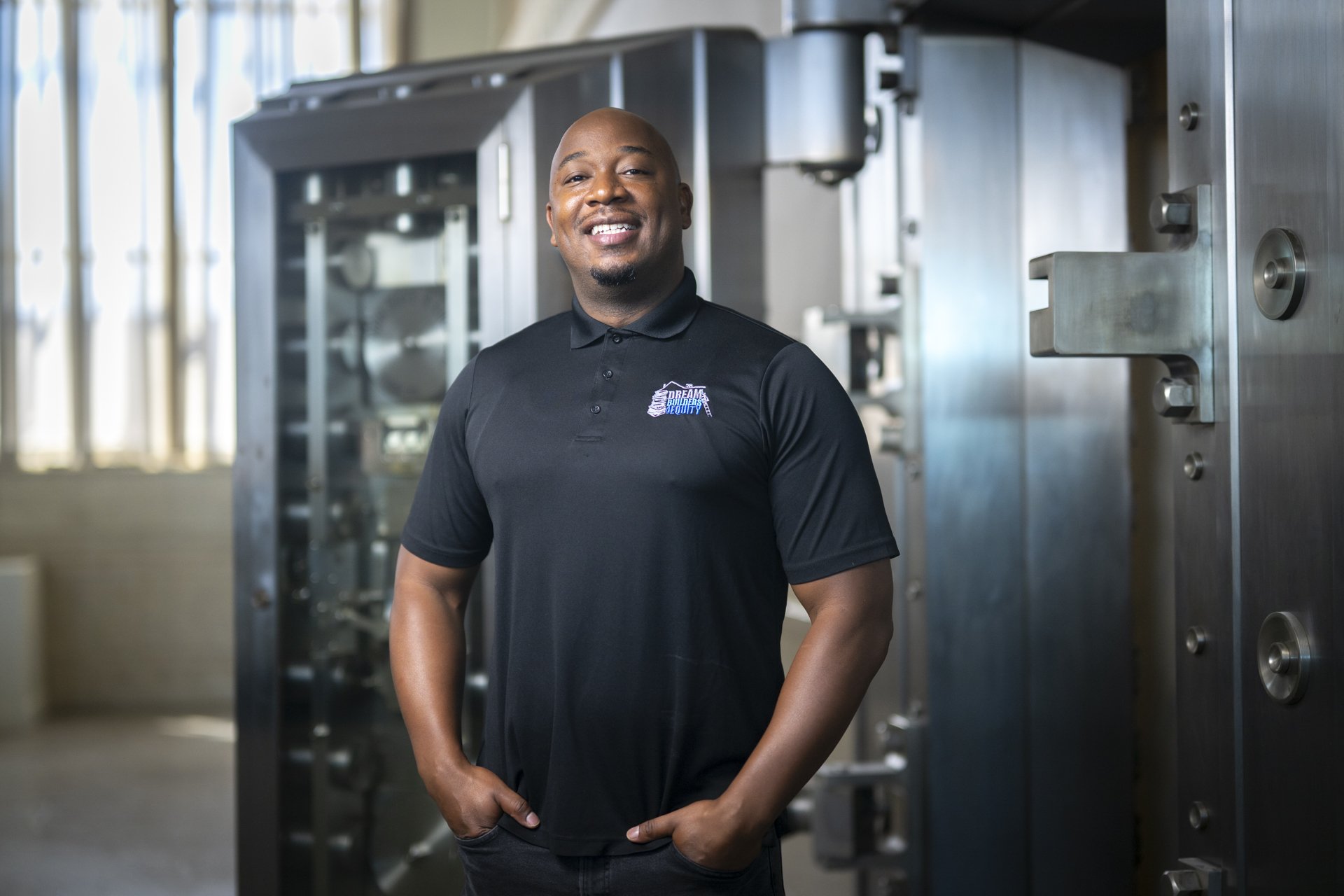
DB4E has seen a lot of growth since you and Richardson founded it in 2016. Catch us up on some of the progress you’ve made in your efforts in and around Hyde Park.
When we founded DB4E, we didn’t have a lot of funding and were doing what we could with the dollars we had in our pockets. Over time, we started to receive significant funding that allowed us to plan for different goals, and it’s allowed us to make great progress, including the completion of five building rehabs with eight additional ones currently underway in partnership with Habitat for Humanity Saint Louis. We’ve completed around 30 home-repair projects for seniors — everything from putting in new bathrooms and kitchens to repairing decks and porches. Our Summer Youth Academy has grown from 30 to 60 students.
We’ve created new programs, like our Black Squares chess program led by Kenny Leonard and William Humphrey, and we’ve opened the retail store House of Vision (HOV) which sells art, apparel, and books from local Black and Brown creators. It’s also where our students have signings for the books they write as part of the program, which coincide with album releases, poetry slams, and fashion shows. We also now have an 11,000-square-foot headquarters in the Old Midwest Bank building in Near North Riverfront. It’s a beautiful space that kids can call home, and we are excited to build upon what we’ve already created there.
It sounds like the organization is focusing as much on housing rehabilitation as it is with other community development initiatives. Is that a shift, or has it always been a part of the vision?
We’ve always understood that rehabbing houses alone will not transform neighborhoods. We need grocery stores, retail stores, hospitals, community spaces, so we’ve taken it upon ourselves to do those things or have partnered with other organizations to help us with that. Prior to us coming to Hyde Park, it felt like the neighborhood was invisible; now the St. Louis Development Corporation is committed to this neighborhood. Saint Louis University is involved as well, as is another nonprofit called Gateway Global that opened training hubs here. WEPOWER and the Urban League are also committed to transforming the area.
They have all seen us be vocal and visible, and that has attracted other amazing folks to be part of the neighborhood. That is how transformation happens. We know we can’t do it all on our own, but what we can do is go into neighborhoods, create hope, and galvanize other folks to come in and be part of the transformation.
The kids who participate in DB4E are the heart and soul of the organization. Now that you’ve had almost a decade of impact, what are some of the successes that have come out of the program?
We’ve had so many success stories, and some of them may be different from what people might assume. We have a lot of young people who go into the trades and construction space, but we also have a lot who go off and do other things. One of our students who came on with us in 2017 went through high school, got a scholarship to Ranken Technical College. After he graduated from there, he worked in the union and eventually began his own construction company that has several investment properties. We have others who are doing really well in the construction trades, and then we’ve also begun to scale out of construction, too.
One of our students worked with us as he worked his way through college, and he is now a dentist, as well as one of our directors and youth mentors. Another one of our students has a full-ride scholarship to Webster University for journalism, and he is working at KMOV. We think our students have been able to be so successful is because we are intentional about the next steps for them after they move on from our program. When they are with us, they get soft skills and exposure, and we make sure they take those next steps.
This is what I think our biggest win is: Getting young people to see that there are other options to what cool can look like. When I was young, I thought tough was the only way, but as soon as I got exposed to the rest of the world and realized there are artists and doctors and other professionals who looked like me, I realized I could do those things, too. DB4E students get exposure to the world and believe that there are so many things they can be. It’s in their DNA.
Perhaps the best-known part of the DB4E mission is its home-construction efforts, which have played an impactful role in the city’s tornado recovery efforts since May 2025. Tell us about how the organization has been involved.
Immediately, our team realized that we had to do something. Jessica Gaines and Colin Nelson, chief construction officers for DB4E, and our chief operations officer Nikki Joseph led our efforts in storm relief. We’ve been at ground zero since day one, and I have to tell you, it’s a disaster. You never stop feeling that when you are there. What people have been through is unbelievable.
Initially, our work centered around supplies distribution, debris cleanup, moving things out of the street, and tarping. When we were out in the field in The Ville, we got to know the people at Invest STL and 4theVille and spent 30 days working at their hub with a full construction team and all of our young people on-site. They spent that entire time supporting them and also leading a lot of the efforts to send out volunteers. It was a great collaboration and impressive vision and leadership from Invest STL and 4theVille.
Now, we are focusing our efforts on what we have the capacity and skill set to best help with what is now needed, like moving and storage support. That includes moving storm-impacted folks to either another home or apartment or helping them move their belongings into storage units that we are paying for, for up to six months. We are also now going into the next phase of repairs, which includes tree removal, and we are hoping to start doing free renovations on the homes that were damaged in the storm.
What do you think recovery looks like, and what gives you hope?
That’s a really nuanced and complicated question. I think people are trying to solve for what should be next, and they are coming together and trying to figure that out collaboratively. That is something that gives me hope.
Also, seeing the community be loose with their time and money has been important. I hope that continues, because we need to distribute as much funds and support as we can to those that have been impacted. This is the time for us to come together and do what we can as fast as we can.
You’re almost a decade into this work. What continues to inspire you and animate what you do with DB4E?
It’s easy to keep up with this work because we see impact. Some things are a little more pie in the sky, but with Dream Builders, we are watching students graduate high school and college, and then get employed. We are getting immediate feedback on their success, and we are also able to see in real time what we do to improve the lives of those we help. We see that a lady’s roof was caving in and now she has a new roof and somewhere to feel comfortable. We see a house that was once in disrepair that we rehabbed; now there is a mother who owns one side of it and her daughter who owns the other. Those things are mind-blowing, and knowing that we actually did that, and that young people got paid while we did that and minority contractors lead the work is incredible.
I can drive down the street and see the impact we have created. And that inspires and rejuvenates me to see the bigger vision of what we could do with this at scale, whether that’s in other neighborhoods in St. Louis or in other cities.
I imagine us being that organization that attracts other people to be a part of the transformation, including gainful employment and workforce development for communities. Knowing that is possible and thinking about how much impact we could have keeps me super excited. We want to get it right in Hyde Park, and then take this show on the road.
Editor’s Note: Revisit our 2021 coverage of Dream Builders 4 Equity here.