Style Icons
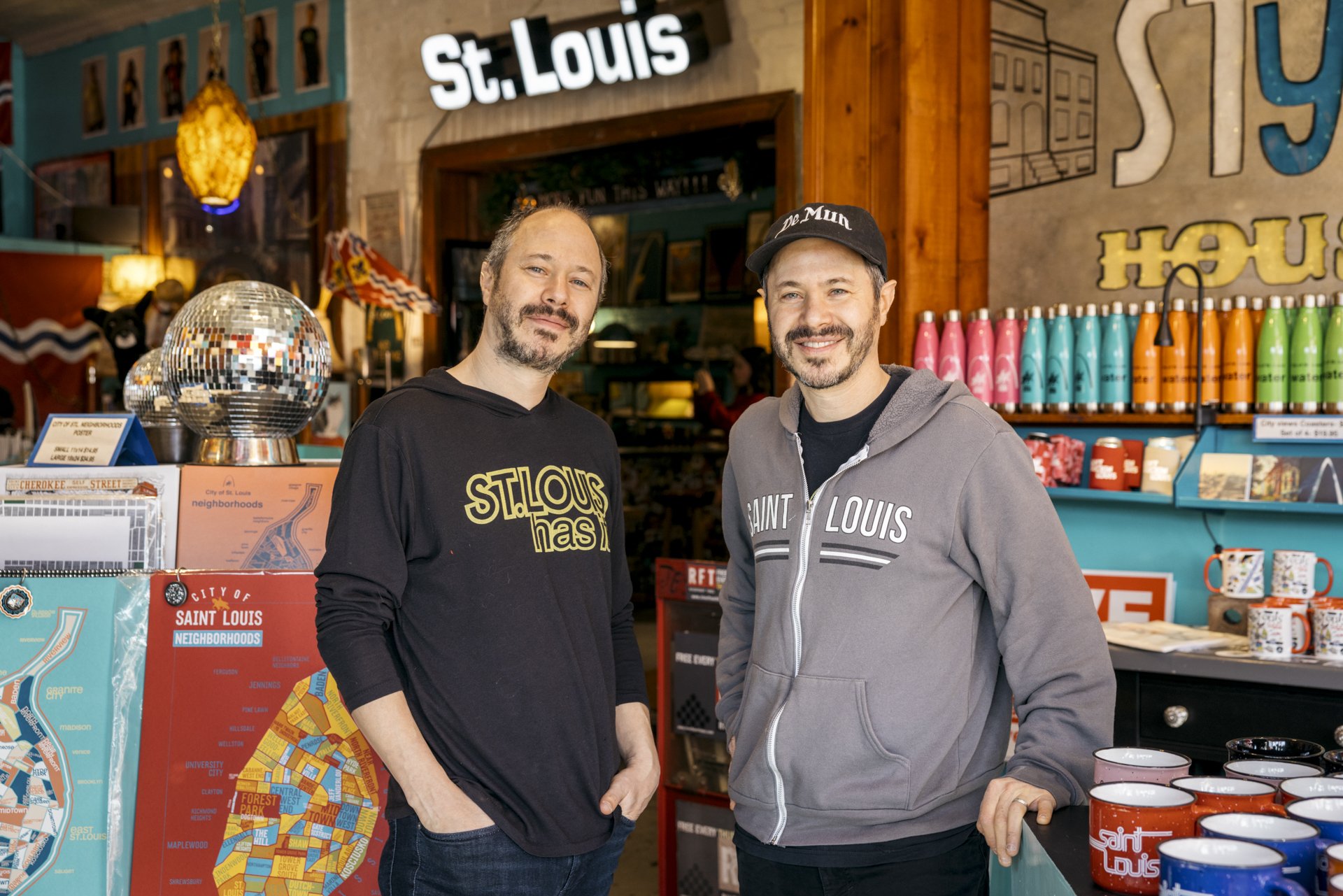
For 15 years, Randy and Jeff Vines at STL Stylehouse have promoted St. Louis and played a vital role in the city’s community fabric — including Cherokee Street’s eclectic identity.
The best T-shirts are often the cheekiest — at least for Randy and Jeff Vines. At their Cherokee Street shop, STL Stylehouse, you’ll find tees, stickers, hats, posters, and all manner of St. Louis swag. Jeff’s favorite shirt design actually predates the store, which the twin brothers opened at the corner of Cherokee Street and Compton Avenue in 2010. Based on a photo Randy took years earlier on South Grand, the tee features the wide grille of an old Cadillac framed by the slogan “Fo’ Chouteau.”
One of the lines the shop carries, Bygone Brand, sells shirts with the logos of late, great businesses such as Mississippi Nights, the Checkerdome, and KWK Radio. One of their newest offerings, added after St. Louis’ longtime alt-weekly shuttered in 2024, features the iconic red Riverfront Times logo, but reads “RIP” instead of “RFT.” Proceeds from the initial run went to a fund to help the journalists who were laid off.
“We like the tongue-in-cheek, irreverent references, which is kind of our edge,” Jeff says. “We are definitely looking to cater to people in-the-know who get St. Louis’ self-deprecating humor.”
It’s that attitude that garnered the Vines brothers a following even before they became a Cherokee Street staple. Back then, the business was known as STL-Style, its official name, yet after opening the shop, the name STL Stylehouse also stuck (today, the Vines say both names are cool with them). Their first designs were printed on a friend’s dining room table in Dogtown as an antidote to the less-than-inspired tourist-friendly St. Louis souvenirs you might pick up at an airport gift shop.
For many years, both brothers kept their full-time day jobs — Jeff at a local bowling-shirt company and Randy in hotel management — and their designs remained a hobby.
Growing up in Creve Coeur, the brothers often heard stories from their father and grandparents about the glory days of North St. Louis, when streetcars still moved citizens around the bustling metropolis.
“That was when we first started really appreciating the city,” Randy says. They developed a sense of hometown pride when they started doing research and realized how large the city once was. “We knew that St. Louis had an incredible history that most cities never will have. It’s got such a glorious past — so much character and charm and just true grit that really spoke to us.”
To that end, their first T-shirts were centered around capturing the personalities of St. Louis’ various neighborhoods. The design for German-founded Baden beckons with “Wilkommen.” Mid-century St. Louis Hills is represented with a period-appropriate Jetsons-style font. South Grand, known for its diversity of restaurants, boasts an experience “around the world down the block.”
A turning point came in 2008, when the Vines — still without a brick-and-mortar — and their work was featured in a 2008 New York Times Sunday feature about T-shirt companies looking to lift up “downtrodden cities” like St. Louis and Detroit. Suddenly, St. Louis expats were aware of a way to show support for their hometown.
“That brought our little side hobby into the forefront,” Randy says. “We realized we should take this more seriously, because we were getting calls and orders from every corner of the world (after that). We realized that St. Louis has a huge diaspora. There are St. Louisans all over the planet, and they’re thirsty for something to connect them to the city.”
Jeff says he doesn’t think this connection is necessarily unique to St. Louis alone, but attributes it to legacy cities like Detroit, Cleveland, Pittsburgh, and Baltimore, which, like the Gateway to the West, have rich histories and evolving identities. He also contrasts this to up-and-coming metros like Nashville, Phoenix, or Austin, which tend to have a lot of transplants.
“St. Louis has fostered this local culture and identity for more than two centuries,” Randy says. “There’s a lot of buy-in to that, and a lot of people who are proud to say they’re from St. Louis. Sometimes it doesn’t get the reputation it deserves in the media, but that’s okay. People who know better know better.”
Things came to a head when Jeff lost his job in 2010, and a friend offered them a Cherokee storefront with “dirt cheap” rent. At the time, it was a little off the beaten path from the neighborhood’s established businesses, and the abandoned building across the street had tattered curtains blowing in the wind. Still, the brothers figured it’d be a fun place to hang out with their friends on the weekends and fulfill the one or two orders they received a week. The pair say they were ready to close up shop if it wasn’t going anywhere within the year.
To keep business going strong, they branched out into custom printing. It started small with a family reunion or two and a nonprofit event here and there, but soon, worth-of-mouth spread, and the Vines were able to turn the shop into a self-sustaining venture.
Today, you’ll spot the store immediately thanks to the royal blue Volkswagen Beetle parked outside and a bevy of bright-red St. Louis flags that give the corner location a festive feel. The colorful two-story mural on the side of the building was commissioned by Jeff and Randy in celebration of their 40th birthday from local artists Robert Fishbone and his daughter Liza Fishbone.
The interior is even more vibrant: Open the door plastered with stickers and you’ll be met with stacks of T-shirts, colorful reusable water bottles, postcards, tote bags, onesies, coasters, coffee mugs, and if you’re lucky, shop cat Frankie. The shop’s walls feature historic city maps and vintage ads and photos of St. Louis nestled between Jeff and Randy’s own designs. You can also have any of STL Stylehouse’s designs custom printed onto the vessel of your choice while you wait. Ultimately, the energy of the space is funneled into one feeling: love for St. Louis.
“We get visitors from all over the world, some of them just passing through St. Louis on a road trip to somewhere else, and they decide to stop, and then they’re like ‘This city just speaks to us,’” Jeff says. “Some have even moved here. They discover this amazing place with cool architecture, very accessible, easy to do a lot of things without sacrificing culture or a sense of place or cool people.”
A lot has changed in the 15 years since the store opened, but one thing remains the same: Cherokee Street has long been known for its quirky offerings. The neighborhood first developed in the shadow of the Lemp Brewery but transformed from residential to commercial with the advent of the streetcar. It eventually boasted a J.C. Penney and a Woolworth’s and was known as a shopping destination in the 1950s and 1960s. But by the 1990s, that identity was replaced by an Antique Row that was hanging on alongside a smattering of small music venues and a record store.
However, affordable rents and vacant storefronts provided opportunities for businesses, including for St. Louis’ Latino community. Cherokee Street became known for its Mexican bakeries and Hispanic and Latino restaurants and still hosts a vibrant Cinco de Mayo festival every year, which brings tens of thousands of people to the neighborhood. Over the past two decades, even more small businesses such as Ruby Francis, a vintage clothing shop, and Dead Wax Records, have moved in alongside stalwarts like Taqueria El Bronco and Diana’s Bakery.
One of the newest storefronts to open down the street from STL Stylehouse is ‘Ssippi, a cozy natural wine bar owned by Brogan Drissell and Emily Kostiuk, who also live in the neighborhood.
“Cherokee has a good, specific energy that other parts of St. Louis don’t have. It’s a weird street,” Drissell says with a laugh. “It allows people to test out ideas because of the affordable rent, the openness of ideas in the community, and because of the diversity. That (describes) a lot of St. Louis, but there’s a special, special variety of that on Cherokee Street.”
Drissell partially attributes the close-knit nature of Cherokee Street to its layout. The two-lane thoroughfare is even more walkable than some of the city’s other popular business districts, which can be more car-centric.
‘Ssippi received a warm welcome when it debuted in July 2022, from the Vines brothers as well as other nearby business owners, like Mildred Wright of Don’s Muffler Clinic across the street. The eponymous Kurtis York of Kuts by Kurtis, a barber shop at Cherokee and Nebraska Avenue, is a ‘Ssippi regular.
“Cherokee ebbs and flows, but I feel this big upswing happening,” Drissell says. Recent additions to the neighborhood include juicery and health food shop La Casa de los Jugos and cookbook store Anchovy Book Co.
Cherokee Street Community Improvement District (CID) executive director Emily Thenhaus echoes Drissell’s confidence in Cherokee’s resilience. St. Louis, and Cherokee Street in particular, she says, reflect the history and development of the United States.
“There’s such a rich history to the City of St. Louis that can be found in the architecture, the arts, the fabric of our communities, which is not something a lot of other places have,” Thenhaus says. “The buildings on Cherokee were built more than 100 years ago, and tell a story not only of the city, but of brewing, of brick making, of industry, the ebbs and flows of urbanization and suburbanization.”
Part of that, Thenhaus says, is the history that’s still being written by places like STL Stylehouse. She considers Jeff and Randy to be unofficial city ambassadors — not only because of their St. Louis merch, but because of their near-constant advocacy for the city.
Besides partnering with St. Louis Public Library, St. Louis Public Schools, and the St. Louis Department of Health, STL Stylehouse designed the official “I Voted” stickers for the city. Randy also gives bus and walking tours as one of 24 guides for the Missouri History Museum’s See STL program. Tours are organized by neighborhood — The Hill, Laclede’s Landing, Tower Grove, Old North St. Louis — but also by theme, like Gay Liberation in the Gateway City, Urban Renewal, and Brick City Broads.
Sure, their products poke fun at not-so-scenic waterways (one shirt recommends you “swim the beautiful River des Peres”), maligned regional accents (another features an outlined highway badge that reads “Farty” instead of 40), and dubious traffic practices (this one replaces a stop sign with “4-Way Roll”), but ultimately the goal is St. Louis pride. Several designs highlight the bright orange of the city’s refuse trucks, the water division logo seen on manhole covers, and the common seal of St. Louis, which features a steamboat. Red, blue, yellow, and white scarves in the style of the city flag signal STL allegiance immediately, while a new design featuring a cartoon toasted ravioli relaxing in a bath of hot marinara sauce exudes insider cred.
“One of the most satisfying things is that we regularly get emails from people saying they saw someone wearing our shirts on the New York subway,” Jeff says. “That’s really why we did this in the first place — to just get people thinking about St. Louis as a cool city and boost our civic self-esteem. The city needs it, and we don’t take anything for granted. People who love St. Louis and get it, they really get it.”
In early 2025, Jeff and Randy hosted a recording of the popular podcast “How to Destroy Everything” and are planning a 15th anniversary celebration for STL Stylehouse later this year.
The pair say they’ve gotten offers to expand the shop, to move to flashier neighborhoods, or open additional locations, but they feel the single Cherokee Street flagship is not only more manageable, but just fits their vibe the best.
“We love to travel and get out of town, but there’s no other city that gives us the same sense of purpose,” Jeff says. “We could have moved away, but we just knew our heart was in it here and nowhere else.”