

Mind Over Matter
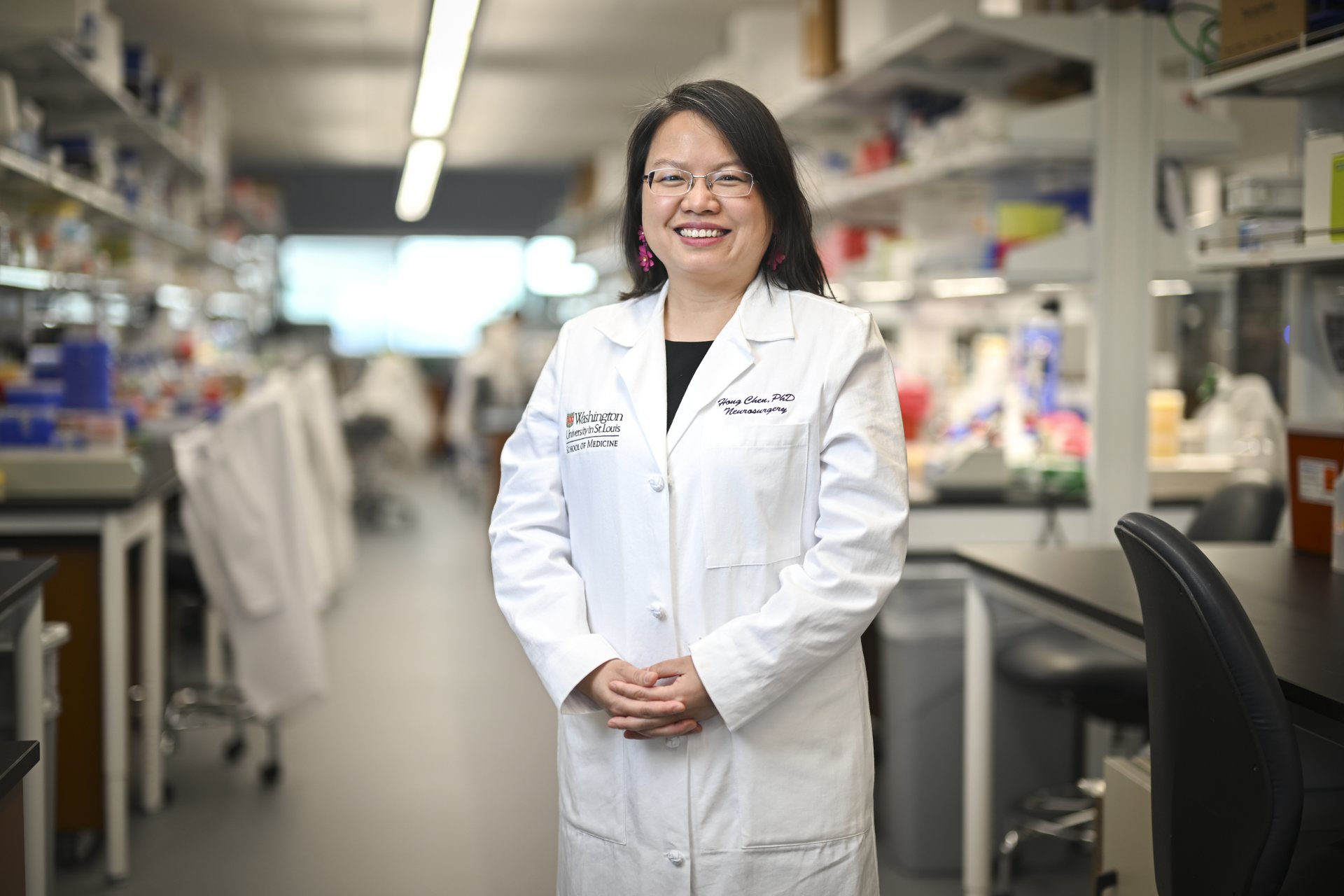
Your graduate research began on the applied physics side of ultrasound technology, but you shifted your focus to the brain because of a personal experience. Tell us about that.
I was doing my PhD work at the University of Washington in Seattle in the applied physics lab. At that time, my research was much more on the physics side of ultrasound. During the wintertime in Seattle, there isn’t much to do except go skiing, so one winter I went skiing and fell, causing me to lose my short-term memory. My husband told my advisor that the doctors said they didn’t know when my memory would come back and when I would be able to go back to my work and training. Luckily, my brain recovered quite quickly, and when I went back to the lab the first thing I told my PhD advisor was, “I want to work on the brain.”
What does it mean to apply ultrasound to the brain? Was this a new frontier when you began your work?
Fundamentally, the vision is to achieve the goal of diagnosing the brain, treating the brain, and understanding the brain by using an ultrasound scanner just like the kind that has been used for imaging babies. Currently, the way the brain is diagnosed or treated most of the time involves surgery or inserting wires and electrodes into the brain. What ultrasound provides is a noninvasive way to do this. When I was doing my postdoc work (in 2012), the technology was still very new. When I came to WashU in 2015, none of this was happening. This technology didn’t exist, so we even came up with the name, neurosonics.
How does ultrasound technology work on the brain?
Think of how you can use a magnifying glass to focus light: The light at the focal point can be so strong that it can burn paper, so you can concentrate light and energy to utilize it for other applications. Sound can do the same thing. You can concentrate sound energy to one point; it’s like concentrating the sound energy of an entire football stadium when everyone is shouting, then collecting that energy to one point. It is so high that you can utilize it to burn or cause thermal ablation to a diseased brain region without cutting the brain open.
Another application is one we call sonobiopsy, which uses ultrasound technology to do noninvasive biopsies of the brain. Imagine that disease is like an apple tree, and each specific disease has specific features, or molecular mutations — there are protein markers for Alzheimer’s disease, for instance. Sonobiopsy uses ultrasound to shake the apple tree so that you can get an apple dropped into the bloodstream, which can then be collected so that you can detect the disease through a blood test instead of having to do surgery or have a needle placed into the brain to get a piece of tissue to be analyzed for disease markers.
We’re not saying we are going to completely replace surgery or biopsies, but this is for patients who are not candidates for surgery, such as those who have a tumor located in a critical place or patients who are not able to go through surgery.
What are some of the successes you’ve seen in using this technology on the brain so far?
WashU currently offers treatment to patients using focused ultrasound technology for Essential tremor and Parkinson’s patients.
For Parkinson’s patients, one treatment option has been to implant electrodes in the brain to perform deep brain stimulation. However, it requires invasive surgery to implant these electrodes, and only patients who have no other options are candidates. Now, we can use ultrasound to focus energy to modulate neurological activity — in other words, turn it on and off.
Just envision it: Now, you don’t need to implant electrodes. You can just grab an ultrasound probe, move it to the diseased location, turn it on, and stimulate the part of the brain to make it work close to normally. This is one success in terms of the technology going from basic research to clinical translation.
You talk about this being a new frontier when you came to WashU Medicine. How has your work there, as well as the culture of the university, moved this technology forward?
When I came to WashU, this technology didn’t exist. WashU gave me the opportunity to make my dream of working on this come true.
I started my faculty position here in 2015 and was one of the first few faculty who had a joint appointment in the School of Engineering and School of Medicine. On day one, I was able to locate my lab at the medical school and directly work on developing ultrasound technology that is fully noninvasive and precise and applied to the brain. This allowed me to quickly collaborate with experts in neuroscience and neurooncology and physicians currently working on the brain so that I could utilize my training in ultrasound to build the technology that could solve medical problems.
I couldn’t imagine any other place that could have provided this opportunity. I definitely believe that the opportunity to work at WashU and in this community where everyone is so collaborative and open-minded has given me the freedom to explore so many different frontiers that have brought this non-invasive technology closer to patients. It has allowed me to move the technology from the bench to the bedside.
That collaborative spirit is pushing you and your team to explore even more possibilities for ultrasound technology on the brain. What are some of the things you are currently working on?
We are already in clinical studies for patients with pain, depression, and many other diseases.
There is another area we are exploring, sonogenetics, where the vision is to combine ultrasound with genetic engineering. What genetic engineering does is provide genetic editing of the brain in a specific brain location to make it more sensitive to ultrasound so that when you turn it on, you have high precision of which neuron you are manipulating. This offers cell-specific neuromodulation. Because this requires genetic engineering, we have to wait for that to be safe enough to be done in humans.
And then there’s another project we are working on that might scare your audience, which is neuromodulation that induces hibernation-like states.
This sounds like science-fiction.
Space travel is one of the reasons for this exploration. What we’ve found in mice and rats is that we can induce a hibernation-like state by using ultrasound to stimulate a specific brain region that decreases body temperature and metabolic rate. If you think about when an animal hibernates, they decrease body temperature and metabolic rate to conserve energy. People have been thinking about this for space travel, but it also provides great opportunities for medical implications. If it works in humans, it could provide a shift in our framework on how we think about patient care.
How is that?
With many diseases, what is happening is that the disease leads to a decrease in the energy supply in the body.
Think of a stroke, where the blood supply to the brain is decreased. What modern medicine does currently is to try to increase that supply; we give treatments to remove blood clots so that the blood supply can come back and bring nutrients and energy to the brain so that it can be recovered. But what if we have a way to decrease the body’s need for energy and nutrients? It’s like balance. Normally, our supply and consumption are balanced, but under a diseased state the supply decreases. Modern medicine recovers that supply, but if we can decrease the metabolic rate we can achieve a new balance where the body doesn’t need as much.
Stroke, cardiac arrest, trauma patients are all potential applications for this: If blood flow decreases due to lack of supply, we could potentially bring the body into a low metabolic state where the body doesn’t need as much so it can protect the brain and body similar to the way that a hibernating animal does not need as much food when it enters this state so that it can preserve its body. Ultrasound could induce this state, and the beauty of it is that it’s non-invasive so it does not require surgery or another complicated procedure. This makes it more clinically translatable.
How has WashU — and the St. Louis innovation ecosystem at large — supported your work, including at the company you co-founded, Cordance Medical?
I have to say that WashU has provided the opportunity for me to be embedded in a community that is open to collaboration and brainstorming with other scientists. Our lab is located in the new neuroscience building, and all 11 floors are filled by neuroscientists. The opportunity to have my lab surrounded by neuroscientists in so many different fields, but who all have a shared interest in the brain, provides opportunities to be creative.
In terms of the ecosystem, our building being next to incubators helped us commercialize the sonobiopsy technology we developed. Our company, Cordance Medical, recently raised $8 million dollars in seed funding, and the support we received from the incubators here was crucial in helping us navigate the process and make decisions on what we needed to do.
And then there are the perks of being in St. Louis — things like access to great schools and education for my children, the cost of living and even the traffic. All of these things make living in St. Louis enjoyable and give me the freedom to focus on my work and think outside of the box as a pioneer. The brain is amazing, and I know I have the tools and capabilities here to develop things that can have an impact on patients, because life is so cherishable.
Join the Story
- Learn more about Dr. Hong Chen on the WashU website.
- Follow WashU Medicine on Facebook, Instagram, X, and TikTok.
- Connect with WashU Medicine on LinkedIn.
- Delve into more STLMade stories about the scientists, researchers, doctors, and engineers expanding the scientific, medical, and innovation communities in St. Louis.