Humans of St. Louis:
Jenna Elizabeth’s Story
After the tornado, St. Louis photographer and artist Jenna Elizabeth documents tree destruction in Forest Park through art — and invites others to help.
Editor’s Note: Over the next few days, we’re sharing Jenna Elizabeth’s story as part of a Humans of St. Louis and STLMade collaboration profiling ongoing tornado recovery efforts across St. Louis. We will update this story with new content as it publishes on our Facebook and Instagram pages this week. And learn how to get involved in tornado relief and recovery efforts across St. Louis.
Subject: Jenna Elizabeth
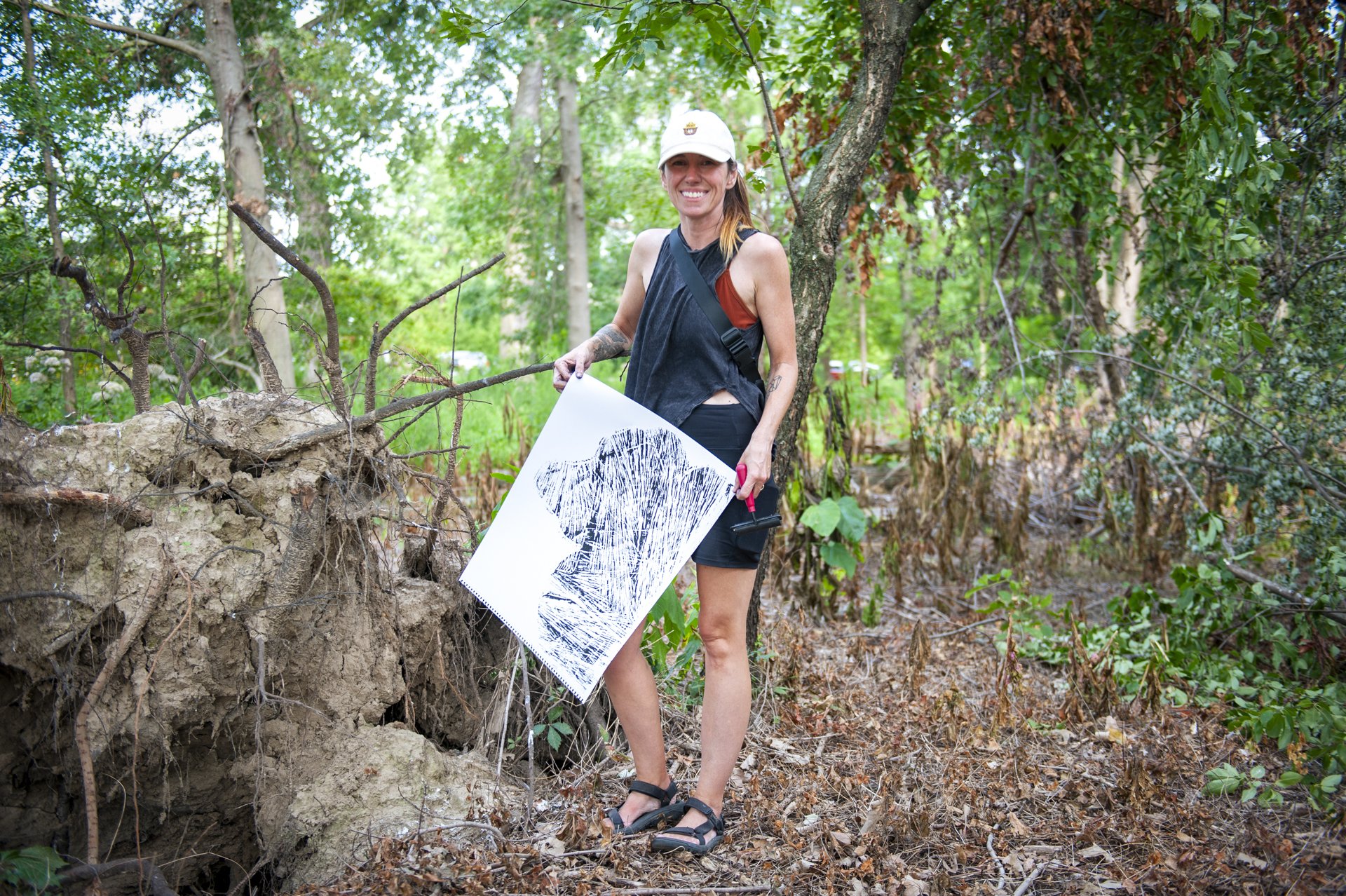
Jenna Elizabeth is a St. Louis photographer and artist who’s been creating art in nature by documenting the tree destruction in Forest Park since the May 16, 2025 tornado that devastated St. Louis. She makes large-scale print transfers of the felled tree rings with black paint and paper — and invites others to help as they pass by, creating a community engagement piece in the park as well.
Your art is such a beautiful tribute to the trees that were pummeled down across the city from the tornado.
As a photographer, my first instinct was to take pictures. But it didn’t work. Then I thought, “Wouldn’t it be great to do something with all of the trees about to be turned into mulch?” But I’m not a woodworker. I wouldn’t know how to do anything with it. I don’t have a backhoe or a truck or a place to store tons of weight of trees. And then the cleanup process just had to happen. Forest Park doesn’t own the trees. The trees are owned by the city. So the city had to do what the city had to do — clean them up. And it was a race for everything to get cleaned up. It wasn’t about conserving them. They had to get out of the way for safety, for the functionality of roads. So this process felt urgent.
I’ve scanned 75 small prints by now and probably have 25 big ones.
Where do you get the materials from for your project?
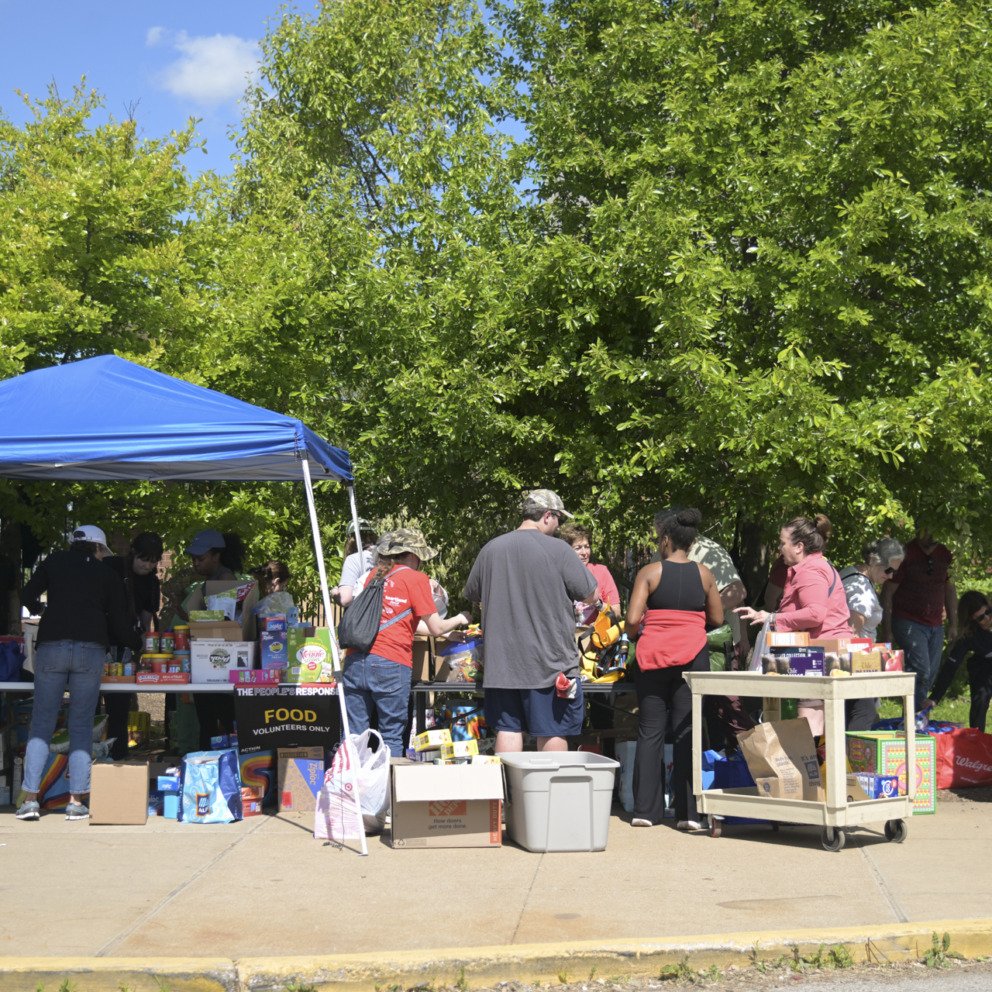
I have a wishlist of supplies, but really it’s me just funding it. Blick and friends have donated some paper. I’m almost done with the trees in Forest Park, and I want to go back to O’Fallon Park, where I worked with The People’s Response. What I mostly need is big paper and more ink.
What would you like to do with the pieces you made when you’re all done and finished?
The Missouri History Museum is collecting documentation of the tornado, so it would be great to see some there. I wonder if any local galleries would like to show the body of work. We have over $1.5 billion of damage, five people died, and thousands are still without homes. My hope is that this project can bring awareness and funding to those who still need help.
***
“I never thought I was an artist; I thought I was a business. I was a photographer. I had a photography business. And it wasn’t until people started hiring me to photograph people who were dying that I thought, ‘Oh, maybe there’s something else to what I’m doing.’ After almost 20 years of saying, ‘I need to be known as a photographer and a small business strategist,’ I came to be known as The Eagle Lady. And now, I’m coming to be known for this. Which is fine. There are worse things to be named for.”
“This project started because by Picnic Island, by the Grand Basin, there are so many big canopy trees over there that were lost from the tornado. In wintertime, an eagle would go over to those trees, and my favorite tree was the one this eagle would sit on the most. So I wanted to be able to honor that tree. It was a huge Cottonwood, like 100-and-something years old. And I was racing against the tornado cleanup crews to get to that tree because some of the trees had already been stumped and were completely out of the ground. So I practiced the technique on one little tree in a big pile, and then I came over here doing a weird-shaped tree that actually ended up looking like an eagle. Even I knew it was woo woo because my mom saw it and started to cry. She never cries.”
“Anyway, I didn’t know what the cleanup process would be like, and if the cleanup crews were gonna cut all the trees down or leave some of the stumps. Some of the trees that were hit, like ones on the golf course, are pretty much completely gone. Now, when you go to Forest Park, you can see some of the trees that I’ve marked.”
Because your characteristic black is on them?
Yeah! Hang on as I use my roller. Now it gets squeaky for a second…
***
“Originally, I wanted to just capture the tree rings. To do that, you have to sand the stump and then blowtorch it. I was out at the park with a blowtorch the first week, trying to make it work. But it was too much. So I figured, ‘What’s real about the way the trees have now been cut at their base is that there’s trauma.’ That’s what this is. So I started going up to the chainsaw crews, saying, ‘Thanks for doing this. You’re making art with me.’”
“The prints are all so different, and I have so many that they’re taking up my entire living room. I went to see how much it would cost to get a 82-by-54-inch frame for one, and it was going to be like $11,000 with museum-quality glass. I don’t know the best way to display these. I’m not a trained artist. I had just seen this sort of thing done, so I watched one YouTube video and thought, ‘I can do that.’ Once I learn something enough, I stick with it. So now I’m doing this.”
“I lay down a black acrylic coat so the actual black ink I use to stamp doesn’t immediately sink into the wood. Because that ink costs $15 a bottle. I have so many of these bottles, there’s got to be more ink in there.”
You’re squeezing out the last of it like toothpaste!
“Yeah, there’s more!”
***
What’s your connection to Forest Park, the trees, and what happened when the tornado demolished a lot of this area?
Most people who know me thought I was in here when the tornado hit. It was a Friday afternoon at 2:30 p.m., and there was nowhere else anybody thought I’d be. But I randomly changed my plans that day to help a friend canvass for signatures. The truth is, I spend a lot of time in this park because, when I moved to St. Louis, this was my office. This is where I took pictures of families and weddings and had other photoshoots, even covering events for Forest Park Forever.
Then the pandemic hit, and I was like, “I’m going to use this place for me.” I live down the street, so I’d spend a lot of time here and walk my five miles a day. That’s when I started seeing the eagles here more. And when my friends and I went on walks, they’d say, “You pick them out so quickly!” So I became the person who can spot the eagles. Then I had an uncle in the ICU at Barnes-Jewish, so I’d come to the park every day, talking to people at the Visitor Center, trying not to be super sad because my uncle wasn’t going to make it. And the eagles would come to me. Sort of. One tree in the park is the reason why there’s an eagle chart in the wintertime at the Visitor Center. So if anybody sees an eagle, they can go inside, put a sticker on the map, and sign the date and location where they spotted it. And that’s how I became The Eagle Lady.
When I’d have therapy, I’d say, “Well, I saw an eagle today!” and the therapist would ask, “How many eagles until you know you’re okay?” I’d reply, “I don’t know. But it keeps being a thing.” So this place is just where I come to grieve. Whenever I have free time, I’m in the park. People use the park for so many things. I’ve also come for the Great Forest Park Balloon Race and the St. Louis Symphony. This place is such a treasure to have in the middle of the city. I grew up in a rural area, in the middle of nowhere. So having nature so close helps regulate me. And when I leave town and come back, it’s the first place I go, so I feel more grounded.
When the tornado hit, my mom and I had gone to dinner, and afterward, I said, “We have to check on the trees in Forest Park.” And as I drove through, it started to hit me how bad it was with the roads blocked off and no power and everything just a huge mess. My mom and I got out, we walked through it a bit, and I cried the whole time. We returned to the car, and I knew we had to go to the Grand Basin. My poor mom. I just kept telling her, “Mom, I’ll take you home in a minute.” And she’d say, “You said that 20 times ago.” So when we got to Picnic Island and the canopy area, that was the most devastating to me because all of the big Cottonwoods, and the ones that were like World’s Fair years old, were gone.
***
“I moved to St. Louis 16 years ago, and having my family here after for a while was such a gift. Then my sister moved here, met her husband, had babies, and moved to Minnesota. And recently we moved my mom and all her stuff up there, too. But we had been all living within a mile radius of each other. Our dream was always to have our own piece of land to be close, and we had that in this city. We were so close. Now everyone is gone. And I’m in this rebuilding phase of my business. So, there’s the tornado and then there’s the upheaval that is my own life.”
“When the pandemic started, I couldn’t do weddings anymore. It made me sick how people behaved. And it made me sick, the disregard for others’ well-being in order to have a fancy day. It just didn’t make any sense to me. Like, have a smaller wedding that’s safer. And I’m not necessarily a person who’s included in much or invited to things. So it didn’t feel like anyone was coming to help me. I’m a one-woman team. So, when I had moral opposition to what we were doing as an industry, it didn’t sit well. I ended up building my car into a camper to be able to safely get to my clients in different cities while exploring, since none of us knew what was gonna happen. And the last five, 10 years — not just for me, but for a lot of people — have been so much. I don’t have kids. I don’t have the traditional lifestyle. It’s just me. Add in the residue of a bad breakup and it’s kind of destabilizing.”
“Grief takes however long it takes though. And one thing that’s hard to do when you’re grieving is to advertise for a business based on love. Also, when you’re sad and can’t advertise for your business, the phone stops ringing. So there’s been a lot of change. And there’s been a lot of therapy. I’m the first in my family to go. I advocate for it. But life’s just been a constant upheaval, and I’ve needed to take care of myself. My story’s all over the place. I photographed women-led businesses, which are also families, and that’s where I light up. That’s where my work comes very naturally to me. That’s where I can sink into my zone of genius.”
***
“People who spend a lot of time in Forest Park were worried about the wildlife after the tornado. Well, my family is like an animal rescue center. Between squirrels and ducks and birds and possums and mice, we’ve ended up facilitating a lot of animal rescues. So the day after the tornado while doing cleanup in the park, I ended up coming across two baby raccoons in a tree. All I could see at first was the mom’s snout, and I knew she didn’t make it. Then I heard some squeaky sounds coming from under the tree and knew there was another raccoon in there. I lay down and wanted to try to get the baby out. I got my work gloves, blanket, and Trader Joe’s bag from my car. Turns out, there were two I was able to retrieve, but one more I just couldn’t reach. Because it was late, I took those two home and slept with them on my back porch. They were so small, I didn’t even care if they bit me. They cuddled up with me; they were so sweet. I fed them some kitten milk just to give them some sustenance until the next morning when I could find a place to take them.”
“Normally, I do yoga in the mornings at the Grand Basin on Saturdays and Sundays. So afterward, I went back to where I found the raccoons, like, ‘I’m just gonna check the tree again before I take the two to this rehab lady I came in contact with.’ And the third raccoon had wiggled its way out. He survived the night, like, ‘Hey, buddy, why’d ya leave me behind?’ That’s how I then became known as The Raccoon Lady. And a few weeks later, I went for a rainy walk in the forest, and there was a worker in her high-viz uniform looking for a baby raccoon that I ended up finding with her. So I took the fourth one to Wildlife Rescue. Mark Glenshaw and his crew, who watch the owls, rescued egrets and hawks. They focused on the birds. I just happened to stumble upon the raccoons.”
***
“Hi, I’m Jenna.”
“Oh! I see what you’re about to do.”
“What am I about to do?”
“You’re about to stamp it.”
“I am! So if you’ve come to the park before, you’ve noticed there’s a big difference in the trees that we’ve lost. As you walk around, if you see the stumps of the trees that are black like this, they’re not burnt. It’s just me trying to preserve them, to give them one more story to tell. I’m a big believer that the trees hold our memories. Everybody uses the park in their own way. And this is my response to the sadness of losing the trees we lost. If you’d like to stay for a few minutes, I’m going to press it, and I’d love for you to sign your names on the back. Sometimes it doesn’t work, but there’s leftover ink, so I ink the tree a bit more and make small prints for others to have, too.”
***
“I started practicing on little trees. And then I did a really big one that was 82-by-54 inches, and it took four people to help me. By the time the clean-up crew got to the big Cottonwoods at the Grand Basin, I figured out how to do the prints well. Or at least good enough. I don’t actually know what I’m out here doing, but I’m following it. Ideas are tangible things. And when this one came through me, it wasn’t an option to not do it. This is the place I come to grieve. And how do you grieve when the place you go to grieve is now the reason for your grief? So that is what this project became. I cry a lot less now while I do it because I invite people in to do it with me.”
***
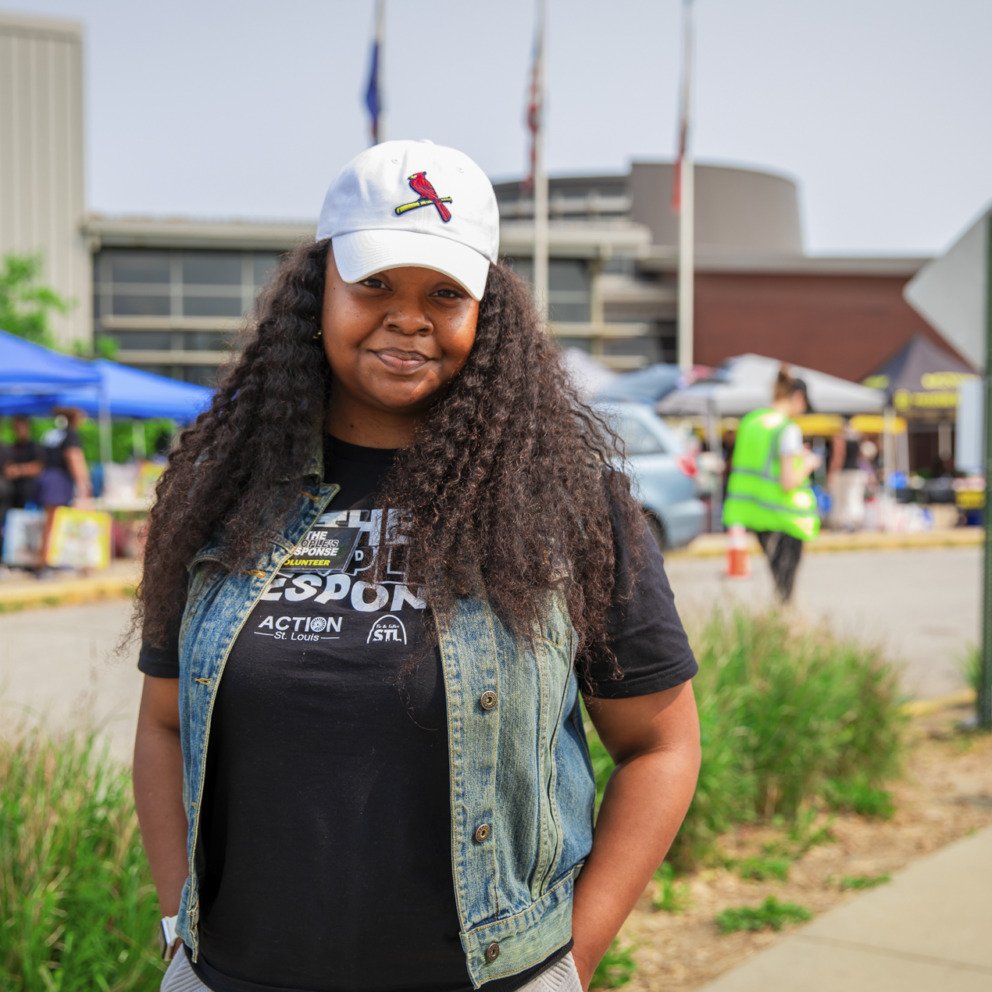
“Being part of The People’s Response, I had the opportunity to show up, serve, and be helpful. I was seeing people spring into action for and with Action St. Louis and For the Culture because the vision was clearly communicated. At the end of every day, we’d have a meeting to go over what needed to happen the next day. And people would hope that the city or the state or the government would show up. And that just wasn’t happening in North City. People are still living in tarps, tents, in hotels, and with family members. We had thousands of volunteers, and it was one of the most beautiful things to be a part of. Then, whenever I’d leave The People’s Response and be all super sweaty, I would go to the trees. And I’d try to take what I had held all day with helping, and release it to the trees. And listen to the trees. And just try to honor their memory. Then, having so many people show up as I painted the tree stumps is something I’ve never experienced as an artist or as a business owner. And also to get to create in this way, and people are supportive. I’m so honored to have worked with The People’s Response. We still continue to have monthly meetings and town halls. And there are still opportunities for anyone to help.”