Leading the Pack
For more than 50 years, the Endangered Wolf Center in Eureka has been a national leader in saving Mexican gray wolves and American red wolves from extinction by breeding wolf pups, reintroducing wolves into the wild, and educating the public.
There are currently around 286 Mexican gray wolves living in the wild, and every single one of them can trace their roots back to the Endangered Wolf Center in Eureka, Missouri. Though wild wolves have long since disappeared from Missouri’s landscape, for over 50 years, the center has played a crucial role in breeding and reintroducing wolves to the wild on a national and international stage.
Tucked right off Highway 44, the center’s unassuming location belies its global reputation. Located on a sprawling property consisting of 2,000 acres of mostly wooded forests, the nonprofit rents 60 acres from WashU’s Tyson Research Center, where it raises and cares for endangered wolves, foxes, and African wild dogs. The majority of the animals will never interact with visitors, and the center’s remote, peaceful location is ideal for raising wolves who will eventually be released back into the wild.
Standing on a raised concrete viewing platform and watching three gray wolves saunter through the woods, it’s easy to forget you’re just 25 minutes away from the Gateway Arch. In a nearby window, a Fennec fox with comically large ears dozes beneath a heat lamp inside one of the center’s buildings. Visitors standing inside a nearby conference room can walk right up to the glass and get to know the playful Lucky and Luigi, two maned wolves who will not be released back into the wild but serve as ambassadors for their unique species. Each is a living testament to the important work of the Endangered Wolf Center, which remains something of a hidden gem, even among lifelong St. Louisans.
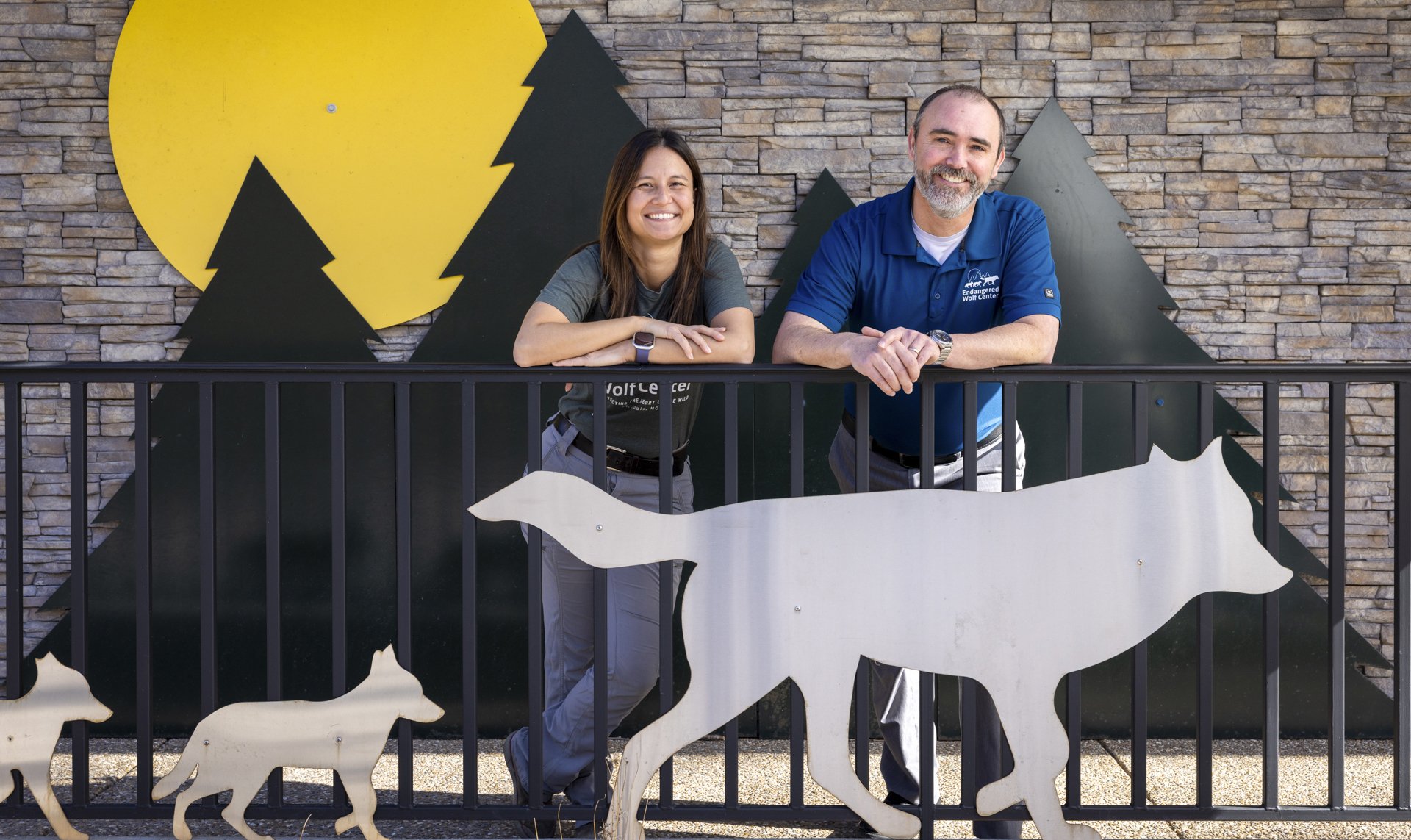
“Visitors are usually surprised to discover the Endangered Wolf Center and its long history of conservation,” says Sarah Holaday, director of animal care and conservation animal care at the center. “Despite this, the community is why we have been here for over 50 years. They support us through memberships, donations, and programming. We could not do our vital conservation work without their help.”
Conservation Foundation
Since its founding in 1971 by Marlin Perkins — a renowned zoologist and the host of Mutual of Omaha’s Wild Kingdom — and his wife, Carol, the center has become a leader in wolf conservation across the U.S. and Mexico.
Marlin was born in Carthage, Missouri, and got his first job at the Saint Louis Zoo at 21, rising through the ranks before moving on to other zoos across the country. Eventually, he returned to serve as director of the Saint Louis Zoo from 1962 to 1970 while also working on Wild Kingdom, which for many Americans served as an introduction to the conservation movement. In 1971, concerned that wolves around the world were in danger of becoming extinct, the Perkins turned their focus to Mexican wolves and red wolves and helped establish the Endangered Wolf Center.
Over the past 50 years, the center has become an international leader in wolf conservation through its programs that breed wolf pups, reintroduce wolves into the wild, and educate the public about the importance of wolves. In addition to other wild canid species and several species of fox, the center primarily works to preserve and protect Mexican gray wolves and American red wolves — the most critically endangered wolf in the world. In fact, the center was the first institution to participate in managed breeding programs for both the red wolf and Mexican gray wolf through the U.S. Fish and Wildlife Service.
The center works closely with the Association of Zoos and Aquariums’ Saving Animals from Extinction programs for both species, which help breed and manage the wolves under human care. The center houses wolf pairs that have been determined to be the best genetic matches for breeding and ensures that the wolves have everything they need to be successful and raise their pups independently. With this in mind, the center’s animal care team very intentionally doesn’t bond with the wolves, allowing them to become better candidates for release back into the wild.
“Our animal care team ensures that we are avoiding habituation as much as possible,” Holaday says. “Wolves are naturally really shy, and so they spend a lot of time being wolves in their habitats. Our habitats are one to two acres in size, so they get to socialize with their pack, learn behaviors, learn how to stay away from people, learn to hunt and share food with their pack. All those behaviors contribute to creating a wolf that will hopefully do well in the wild.”
Since both Mexican gray wolves and American red wolves are on the endangered species list, the center collaborates closely with the U.S. Fish and Wildlife Service recovery teams to release wolves into the wild.
The American red wolf — which was extinct in the wild by the 1980s and continues to be critically endangered, with only 20 known to be left in the wild worldwide — was the first large carnivore to be reintroduced to the wild in 1987. The Endangered Wolf Center has continued to play a vital role in saving the species in the years since. The center was one of the first facilities to successfully breed American red wolves, starting in 1981 with two red wolves, Pete and Sabrina, whose daughter, Brindled Hope, went on to give birth to one of the first two litters to be born into the wild since reintroduction began.
In 1998, the center and its partners released the first captive-bred adult Mexican wolves into the wild, and in 2014, conducted the first fostering of Mexican wolf pups into the wild. Fostering pups into wild litters has been a huge goal of the center — and something the team knows Marlin and Carol Perkins would have been proud to see — as adult wolves have a much steeper learning curve in the wild. Pups born at the center, meanwhile, are flown out to a release site and placed into a wild litter when they’re no more than 14 days old, before their eyes and ears even open.
“This allows them to be raised by a wild mom and dad who already have a territory, who already have knowledge of how to survive and are thriving,” Holaday says. “They get to learn directly from them on how to be a wild wolf, so that eliminates a lot of that steep learning curve and allows them to be more successful in the wild. It also is a great tool from the genetic standpoint, because the population that’s cared for within human care has more genetic diversity in it, because it is managed by us instead of wild wolves picking their mates. We’re trying to add that genetic diversity into the population, and we do that with pups.”
Conservation Preservation
As of today, 143 Mexican wolf pups have been fostered into the wild in New Mexico and Arizona, 52 of which were bred at the Endangered Wolf Center. Over 200 Mexican wolf pups have been born at the center, the most famous of which is arguably Anna.
Born in 2001, Anna gave birth to a record-breaking 41 pups in her lifetime, many of whom went on to live in the wild in Arizona and New Mexico. She also became the face of wolf conservation across the country, having had her image projected onto the Empire State Building and the Vatican and printed on a stamp for the Endangered Species Act. Anna is now on display in the Missouri History Museum’s Collected exhibit, and her legacy illustrates the center’s long and successful history of caring for endangered wolves.
Though wolves have long been maligned in popular culture, their conservation is so important because they are a crucial keystone species, meaning other plants and animals depend on them to survive. As a top-line predator, wolves maintain balance in the ecosystem by controlling deer and elk populations and preventing overgrazing, which allows plants to thrive, reduces the spread of disease, and ultimately increases biodiversity.
“When you remove wolves from the ecosystem, you start seeing corrections that aren’t necessarily well-balanced,” says Fred Gauna, executive director of the Endangered Wolf Center. “Prey populations start increasing — here in Missouri, whitetail deer wasting disease is exacerbated by dense population.”
“One of the ways wolves and top-line predators have an effect on the ecosystem is decreasing the pressure from deer and other small animals. Deer populations would be healthier with an animal like a wolf on the landscape, and that also has a cascading effect on the rest of the ecosystem. When deer are moving, you see healthier forests because they’re not sitting in one area; you see other areas start to recover from a lighter touch.”
Conservation Education
In addition to its work introducing wolves into the wild, the Endangered Wolf Center also offers robust programming to educate the public about the importance of wolf conservation.
The center in Eureka hosts more than 13,000 visitors each year for tours, field trips, summer camps, scouting programs, and its signature evening wolf howls. The tours are enthralling from beginning to end, including the last stop at the gift shop, which is located in a renovated World War II-era bunker. By design, however, the center is not set up to accommodate a large number of visitors at any given time.
“One of the things with trying to raise animals that aren’t acclimated to humans and getting the word out and doing programming on-site is that there’s an upper limit to how many visitors we want to have,” Gauna says. “We want to get the word out, but we have to do it in a way that is mindful of our mission of raising the American and Mexican wolf in a way that isn’t detrimental to them being released in the wild.”
The Endangered Wolf Center was an early leader in its field and has spent the past five decades honing best practices for breeding wolves in managed situations to make them great candidates for wild release. The center has served as a support system for similar organizations across the country, sharing its expertise, serving as a resource, exchanging information, and hosting different zoos and wolf conservation centers at its space in Eureka so that the wolf conservation community as a whole is stronger.
The center relies heavily on community support to do its work, and Gauna notes that the St. Louis community is rich with support in many different avenues. Partners such as the Missouri Department of Conservation and U.S. Fish and Wildlife Service help amplify the center’s message and grow its conservation work, but countless individuals have also provided crucial financial support to allow the center to do this work.
“Philanthropy in St. Louis is amazing,” Gauna says. “Folks have supported the St. Louis community and Endangered Wolf Center for 55 years and that couldn’t have happened without the generosity of the folks in the area. St. Louisans take a lot of pride in things that come from St. Louis, and we can see that in a lot of our supporters who are really proud of the work that we do and the fact that it’s based out of a place that they call home.”
Holaday adds: “The St. Louis community is the reason why we are still here, over 50 years later, doing wolf conservation. We rely on their support to do this work. We aren’t funded by the federal government; we aren’t mainly funded by grants. We’re funded by the generosity of this community, and so they’re integral to what we do. They step up, as they do for many other nonprofits and organizations in the area, and help us ensure that we can continue saving these animals.”