How the brothers behind a St. Louis startup are pioneering technology to prevent the next pandemic
With its innovative breath-based diagnostic and air bio-detector, Varro Life Sciences aims to protect against future global health crises.
John Cirrito knows that true “eureka” moments are rare. For over 20 years, he’s studied Alzheimer’s disease as a professor of neurology at WashU Medicine in St. Louis, focusing on how proteins in the brain change as a result of the disease. Over a decade ago, he and fellow professor Carla Yuede developed a nanobody-based electrochemical biosensor to detect the protein that builds up in the brains of people with Alzheimer’s disease.
In August 2020, when the National Institutes of Health put out an emergency call for new ways to detect COVID-19, Cirrito and Yuede heeded it. They realized that they could adapt their work with Alzheimer’s disease to help prevent COVID-19 by changing the antibody on the biosensor to the SARS-CoV-2 spike protein. After quickly getting an application together and ultimately receiving funding for the project, they 3D-printed a breath-based diagnostic device using their biosensor technology and conducted a clinical study at WashU. Within seconds of their first patient breathing into the device, they got a positive signal.
“It was like, ‘Oh, s***, this works,’” John remembers. “Within seconds, the first call I made was to (my brother) Tom to say, ‘Hey, we just got a positive result from somebody who’s COVID positive. Being able to make that call to him was incredible. That was one of those eureka moments — this works.”
Industry Innovators
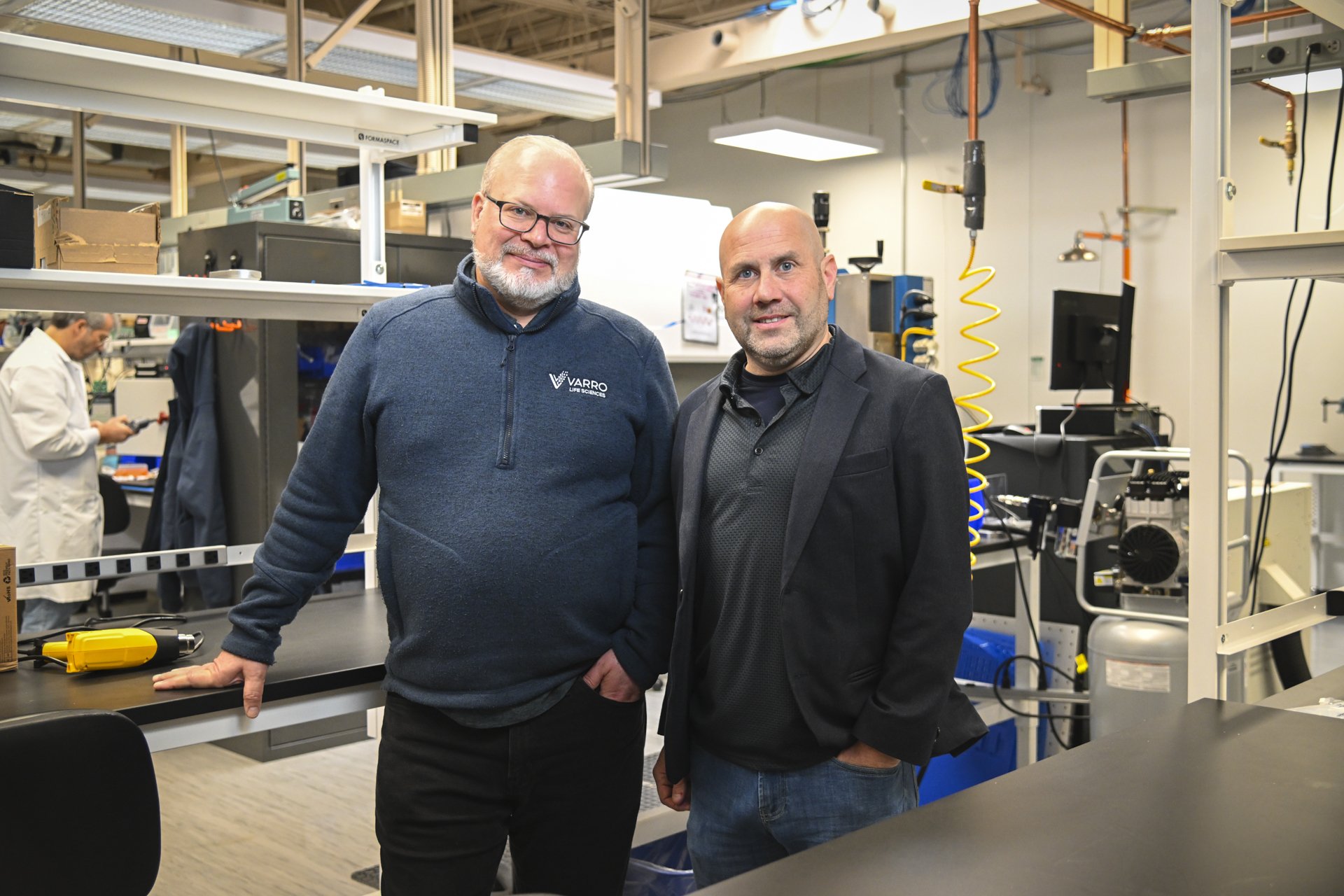
John’s brother, Tom Cirrito, founded what would become Varro Life Sciences in February 2020 to increase innovation focused on the prevention of disease transmission. He says it was a no-brainer to team up with John and Carla to leverage their microimmuno-electrode biosensor technology to develop devices that can detect and monitor infectious diseases. In order to work more closely with John and Carla toward that goal, he moved back to his native St. Louis, where Varro opened a $42.5 million state-of-the-art lab and R&D facility in St. Louis’ Cortex Innovation Community in September 2025.
Today, Varro uses that innovative technology, which can rapidly detect aerosolized pathogens, in two products: a breath-based diagnostic and an air bio-detector. Designed as a more comfortable alternative to nasal swabs, the breathalyzer requires just one breath from patients and delivers accurate, non-invasive results in just 60 seconds. Yuede likens the technique to that of a blood glucose test without the blood draw.
“It’s not exactly the same, because we’re using nanobodies and detecting a different signal, but it’s an electrochemical technique that gives you a reading from the molecule that you’re trying to detect,” she says. “In this breathalyzer, we’re condensing your breath into a fluid or a condensate that then can be put onto the electrode surface and read, similar to what you get when you do the blood glucose test. The process that would measure how much glucose is in your blood is along the same lines as what we’re doing with this technique.”
While the breathalyzer was initially developed to detect COVID-19, the team has adapted the technology to identify other respiratory viruses including Influenza A, Influenza B, and respiratory syncytial virus. It can also detect multiple pathogens from a single breath, and ultimately could detect dozens of pathogens simultaneously. Since it’s fast, easy to use, and doesn’t require specialized training, it’s a more accessible alternative to traditional PCR tests, such as nasal swabs for COVID-19.
“With the breathalyzer, the ease of use is a really key advantage,” Tom says. “Because it’s so simple to operate, it can be operated by an untrained technician. That means that we no longer have to be restricted to emergency rooms, hospitals, urgent care centers, doctors’ offices — the typical places where you’ll get a diagnosis for a respiratory infection. TSA agents could now screen people as they go on an airplane, because it’s only one minute. If you’re going to use PCR, that takes 15 to 20 minutes minimum. We would snarl air traffic across the country if everybody had to go through that.”
“Or, imagine you have a respiratory infection and you want to get a diagnosis so that you can get medicine,” Tom adds. “Instead of trying to schedule an appointment with your doctor or going to the emergency room and waiting God knows how many hours, you go to the pharmacy.”
Varro’s air bio-detector, meanwhile, uses microimmuno-electrodes, which consist of semiconductors with nanobodies attached, to rapidly detect pathogens — whether viral, fungal, or bacterial — in the air. Since it provides such fast, accurate detection, the bio-detector could be a game changer in a number of fields, from detecting swine flu or bird flu and strengthening agricultural supply chains to monitoring for bioterror threats in the military.
“There’s all kinds of options for what you could do with this technology,” John says. “As far as the air biodetector, there’s nothing like that that we know of right now. People swab a space and then send out for PCR and tell you three days later if there was a virus present. That doesn’t help anybody in the room now. We want to know when there’s a virus present so we can increase ventilation, get people out of the room, or do whatever we need to do. Three days later is, I think, useless.”
Hometown Headquarters
Varro’s products are developed in the company’s headquarters at Cortex, which features an R&D lab and “clean room,” where factors such as temperature and humidity are highly controlled, just like in a semiconductor foundry. As St. Louis natives themselves, John and Tom are excited to have been able to hire so many of their 20-plus employees from the region, which they say is a testament to St. Louis’ robust biotech innovation community. In addition to a diverse, educated workforce and world-class research institutions, they say there’s a welcoming entrepreneurial spirit that runs through St. Louis, which makes it easy to build connections and collaborate across disciplines.
Moving forward, the Varro team is focused on R&D, clinical trials, and regulatory approvals, including finalizing the design of the biosensor. As the company looks to scale its technology, the team is also transitioning from the original screen-printed carbon electrodes that were used in clinical trials to semiconductor wafers, which can be produced in massive quantities with low cost and failure rate. The wafers, which consist of a customized silicon chip with the nanobody attached to it, will be produced with a wafer manufacturer and sent to Varro’s facility in St. Louis, where the team will complete the final steps to link the nanobodies to the chips in-house.
They’re also building out their nanobody library, which will enable them not only to develop new biosensors against emerging pathogens, but to get them out into the field quickly — within a matter of about four to six weeks — to help bend the curve and prevent the spread of infection. They plan to conduct clinical trials in the 2026-27 flu season and submit for FDA clearance in time to have the breath-based diagnostic on the market by the end of 2027. Since the air biodetector doesn’t require FDA regulation, it could be on the market even sooner.
For now, Varro is focused on detecting airborne pathogens, but Tom stresses that the biosensor could be adapted for use in many other applications, testing everything from mucus, spit, or urine to wastewater, poultry farms, or soil.
The brothers have decided to focus their current work on aerosols because of the novelty and significance of this work — by detecting pathogens in the air in real time, Varro’s products could protect society from the next pandemic, no matter what virus is the cause. And when the commercial version of their game-changing technology finally hits the market, John and Tom are excited to be able to say it was made in St. Louis.
“We are very proud to be here in St. Louis,” Tom says. “We’ve built a lot here, and we take a lot of pride in what we’ve done. If we’re successful — and we’re certainly on the right track to being successful — after our device is approved, the first time somebody picks it up and takes a diagnostic test with it, they’re going to say, ‘Wow, this is so cool.’ We all had to shove cotton swabs into our brain for years, right? We all know what it is like. And then they’re gonna say, ‘This is made in St. Louis.’ It’ll become widespread knowledge that this new technology, this incredibly innovative thing that’s making everybody’s life better, was made here.”