On the Right Track
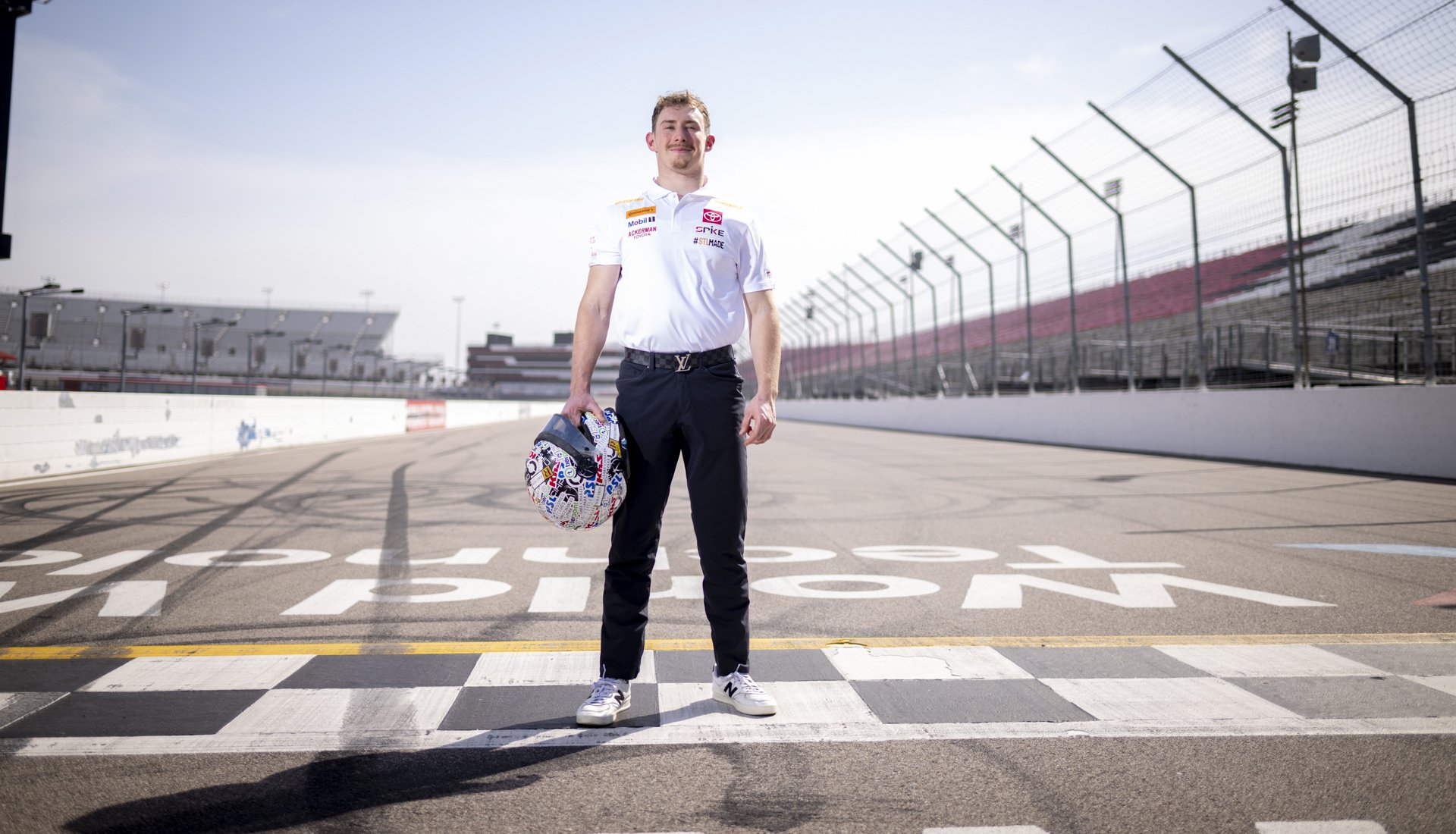
Race car driver and Kirkwood native Spike Kohlbecker’s career is picking up speed as he cruises into his third season with Toyota Gazoo Racing North America.
Luke “Spike” Kohlbecker can’t remember the exact moment he fell in love with racing, because it’s always been a part of him. Growing up in a family of car and racing enthusiasts, the Kirkwood native was itching to get behind the wheel not long after he could walk, donning his Superman cape at the age of 3 before jumping into his electric go-kart to do laps on the track his dad sketched out with chalk in their driveway.
Even at that age, his family saw Kohlbecker’s love of racing as bigger than mere child’s play. At the area go-kart race track, he was different from the other kids; while most of his preschool peers were all over the place on the track, Kohlbecker was hyper-focused on the car and the race in a way that was far beyond his years. That passion and commitment to racing became even more apparent after his grandfather gave him a go-kart for Christmas when he was 4-years-old. He began racing competitively not long after, until he was 14, when he upgraded to racing actual cars.
It should have been no surprise, then, when he turned to his parents at the age of 16 and said he wanted to race full-time.
“I was in high school when I told my parents that I wanted to really pursue racing,” Kohlbacher says. “My dad laughed in my face, but six months later, I was (racing) in New Zealand.”
Six years after that conversation, under the name Spike Kohlbecker Racing, he made his way to the Toyota Gazoo Racing North America GR Cup racing circuit. The competitive racing series is designed for amateur racers and car enthusiasts and serves as a developmental pipeline for drivers as they make their way up the ladder of elite racing. In 2023, his first season with the series, Kohlbecker finished third overall; last year, he finished second overall. Now on the cusp of his third season, he has even bigger goals.
“It would be very nice to win the GR Cup championship,” Kohlbecker says. “That is a big goal for this year.”
At just 22, Kohlbecker might seem to have big aspirations for someone his age, but his depth of racing experience allows him to have such goals. He’s been racing go-karts competitively since he was a preschooler — not the go-karts found at amusement parks, his mom and de facto media manager, Amy Kohlbecker explains, but machines capable of reaching speeds of 40 miles per hour that require protective gear and a maturity not often found in children that age.
“Spike just took it,” Amy Kohlbecker says. “Really early on, you can tell the kids who will weed themselves out quickly because of the pressure. It’s very high-pressure, even when you are little because there are a lot of rules and regulations you have to know. Even as a 5-year-old, if you are in a race and an incident happens, you have to be able to go and present your case, so at that very young age, you learn some adult things. You have to be able to handle that.”
For Kohlbecker, though, that focus and maturity came naturally. An athletic kid who played a variety of sports throughout his childhood, Kohlbecker took to racing precisely because of the way it pushed him, both physically and mentally.
“I’ve always been someone who has to stay busy,” Kohlbecker says. “I can’t stand just staying home and doing nothing. I have to be active. It’s just the way I am. I think you see this in a lot of people who train at high levels — whether it’s for pickleball or a spelling bee. You want to do your best to be competitive.”
Kohlbecker proved himself up to the challenge that racing presented, competing throughout the Midwest, and eventually on the national go-kart racing circuit, where he kept winning — which meant he kept advancing. It also meant that the sport became more and more expensive, which meant the Kohlbecker family had to get creative when it came to funding their son’s aspirations.
“It’s an incredibly expensive sport,” Amy Kohlbecker says. “When you win, you are forced to move up a level, which means the cost goes up. Almost everyone he competes against comes from wealth — they don’t have to worry about how much the season will cost because they can just write a check. To give you an idea of the cost, some of the kids he was competing against (on the go-kart circuit) were spending $250,000 a year, and Spike was beating them. But it meant we had to start fundraising to continue. We’ve had to cultivate relationships. Every year, we can’t believe we are in a car, but there is always some amazing person who steps in because they believe in him.”
At 14, before he was able to legally get a driver’s license, Kohlbecker moved into racing open-wheel IndyCars as part of a pipeline called The Road to Indy. Kohlbecker learned to drive at the former Bob Bondurant School of High Performance Driving in Chandler, Arizona, a prestigious program he had to get special permission to enter due to his young age. That experience, coupled with track time at World Wide Technology Raceway in Madison, Illinois, gifted by owner Curtis Francois (daily rental of the track can run $30,000 per day), allowed Kohlbecker to gain the skills needed to progress in his craft.
Kohlbecker competed in Canada, where he caught the attention of the racing world thanks to finishing third overall in the series. At that point, he knew he had to make some tough decisions about the course of his life if he wanted to continue moving up in the racing world, opting to attend online school through Kirkwood School District so that he could compete internationally.
“Spike has really had to give up a lot of what other kids his age get to do,” Amy Kohlbecker says. “He’s missed being with friends, going to dances and parties, and having that normal high school experience. But he does it because he’s committed to his sport and he’s so passionate about it.”
Once he made the leap to online schooling, Kohlbecker was able to go all-in on his international racing career, moving to New Zealand for three-and-a-half months, then to the United Kingdom and back to New Zealand, where he was racing against the world’s biggest open-wheel prospects — including two who have gone on to become Formula One drivers. And no matter where he was in the world, Kohlbecker was always sure to display his hometown pride in the most visible way possible: emblazoned on his race car.
“I’ve always had #STLMade on my car, because we want (people) to know that I am a kid from St. Louis,” Kohlbecker says. “Without St. Louis and the support I receive, I wouldn’t have been able to do any of this. (The community) has shown that it loves to support people who are from here and that they are rooting for you. St. Louis has done a lot for us.”
Kohlbecker’s time on the international open-wheel circuit was a huge step in his career. He kept winning, which meant he was getting even more exposure in the racing world and more opportunities to advance. However, that success came with added expenses that began to make the sport untenable, even with generous sponsorships.
Those financial challenges prompted Kohlbecker and his family to reconsider how he might advance in his craft, which ultimately led them to move into closed-wheel racing in the Toyota Gazoo North America GR Cup circuit, a newer racing circuit with a generous prize purse that drivers can reinvest into the sport. Although he’d never driven a closed-wheel car competitively, Kohlbecker finished third overall in his first season and second in 2024 all while balancing his college career at Boise State University, where he is majoring in business administration. He admits it’s a lot to balance, but he loves the challenge.
“I think racing is an art,” Kohlbecker says. “Every time you hit the brakes and accelerator — the way you do it by finessing and releasing the brakes or touching the throttle can create art. The great thing about racing is you are always trying to improve, because if you aren’t, somebody else is. I’ve always liked to self-improve. Racing is a great way to do that; it’s a lot of fun, but it also gives you something to look forward to and to train for. It gives you all that and it’s a way to better yourself.”
As Kohlbecker readies himself for the 2025 GR Cup season — a gruelling training regimen that includes significant neck and core strengthening as well as training to endure the extreme temperatures inside the race car — he and his family are overwhelmed with gratitude at the amount of support they have received from the St. Louis community throughout Kohlbecker’s racing career.
“Without the sponsorships we get from people in St. Louis, I wouldn’t be where I am today,” Kohlbecker says. “I have very successful parents supporting me, but they can’t front the bill, so having St. Louis back me up in that way has been really important.”
Amy Kohlbecker echoes her son’s sentiment, pointing to the significant corporate sponsorship funds they receive from St. Louis businesses like Ackerman Toyota, Margay Racing, TierPoint, RSolution, and True Title Company that have been vital to pursuing his dreams.
“It’s interesting about the people who write checks — we thought they would all be racing fans, but we found it is people who want to believe in someone,” Amy Kohlbecker says. “They might be in a completely different field, most who sponsor Spike haven’t been to a track, but they believe in the idea of someone who is trying to perform at the highest level. They tell him, ‘You have this talent; I have this money. I want to give you this to help you pursue what you want to accomplish.’ It really takes a village.”
That support extends far beyond the financial resources that have been generously given by St. Louis businesses. Kohlbecker is always thrilled when he sees people representing the Spike Kohlbecker Racing brand. “I’ve met a lot of people along the way and have built friendships,” Kohlbecker says. “I see them in our shirts, but I also see kids wearing them on random Instagram posts — kids I wouldn’t know had one of my shirts. It’s a nice feeling.”
Even as he is focused on pursuing his racing career, Kohlbecker finds ways to give back to the community that has given him so much. Last October, near the end of the 2024 racing season, he partnered with Valeda’s Hope, a local organization that supports women with breast cancer, for an event called Sticker the Car Pink that raised $10,000 in one weekend. The event was a huge success; Kohlbecker jokes that his car was almost unrecognizable from the amount of stickers that covered the vehicle, and he was thrilled to have such a visible way to show his love for St. Louis.
As Amy explains, the event was emblematic of Kohlbecker’s commitment to not only giving back, but representing his city — a place he credits with helping him get where he is and one that continues to inspire his racing journey.
“I’ve been racing for 17 years, and every year I’ve seen a lot of amazing people have to drop out because of funding reasons,” Kohlbecker says. “But I’ve had a seat every year because of the people here who have supported me. I’m very thankful for that.”