Connecting Care
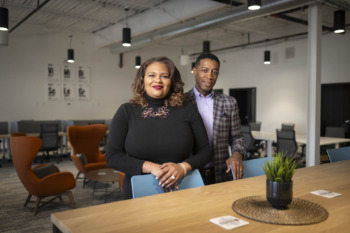
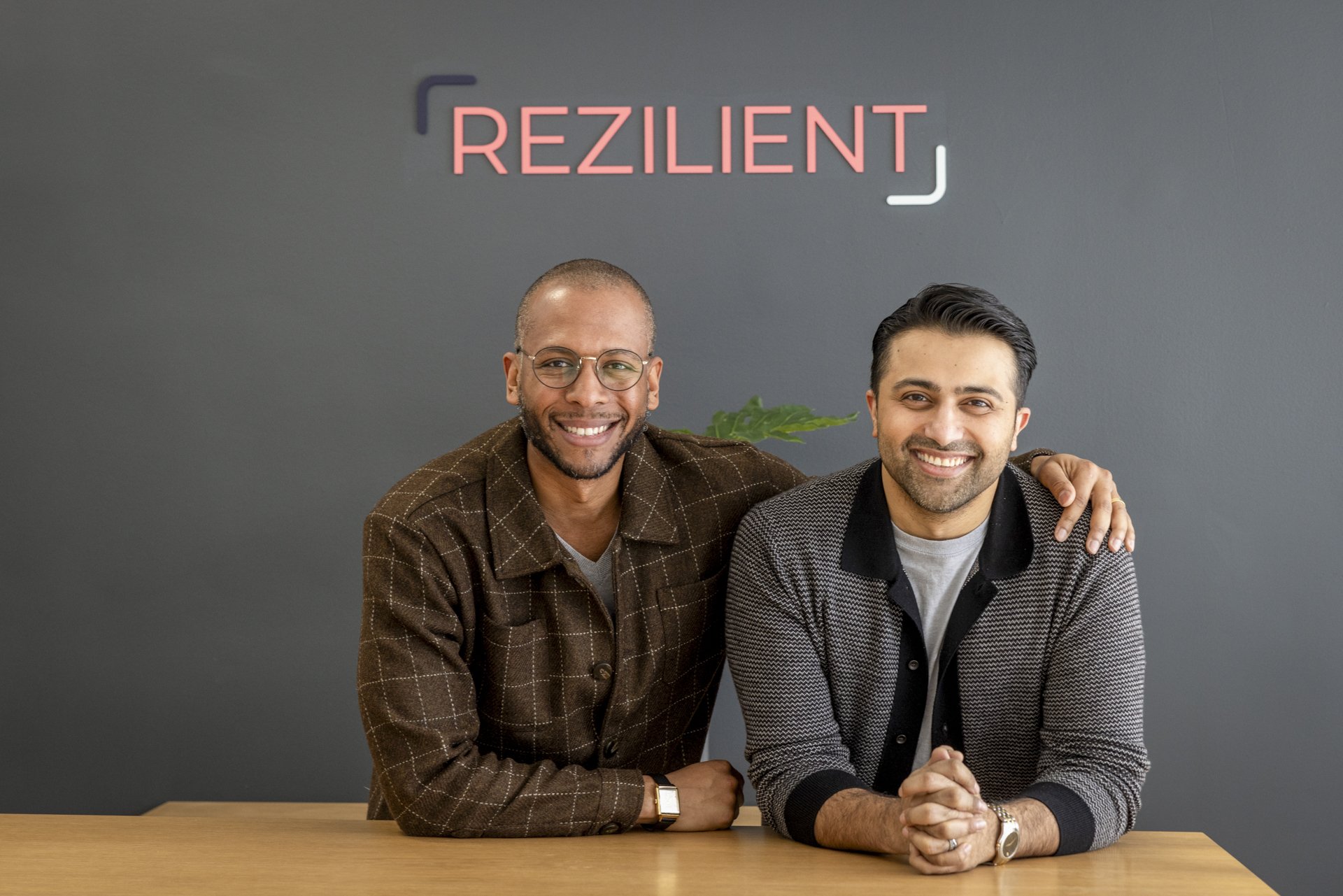
With Rezilient Health, founders Danish Nagda and Jeff Gamble are hoping to improve health care experiences and outcomes for patients in the St. Louis metro and across the U.S.
Danish Nagda describes himself as a reluctant entrepreneur. A physician by training, Nagda assumed he would spend his professional life as a clinician, and was well on his way down that path as an ENT resident at Washington University School of Medicine. Then, life presented him with a situation he could not ignore — one that would alter his professional trajectory and has the potential to change the health care industry at large.
“My dad had a heart attack in his 50s, then became bed-bound with heart failure and died at 69,” Nagda says. “He’d achieved the immigrant American dream, but despite having health insurance, he still didn’t have access to care. We took a step back and asked how it was that Dad got here, and we realized that there are families like mine all over the country.”
Nagda’s experience led him and his friend Jeff Gamble to ask an important question: How is it that even those who have health insurance lack access to quality health care, get sick from preventable diseases, and die from conditions that could have been treated if addressed earlier? The issue, they came to realize, had to do with lack of access to primary care treatment. If they could solve that problem, they could dramatically increase patient health while lowering health care costs for employers. That win-win proposition is the foundation of their fast-growing St. Louis-based health care startup, Rezilient Health.
Gamble and Nagda founded Rezilient Health in 2016 while participating in a Cortex Square One entrepreneurship program. Both were there working on their individual projects, but the more they got to talking with one another about their ideas and Nagda’s father’s health struggles, they realized that they might be able to have a bigger impact by teaming up. Quickly, they understood that primary care access should be the focus of their work.
They knew there was likely a tech-based solution to the challenges patients experience with accessing primary care, one centered around remote care. Through a network of Rezilient’s community CloudClinics that link up patients on-site with remote clinicians, Gamble and Nagda could increase access to vital health care without sacrificing the in-person examination that providers describe as the foundation of what they do. The name for the clinics is a reference to The Cloud, the type of computer data storage where physician and patient data is saved.
“We asked ourselves what would it look like to build a new digital infrastructure with the patient-doctor relationship at the center,” Gamble says. “We do work within the traditional system — we refer patients to Barnes-Jewish Hospital, SSM Health, or Mercy depending on how their health plan is designed, and we develop relationships with those downstream providers. For us, this is less about blowing up the old system and more about how we can bend the old system into something that works for members and their families.”
Rezilient Health launched its first CloudClinic in 2022 in downtown Clayton, followed by a clinic in St. Peters later that year. The bright, light-filled facilities, with sleek furniture and glass-lined spaces, look similar to a modern doctor’s office, save for the large, flat-screen television in the exam rooms, which serve as the means for interacting between patients and providers. At the clinics, patients can receive imaging, lab work, on-site referrals to specialists, and an action plan for addressing both acute needs and long-term wellness goals. In this sense, the clinics differ from urgent care services, as Rezilient is focused on creating an ongoing relationship between the doctor and patient based on whole-body, preventative care. “This whole-person, preventative care is the key to getting the incredible clinical outcomes we do,” Nagda says.
The CloudClinic model has been replicated in three states as of January 2025: A patient arrives for a same-day appointment and is greeted by both a medic for a physical exam on-site and a doctor on a tele-health screen who leads the examination. All devices at the clinic are tethered to a software program that livestreams footage to the doctor: For example, if the medic looks into a patient’s ear with an otoscope, the patient’s eardrum is visible, in real time, to the doctor, who then creates a treatment plan. If the patient needs to be referred to a specialist, that referral is made on the spot, dramatically reducing the lag time between when a patient first encounters a health issue and when they have a plan of action to address it. The byproduct of this, Gamble and Nagda say, is that patients are treated in a more expedient fashion and are engaged, in real time, with a doctor, and next steps, if they are needed. Though the relationship is technically virtual, Gamble and Nagda note that Rezilient actually increases doctor-patient interaction.
“My personal philosophy is that technology doesn’t exist for technology’s sake — technology exists to enable human interactions in a way that maybe couldn’t happen before,” Gamble says. “That’s why, as an organization, we don’t believe in bringing in AI and getting rid of all the providers. It’s silly to talk about that, because, in the end, people are not looking to replace doctors. The goal is to give people more humanity.”
Gamble and Nagda have been pleased with the reception Rezilient has received so far and point to the company’s impressive 95 percent Net Promoter Score (a measurement of customer loyalty and satisfaction), and its 2024 Clinical Outcomes Report, which shows that Rezilient ranks in the 90th percentile across key primary-care measures, as compared to traditional in-person clinics. The partners have also received positive feedback from their patients, who consistently say they love Rezilent’s model and feel more connected to both their provider and their care plan. Gamble and Nagda have seen success throughout their clinics in Missouri, Texas, and Oklahoma, and they’re getting ready to expand again thanks to a new contract they just finalized with Oklahoma State University.
“I want to see a CloudClinic in every city in America,” Gamble says. “I think if we can successfully do that, it opens up a lot of opportunities down the road.”
They are pursuing that goal through an employer-based health care model. Currently, Rezilient is offered as a subscription-based benefit that businesses with self-insured health insurance models offer their employees. As Nagda explains, this is much more than a perk but ends up being a significant health care cost savings for the employer, as it allows patients to get out in front of preventable or treatable early stage health issues.
“By providing high-quality care, same-day appointments, and the ability to diagnose and treat disease very quickly in a team-based model, people can get the best care for themselves and their families,” Nagda says. “The big untold truth is that we have become so focused on people over 65 that we have forgotten everybody under that age.”
Nagda doesn’t have to look further than his own experience to illustrate this problem. Underlying his father’s heart condition was undiagnosed sleep apnea, which was left untreated for 20 years. A simple C-PAP, he explains, would have treated the problem. Instead, his father’s condition escalated into more serious heart issues, and now he is gone. It didn’t have to be that way, Nagda says, and he, Gamble, and the Rezilient team never lose sight of that as their mission.
“I never thought I was going to be here, but I’m so grateful,” Nagda says. “As a doctor, you can have an incredible depth of impact, but here, we get to have such breadth, impacting millions of patients if we are successful.”
That breadth, Gamble and Nagda point out, has been enabled by St. Louis’ innovation ecosystem. Even before joining forces through a Cortex Square One program, Gamble fell in love with health care innovation during his time as a graduate student in neural engineering at Washington University.
While studying there, he had the opportunity to do some product work for the local startup Neurolutions, and even launched his own company, SnapPEAS, that used machine learning to create meal-planning recommendations for users based on personal preferences and grocery store inventory. At the time, he was involved with the university’s Skandalaris Center for Interdisciplinary Innovation and Entrepreneurship and met Nagda while participating in idea labs on Washington University’s campus. (Nagda, who graduated from the Perelman School of Medicine at the University of Pennsylvania, one of the top medical schools in the U.S., in 2014, chose to return to St. Louis as he missed his hometown and valued the opportunities WashU offered medical residents.)
If the groundwork for their partnership was laid at WashU, Square One was where the spark for Rezilient Health ignited. Gamble points to the resource access made possible by Square One as an important role in Rezilient’s development, and he notes that the region’s entrepreneurial community has been a tremendous support for him and Nagda.
“One thing that has been over-the-top fantastic is the local founder community,” Gamble says. “There are a lot of fantastic founders in St. Louis, and we have gone out of our way to get to know each other and develop relationships with each other. I know I can pick up the phone and call founders from various organizations here and get the help I need.”
Nagda echoes Gamble’s sentiment about the early stage entrepreneurial support found in St. Louis’ innovation ecosystem. He also believes one of the most important things St. Louis can draw upon — what he and Gamble have been able to draw upon with Rezilient — is the region’s robust health care community.
“We are a health care city,” Nagda says. “There is a lot of talent here, and a lot of opportunities to talk to other smart folks in health care. That’s a huge advantage.”
Nagda would like to see the region build upon its health care ecosystem, and its innovation ecosystem in general, by increasing access to funding for startups like Rezilient. He believes that more companies achieving venture capital exits and becoming bigger here will create a momentum that leads to more investment and then reinvestment. He sees fellow healthtech companies like Geneoscopy, which recently closed on a major Series C funding round, as being vital to that momentum building, noting that a win for any St. Louis startup is a win for the entire community.
Gamble is optimistic that Rezilient, too, is well on its way to being one of those momentum builders and St. Louis startup success stories.
“If we win big, it is a big win for St. Louis,” Gamble says. “It’s exciting for us, because we are a very St. Louis-led organization, and believe we can build something great in St. Louis.”
Join the Story
- Learn more about Rezilient Health on its website.
- Follow Rezilient Health on Instagram and X.
- Connect with Rezilient Health on LinkedIn.
- Explore more stories about inspiring St. Louis entrepreneurs who are contributing to the growth and success of the area’s startup community.
- Discover more about Rezilient Health in this HEC-TV video.