From bocce to red sauce, dig into
the enduring legacy of St. Louis’
Little Italy
How The Hill, a beloved St. Louis neighborhood shaped by Italian immigrants, uses its past to build a culture still centered around faith, food, and family.
Editor’s Note: This is the first of two stories dedicated to The Hill neighborhood in St. Louis. Read our second story, focused on new housing developments, restaurants, and current efforts to enhance community life in the neighborhood, later this month. Get a taste of that story in the above video, which features Nick Williams of Nicky Slices Pizza Club.
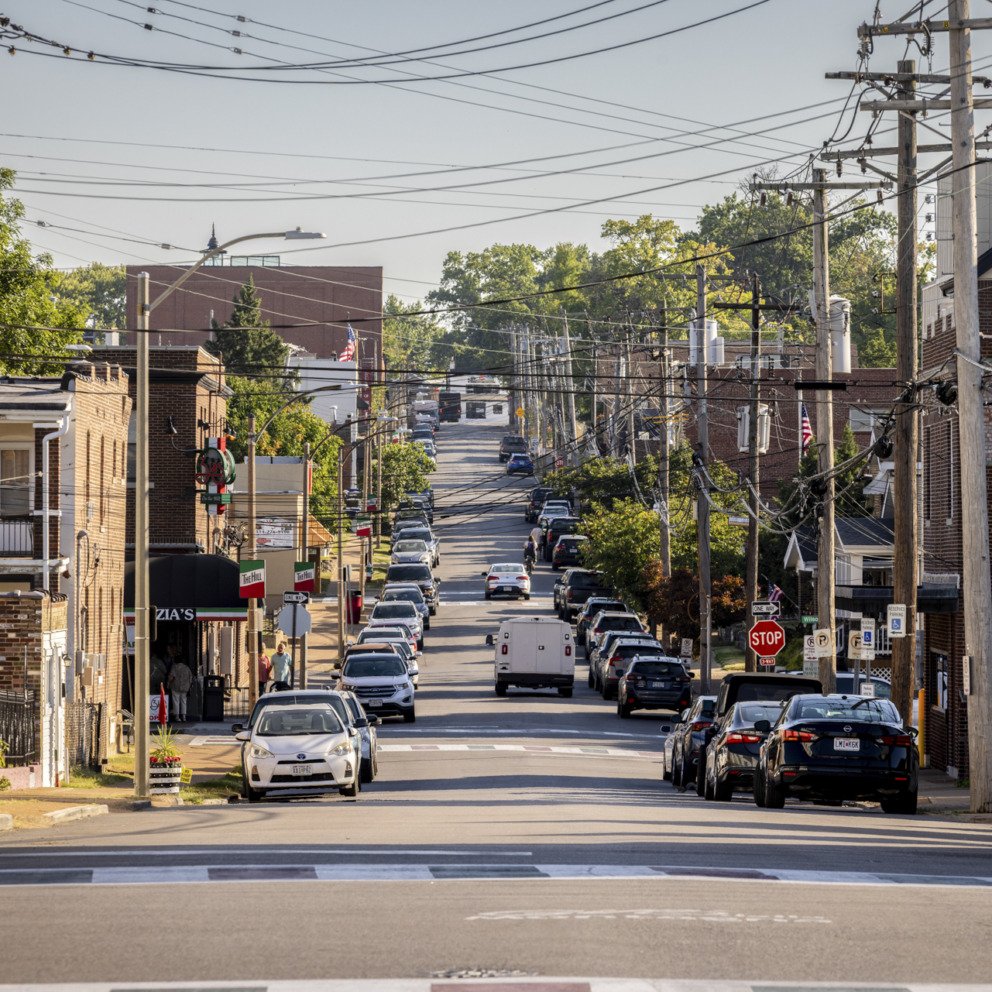
In many ways, the St. Louis neighborhood of The Hill, whose red brick clay mines attracted thousands of immigrants more than a century ago, remains the same. Children still roam its 52 square blocks, the same streets where baseball greats Yogi Berra and Joe Garagiola once strolled.
Alex Donley still serves up hot salami sandwiches from Gioia’s Deli across from Berra Park, in the same building where Italian immigrant Charlie Gioia opened a grocery store in 1918. The structure’s wood and brick came from demolished buildings after the 1904 World’s Fair in Forest Park, or so the story goes.
Donley stores ingredients in the original walk-in refrigerator. “It’s an insulated box, so the actual refrigeration parts are new, brand new,” Donley says. “The box is the same. It’s amazing stuff.”
Carolyn Cassani Ring, 83, grew up on The Hill, moved away after she got married, and moved back two years ago into a shotgun-style house, a common type in the neighborhood.
“Ironically, it’s the house that I was brought home to from the hospital,” she says. “From the time I was born ‘til I was about 4, we lived in that house.”
She now greets visitors at The Hill Neighborhood Center as its operations coordinator, and tells them about The Hill’s history and what it was like to grow up there.
Does it feel the same?
“Absolutely,” she says. “I think it’s because everybody is so cordial. I could be putting the flag and the sign outside, and people walk by and say, ‘Good morning,’ and I don’t know them. You know, they’ve come from DiGregorio’s Italian Market, or they’ve come from Cafe Dolcé, the coffee shop right over here. It’s just a great, sociable community.”
Building a Neighborhood
There are more than 75 unique, small businesses here, and 92 of the blocks are residential, many with shotgun-style homes or brick bungalows that often don’t hit the market before they are sold to a family member or a friend. Fourth and fifth generations still live here.
Before the Civil War, the clay deposits attracted immigrants: first Black Americans, then Germans and Irish, then Italians, who worked in brick and tile factories that sprung up alongside the River des Peres.
One of the highest points in the city lies just south of The Hill’s boundaries, thus the neighborhood name. As workers walked home at the end of their shifts, they waved and called out: “La Montagna! La Montagna!” It translates to “The Mountain.”
Partly because the neighborhood was boundaried by railroad tracks, the river, and the clay mines, it was geographically isolated from the rest of the city. As more Italian immigrants poured in during the turn of the 20th century, they built up a community where they could work, live, shop, eat, play, and worship.
Joe Vollmer grew up on Tower Grove Place, just beyond the east boundary of The Hill. He’s not Italian, but as a kid, he spent time roaming The Hill’s streets and “chasing my dad and grandpa and my uncles out of taverns,” he says.
He served as the neighborhood’s city alderman for 22 years, and now runs his Hill hangout spot, Milo’s Bocce Garden. The building dates to 1902, and Vollmer calls it the neighborhood’s last tavern.
He points out that the first generations of Italians here were taught not to be Italian due to discrimination. Maybe they changed their names, or they encouraged their children to learn English to assimilate. In the early 1900s, the area didn’t have running water or electricity, he points out.
“But the Italian people who came here didn’t care,” he says. “That’s why this neighborhood became what it did, because no one wanted to be around these folks. So they created their own little stores, their own markets, and they basically took care of each other.”
A Church at its Center
In 1903, Italian immigrants built their Catholic church, St. Ambrose, out of wood. In 1922, it burned in a fire. Italian immigrants rebuilt the church, each pledging $1 a month for five years. The church reopened in 1926, a brick Lombard Romanesque Revival style literally built by its members, their names engraved in marble panels still at the back of the church.
Workers married “picture brides” from the old country, known to the future grooms by the pictures they sent to America. Today, the Rev. Jack Siefert says it’s a popular spot for weddings — about 50 a year.
He’s been pastor here since June 2021. When the Archdiocese of St. Louis was considering priest reassignments that year, the vicar for priests called Siefert and said, “You’re half-Italian, right?”
Yes, he replied. His mother, Josephine, was a Gianino. She grew up on Wilson Avenue, went to Sacred Heart Villa — opened in 1940 to serve immigrant families — and graduated from St. Ambrose. She was baptized, received her first communion, and married at St. Ambrose. The church also hosted her visitation and funeral.
“To be honest with you, I never felt worthy enough to be in a place like this,” says Siefert, his mother’s framed certificates of her sacraments hanging on a wall behind him in his office. “These are such cool assignments.”
He’s filling big shoes. Monsignor Sal Polizzi, who died in 2023 at age 92, served at St. Ambrose for more than 40 years. In the early 1970s, the federal government planned to extend Interstate 44 through St. Louis, and Polizzi became a national figure as he organized the church, community and local politicians to get an overpass installed that would link sections of The Hill that had been cut off by the interstate.
Polizzi was the driving force behind Hill Day, one of the city’s first big neighborhood festivals, as well as its sponsoring organization, The Hill 2000, now The Hill Neighborhood Association. Polizzi urged neighbors to “don’t move, improve,” to clean up their properties, take pride in them, and not move to the expanding suburbs.
Msgr. Vince Bommarito served as pastor on and off at St. Ambrose for decades before being reassigned in 2021, and also understood his role as a neighborhood leader. He served on a committee that raised money to establish Piazza Imo, a gathering spot across from the church with a marble fountain made in Italy as its centerpiece. He auctioned off Sicilian dinners in the rectory to raise money for charity. He knew most everyone in the neighborhood and he connected sellers with buyers.
“The Hill doesn’t understand you; you understand The Hill. We’re blessed here,” he told Sauce magazine in 2018.
Siefert sees his primary role as feeding the faith. He keeps the church open and accessible — there are often three Masses a day, and he says it’s never hard to get fellow priests to help out, probably because they can grab lunch or dinner afterwards, maybe soak up the atmosphere on an outdoor patio. Siefert loves quiet mornings when he can sit on the deck and smell the bread from the bakeries.
“Here’s how I define the Italian heritage: faith, food, and family. Those are the big three,” Siefert says. “How do you maintain that Italian cultural gift in an ever-changing, expanding population? That’s just kind of tricky.”
The church is used to welcoming others. Every week, Siefert meets people from around the area or even the country who come to visit; either they have a family connection here or they visit the neighborhood as one of the nation’s last Little Italys.
During his homilies, Siefert talks about the beauty of Italian culture and what it can offer to St. Louis and to families. “Every culture has gifts, charisms that it brings to the culture of St. Louis,” he says. “Every time I get a chance, I don’t care if it’s a funeral or a wedding, Sunday Masses, I’ll highlight what this area offers to St. Louis. That’s huge.”
Connecting over Food
Gathering around a table to eat good food unites families and solidifies a neighborhood as well. The title of the oldest restaurant on The Hill belongs to Rigazzi’s, dating from 1957 and home to the 32-ounce Frozen Fishbowl, its signature drink. Other longstanding Italian restaurants include Cunetto House of Pasta (1972), Dominic’s on the Hill (1971), Favazza’s on the Hill (1978) and Charlie Gitto’s (1981).
Vollmer says that when he was growing up in the 1960s, the only neighborhood restaurant was Ruggeri’s, now an event hall, Rose of the Hill. The rest were groceries and taverns.
“Those restaurants came to be as far as a different class of dining,” he says of those that opened in the 70s. They’re now considered old-school classics.
The classic dishes attract visitors from near and far, further solidifying the neighborhood. Some family members behind these restaurants opened branches elsewhere in the city and county.
Vollmer’s tavern, Milo’s, serves pasta, sandwiches, and bar fare as well as toasted ravioli and thin-crust pizza, St. Louis favorites.
“On Saturdays — it’s very true what Yogi Berra said, ‘Nobody goes there anymore, it’s too busy,’” Vollmer says. “You’ll walk in my bar and it’ll be, I’ve never seen any of these people before in my life.”
Visitors from out of town or the suburbs want to soak up the atmosphere, watch a game on TV, sip a beer, eat pizza, and hear the church bells from St. Ambrose, he says.
Of course, the locals come, too — his young nieces and nephews and grandkids come here, and sometimes, you’ll see a priest or a nun in the crowd.
Some sandwich shops go back even further. Amighetti’s was founded in 1916 by Louis Amighetti as an Italian bakery; the Amighetti Special sandwich debuted in 1969, establishing the place as a legendary deli. Since 1971, Charlie’s Market & Deli on the Hill produces a line of fresh meat and pizza toppings it sells wholesale and at its market and deli, which also serves salads, sandwiches, and pizza.
Donley, of Gioia’s, opened his first St. Louis County location in 2018. He now operates locations to the west in Creve Coeur and Maryland Heights, one to the south in Valley Park, as well as in Winghaven in St. Charles County. At first, he worried he would keep people away from the city. “Am I gonna cannibalize my customer base?” he wondered.
But since they started opening stores elsewhere, fulfilling those neighborhood needs for delis, foot traffic in the original location has increased by 6% each year.
“It’s not really cannibalizing anything. We’re just kind of spreading the word. I’m kind of like the Johnny Appleseed of hot salami,” he says, laughing.
Adriana Fazio, who opened Adriana’s on The Hill with her daughters Suzanne and Diana in 1992, says there’s not much competitiveness between restaurants. People take pride in their families, such as her own Sicilian immigrant parents, and what they’ve established here.
“They’re just so proud of everything that’s occurred here and how it’s eventually become someplace to eat on every corner,” says Adriana Fazio, now 87. “There’s no parking lots, but you’ll never go hungry because there is almost some place to eat on every corner. I remember that change taking place and I’m very, very proud of that change because there’s room for all of us here.”
Generations of Goodwill
Jennifer Gianino grew up on The Hill in the 1970s and 80s. She and Siefert are first cousins — Siefert will officiate her wedding at St. Ambrose in June 2026 — and she’s also the neighborhood association president.
She knows all her neighbors, and could probably point out who lives in half of the homes in the neighborhood.
“Everyone knows everyone. Everyone is connected,” she says. “And it is kind of like how I grew up: playing outside. My parents were always on the front porch. This is not a backyard neighborhood. Everyone is on their front porch all the time. I think the only thing that really has changed is that we have golf carts now.”
The fact that neighbors can walk somewhere — or drive a golf cart — to eat dinner, grab groceries, or chat over coffee, she says, “is just really nice. I think that’s what makes us a community.”
The neighborhood association’s four key pillars are historical preservation, neighborhood beautification, philanthropy, and safety and security.
Gianino’s personal goal as association president, she says, is to keep the neighborhood as authentic as possible to their Italian roots. Her grandparents on both sides came here from Italy. She knows that time will march on, but wants those values to remain.
Her fiance isn’t Italian, but he fits right in, she says.
“It’s just the best neighborhood,” she says. “We’re just accepting of people. It’s just really nice. I don’t see myself living anywhere else.”