Brick by Brick
The legacy of St. Louis’ historic brick industry is alive and well in Laclede’s Landing, Main Street in St. Charles, and downtown Alton, Illinois.
The history of St. Louis brick isn’t just evident in the gingerbread houses of south city or the bricks lining Main Street in St. Charles. It stretches far beyond city bounds to landmarks across the country, including Chicago’s iconic Navy Pier and the towering Chrysler Building in New York City — both of which are made of bricks from St. Louis-based Hydraulic-Press Brick Company, which was once the largest brick producer in the world.
Today, neighborhoods across the greater St. Louis metro reflect the area’s history and legacy of distinctive brick streets, sidewalks, and brickwork architecture.
A Historical Foundation
Brick clay mining first took off in St. Louis in the 1840s, when large reserves of red clay were discovered in the Cheltenham Syncline, a bowl-shaped geologic formation located just south of Forest Park near Manchester Avenue and South Kingshighway Boulevard.
“The way St. Louis became a brick metropolis is that we got extremely geographically lucky,” says Andrew Wanko, a public historian at the Missouri Historical Society. “Eastern Missouri sits on one of the greatest clay deposits in the nation. We were pulling those red bricks that St. Louis is made out of from clay right beneath the city’s feet, turning it into bricks right here in town, and then taking them no more than a few miles away to where they ended up being shaped into the incredible architecture that you see around us today. Our city looks different from anywhere else in the world because we happen to exist on this geographic jackpot that we found right beneath our feet.”
In addition to unfettered access to clay, St. Louis’ brick industry was spurred onward by the devastating Great Fire of 1849 along the city’s riverfront. The fire, which burned 15 blocks of St. Louis overnight, was an economic catastrophe for the city, which began rebuilding with durable, fire-resistant materials such as stone and brick. All structures east of Jefferson Avenue were required to be made entirely out of brick, creating a huge demand throughout the city.
The Laclede Fire Brick Company was the first to set up shop in St. Louis by 1844, though by the end of the 19th century, there would be more than 50 clay manufacturing companies in St. Louis — the densest concentration of such companies in the country. Brick production in St. Louis skyrocketed across the second half of the 19th century thanks in major part to the arrival of the hydraulic press, which was brought to St. Louis by Edward Canfield Sterling in 1868. Up until that point, all bricks had been made by hand — workers would push clay into individual wooden molds as hard as they possibly could, then use a wire to flatten the surface and fire them in a kiln. The hydraulic press was able to produce bricks 10 times as fast with 10 times the strength, and it could also create them in different ornamental shapes, such as bricks with sharp points or curved edges, evolving clay from a building material into an art form.
By the 1890s, Sterling’s Hydraulic-Press Brick Company would become the biggest brick company in the entire world, with 11 different brickyards in town producing more than 200 million bricks every year. Clay was used for bricks to build houses as well as for chimney liners, floor tiles, roof tiles, terracotta flower pots, and brick street pavers.
Those brick street pavers were especially sought for St. Louis’ famously muddy streets. The pavers were vitrified — a process in which they’re heated to such high temperatures that the clay melts and reforms into a glass-like material, making the bricks incredibly hard and nonporous, and therefore weather-resistant and hardy enough to endure the wear of horse-drawn carriages. Almost all of St. Louis’ inner ring neighborhoods, Wanko says, had their streets paved with brick pavers, many of which are still nearly perfectly intact underneath the asphalt we drive on today.
St. Louis brick manufacturing hit its peak in the early decades of the 20th century due in major part to the Great Depression,, but also due to changing architectural styles — the ranch house boom, for instance, used almost exclusively wood framing. In the mid 1950s, large areas of the city, particularly on the near north side, were blighted and cleared away during urban renewal efforts — in Mill Creek Valley, for instance, 20,000 Black residents were displaced when the city bulldozed more than 400 acres of historic St. Louis urban fabric. More recently, brick theft in North City has seen walls and even entire buildings disappear as bricks are illegally harvested to sell to brickyards and distributors. While St. Louis’ brick architecture can still be seen in many areas of the city today, not every neighborhood has seen the same level of investment, revitalization, and renewal over the years — and not by accident.
“The neighborhoods we see around St. Louis today are just a fragment of what once existed here,” Wanko says. “It’s amazing to think about what was there, but it’s also a shame to think about all that we have lost. In these neighborhoods, especially on the near north side, it is incredibly important to preserve not just these structures, but to preserve the community members who have been advocating for these neighborhoods for a very long time. That’s a very important thing as St. Louis’ central corridor booms and a lot of its historic neighborhoods see this reinvestment. We need to make sure that reinvestment is being shared as equally as possible across the city’s residents.”
Wanko sees the city’s history of brick production and its built environment as a legacy worth learning from, preserving, and appreciating. He points to several groups working to maintain St. Louis bricks and brickwork, including the Landmarks Association of St. Louis, which has stepped up over the years to save historic structures such as the Wainwright Building and the Old Post Office in Downtown St. Louis.
“There are a lot of cities who want to be us when it comes to our everyday built environment,” Wanko says. “We have an incredibly rich architectural history, with examples of nearly every single architectural style you can imagine right here in St. Louis, and that is something we should definitely be very proud of and celebrate much more. I think the city’s architecture is the top thing we need to focus on because it is irreplaceable.”
It’s easy to explore and experience St. Louis brickwork firsthand in neighborhoods across the region. Here, we explore how revitalization efforts in three commercial-meets-residential districts are further cementing the area’s brick legacy.
The Landing
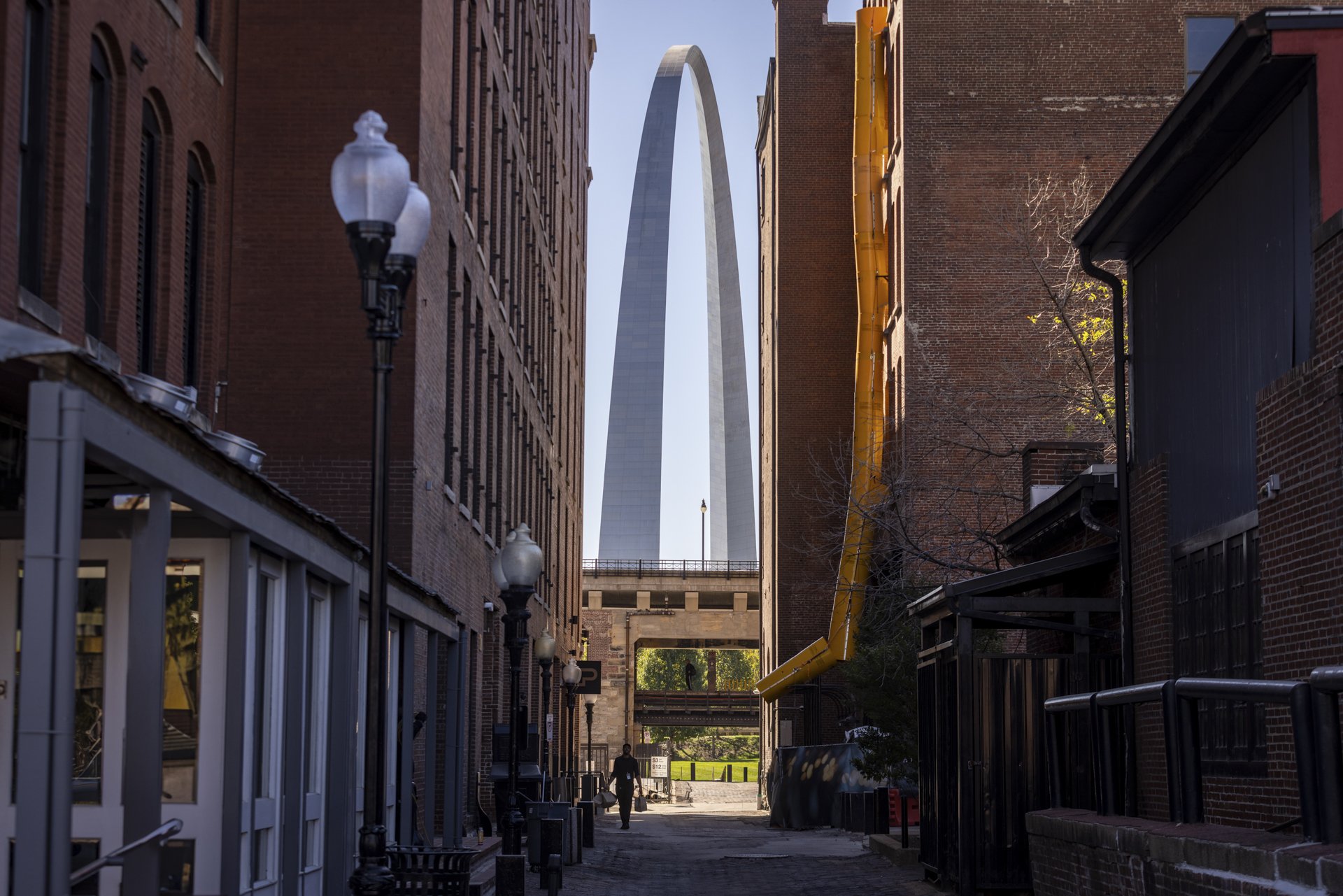
While much of St. Louis’ storied riverfront architecture has been lost to time, Laclede’s Landing — with its nine blocks of century-old red brick buildings, cast-iron façades, and cobblestone streets — still offers a way for people to get a sense of the city’s historic built environment.
“It provides this incredible look at what the cast iron and brick riverfront of 19th century St. Louis would have looked like,” Wanko says. “All of this incredible activity that was happening right there on a very small area of the riverfront. It just goes to show what a huge port St. Louis was, how we really were this crossroads of geography and commerce in the United States.”
Many St. Louisans still think of the small district, which is located directly north of the Gateway Arch National Park, primarily as a nightlife and entertainment district. But the Landing has recently undergone a massive $75 million redevelopment project to turn it into a residential neighborhood led by Advantes Group, which has transformed many of the neighborhood’s time-honored buildings into apartments, retail spaces, and office spaces. This fall, Pocketparts, a local nonprofit that redevelops unused plots of land into recreational areas, helped open the Laclede’s Landing Active Art Park and Disc Golf Putting Course, and last year, Great Rivers Greenway helped open the Katherine Ward Burg Garden, which welcomes food trucks and hosts events throughout the year.
“The Landing is known to most folks as an entertainment district,” says Brandyn Jones, executive director of the Laclede’s Landing Neighborhood Association. “Now, it’s really becoming a neighborhood. Many of the buildings have been or are being renovated for residential, so there are amazing lofts down here with incredible views of the river, the Arch, the Eads Bridge. There’s a coffee shop, there’s a little market, there’s a bar — we’re adding the building blocks that create a neighborhood.”
As the neighborhood transforms into its next life, however, a point has been made to preserve the elements that give Laclede’s Landing its inimitable character, including the original cobblestone streets and its red brick buildings and sidewalks.
“The cobblestone is a critical identifier to the neighborhood, and it’s a piece of history,” Jones says. “Just as the buildings are historic, the streets are historic. Great pains have been taken to maintain that cobblestone to maintain the true feeling of the neighborhood as it was designed and built. It’s been reset a time or two because the cobblestones get out of whack from time to time, but it’s integral to the personality and the look of the neighborhood. The streets are actual history.”
That history is alive and well at The Cobblestone STL, a market, deli, and coffee shop that opened in the six-story red brick Christian Peper Building earlier this year. In addition to its façade, red brick is on full display inside the open concept space, which is also home to lofts, offices, and the Old Spaghetti Factory, and features high ceilings, repurposed wood, and exposed red brick walls. Co-owners Camille Jackson and Chris McMenomy, who opened The Cobblestone STL in partnership with Luke Jackson, Kyle McEvoy, Tim Meinecke, and Andy Roesch, intentionally let the red brick shine when developing the concept.
“The red brick in St. Louis is iconic,” Camille Jackson says. “What’s really great is we are right next to the Gateway Arch National Park, but then when you walk on over to the Landing, which is just steps away, you see another iconic St. Louis landmark, and that’s the red brick buildings. These red bricks were made here in St. Louis from St. Louis clay, which is just really cool. You don’t find that anywhere else. To be able to be located on the riverfront and to have that exposed brick, it just tells another story of bringing the past into the present and getting to showcase the perseverance of St. Louis.”
Initially, Jackson and McMenomy were skeptical about opening a business on The Landing. But when they saw the vision for transforming the district into a residential and commercial area, they saw an opportunity to invest in the City of St. Louis — and they were all in. They’re adamant about making The Cobblestone STL, which is 70 percent locally stocked and sustained, a community spot that’s safe, comfortable, and welcoming to all. They’re now bullish on The Landing, and they hope to play a role in changing perceptions of the neighborhood and bringing more people to the area. McMenomy often finds himself stopping for a moment before coming into work to take in views of the riverfront and the Arch, and he wants to share that enthusiasm with others.
“It’s like, how could you not want to be a part of this?” he says. “How could you not love what you’re seeing right now and just how things have changed so much? We want to extend that to all the St. Louisans out there and show them that this isn’t that nightclub scene anymore. This is a community now.”
Main Street in St. Charles
When Lydia Crespo was placing a wholesale order for the “Saint Chuck” T-shirts and sweatshirts she designed to sell at her store, Chuck and Lou on Main Street in historic St. Charles, she knew exactly which color they should be: Brick red.
“If you want something that reminds you of St. Chuck, it can’t just say it on the shirt,” she says. “We chose that brick red color to really drive home that that is what St. Charles is about — that brick street.”
Crespo, who also owns Cozy Shop just a few blocks down, opened Chuck and Lou earlier this year to offer locals a way to celebrate their hometown pride in both St. Charles and the St. Louis area more broadly. The store sells apparel, art prints, stickers, glassware, and more, all emblazoned with metro-inspired designs.
“St. Charles is a very unique place because we have people who have lived in the neighborhood all of their lives, so there’s this big local love and appreciation,” Crespo says. “However, Main Street is a major tourism destination, so we have people from not just all over the country but all over the world visiting St. Charles every day. There is a very unique overlap of wanting to participate in the culture of St. Charles and St. Louis, which is something that I very much deeply love and appreciate, and I knew I could make an entire store that could help you live like a local.”
For Crespo, who grew up attending the Festival of the Little Hills and St. Charles Christmas Traditions, Main Street was a natural place to locate her businesses. As an artist, she was immediately drawn to the picturesque red brick streets and buildings, which have been painstakingly preserved over the years. That red brick has also captivated many of the tourists who stop into Chuck and Lou, who often comment on just how long Main Street is compared to other long-standing main streets across the country.
“Just the image of that very distinct red color and the feel of it underneath your feet, it sends you back in time,” Crespo says. “You can tell that it has been there for quite some time, and it’s still flourishing. That’s what I love about this area, is that since 1769, it’s been a small business hub. I’m proud to be a part of continuing that tradition.”
According to Amy Haake, archivist and chief administrative officer of the St. Charles County Historical Society, brick has been important to St. Charles since the 1790s. The city was home to several flourishing brickyards over the next century, the most successful of which was St. Charles Brick Co., established in 1895. The first brick house in St. Charles was built for Colonel Timothy Kibby on the southwest corner of Main and Pike streets in the heart of what is now a Nationally Registered Historic District. Although the date of construction is unknown, Kibby lived there circa 1805 and the house withstood the 1811 New Madrid earthquake.
Today, brick is a key part of the identity of Main Street, from its brick-paved roads and sidewalks to time-honored buildings such as the connected brick structures that make up the First Missouri State Capitol State Historic Site. In the 1950s, St. Charles citizens who recognized the value of the city’s historic architecture fought to restore the State Capitol building, which had been in use from 1821 to 1826 and reopened in 1971. The restoration helped kick off a revitalization of the core of St. Charles, the results of which can be seen — and felt — walking along the beautifully preserved red brick streets today.
While not all of Main Street itself is actually brick — North Main was originally brick but is now made from molded cement to simulate the brick found in the historic district — the majority of bricks on South Main are original, said to date to 1904. The red brick lends a distinct aesthetic and charm to the area, which continues to capture the hearts of locals and tourists alike.
“There are people who complain about the bumpiness of the brick streets, especially on South Main, so there have been people who have said ‘get rid of it,’” Haake says. “But it is part of that subjective environment of South Main Street that’s part of its history. To lose the brick would be to lose some of the attractiveness to tourists when they come. There are people who come down here and want to live down here because of that look. They like the feeling of it. They feel connected more to history because of these streets and all the buildings around it as well.”
Downtown Alton, Illinois
When Laura and Matt Windisch moved to Alton, Illinois, from St. Louis in 2018, they didn’t know much about the area. The owners of Stacked Burger Bar in south city were attracted to Alton for its affordability, but they quickly fell in love with the people. It didn’t take long after settling in for them to know they wanted to become an active part of the community they now call home.
In 2022, the couple helped open FLOCK Food Truck Park & Bar, which offers a full bar serving beer, wine, and housemade cocktails and welcomes rotating guest food trucks throughout the week. FLOCK is also now home to two permanent food trucks, the Space Shuttle Café, which features a new chef and menu each season, and Byrdies, a build-your-own salad, wrap, and loaded fries concept operated by Laura Windisch, the concept’s general manager. From the start, Windisch has wanted to operate her own food truck, and she’s been excited to both get back into the kitchen and create a casual gathering place with an inviting atmosphere for the Alton community.
FLOCK is one of the first completed properties from AltonWorks, a property development company working to revitalize historic downtown Alton. Since 2018, AltonWorks founders Jayne and John Simmons have acquired 34 properties in downtown Alton, including the Old Post Office, the Jacoby, the Grand Theatre, and the Stratford Hotel, and are currently working to breathe new life back into them. AltonWorks also owns 24 vacant lots and residential properties adjacent to downtown Alton.
“We were very excited to be included in this incredible effort,” Windisch says. “In the coming years as more projects are completed and the full vision comes to life, I will be very proud to say we were here at the start. My hope is that FLOCK, along with the many other awesome current and future businesses, showcases what a great place this is to live, not just visit. While it already has so much to offer, I want the downtown area to turn back into a destination with walkable shops, restaurants, galleries, and more. There is just something about those red brick streets that take you back in time. It shows the town’s history and reminds us that it was once a thriving, bustling district and can be again.”
The vision that AltonWorks is bringing to life in the community dovetails with that of Alton Main Street, a division of Main Street America that plans events in downtown Alton, hosts beautification projects, and offers small business support services all with the goal of keeping downtown Alton on the map. Executive Director Sara McGibany says that outreach is crucial to preserving the neighborhood’s architecture, which has been a designated Main Street since 1995.
“Downtown Alton is special first and foremost because of the atmosphere,” she says. “Everybody loves our charming old buildings and our beautiful brick streets, and that historic architecture is at the heart of our mission. The brick has been a part of our identity for a really long time.”
As downtown Alton continues forward on its massive revitalization plans, preserving the brick at the heart of the city’s atmosphere is a top priority. For one, bricks are durable — the bricks in Alton have lasted for 100 years, whereas pavement has to be completely repaved every 20 or 30 years — so they significantly cut down on maintenance costs. But Alton’s brick streets are also a major tourism draw, generating commerce for the city. West Seventh Street in particular is said to be the steepest brick street in the world.
This year, Alton is celebrating the 50th anniversary of its brick ordinance, which protects bricks by requiring that they be restored to their original nature rather than being patched with concrete or asphalt after utility work. The ordinance protects nearly every brick street in the city and is continuing to expand its reach — McGibany says Alton’s Historical Commission and the Alton Landmarks Association solicited the public’s help last summer to create a thorough inventory of any brick streets not already on the list and add them to the ordinance.
“We’re celebrating 50 years of being mindfully protective of our brick streets,” she says. “It really does define what era (downtown Alton was) built in. There’s nothing like red brick, not only because of the aesthetics of it, but it also is a traffic calming measure. People in neighborhoods like it because it does slow the automobiles down. We definitely have our ear to the ground on what attributes of Alton people find cool and significant and important and interesting to go see, and red brick streets are frequently mentioned as one of the draws to town.”
Andrew Wanko at the Missouri Historical Society agrees. St. Louis’ red brick streets, sidewalks, and architecture are not only draws to the metro, they’re a link to our past and a distinctive piece of our identity and character as a region.
“It’s incredibly unique because it came from the ground right beneath our feet,” Wanko says. “Kansas City doesn’t look like this. Memphis doesn’t look like this. Indianapolis doesn’t look like this, because they did not have this clay there. A lot of the brick buildings you see in those places are using St. Louis brick. We really were a huge hub of clay manufacturing and that’s pretty amazing to think about.”
Editor’s Note: In March 2025, Lydia Crespo announced the closure of Chuck and Lou’s brick-and-mortar store. You can still find Chuck and Lou merchandise on the shop’s website and inside Cozy Shop, which Crespo also owns.
Join the Story
- Explore more St. Louis history by visiting the Missouri History Museum and its website.
- Follow Cobblestone STL on Facebook and Instagram.
- Learn more about Chuck and Lou on its website and connect with the shop on Facebook and Instagram.
- Find out more about FLOCK Food Truck Park & Bar on its website and on Facebook and Instagram.
- Discover more about the history and offerings of each neighborhood:
- Dig into more history about St. Louis’ world-famous brickwork in this HEC-TV video.