Building a Legacy
Architects Peter Tao and Helen Lee are leaving their mark on St. Louis' built environment and helping to transform the community itself.
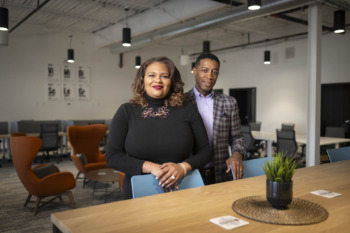
Representation and community are more than buzzwords for husband-and-wife architects Peter Tao and Helen Lee. “It’s interwoven into almost everything we do,” Tao says. Their award-winning St. Louis architecture and design firm, TAO + LEE Associates, Inc. will celebrate 30 years in business in 2025.
Working from their Downtown St. Louis office, Tao and Lee’s firm has completed projects for some of the most high-profile institutions and restaurants in St. Louis, including the Missouri Botanical Garden, Saint Louis Art Museum, Missouri History Museum, Washington University in St. Louis, Katie’s Pizza and Pasta Osteria at Ballpark Village, SADO sushi restaurant, and Madrina Italian restaurant, as well as numerous corporate and residential spaces. Their unique design approach is complemented by a strong commitment to serving their community — both the greater St. Louis community and the local Asian American and Pacific Islander community, of which they are an integral part.
Tao and Lee met in New York City on the campus of Columbia University, where they both earned their graduate degrees in architecture. After starting their careers at separate firms in New York, they eventually married and moved to London to open a new office of Tao’s then-firm, KPF. They lived there for five years and started a family with two children, Naomi and Matthew, before deciding to return to the States to forge a new career path together in 1995.
“I got tired of the corporate world and corporate politics,” Tao says. “When you move up the ladder in architecture, you don’t so much get to be an architect anymore. We wanted to still design.”
Rather than return to a cramped apartment in New York, or move to Lee’s hometown of Los Angeles with its high cost of living and long commute times, they settled on St. Louis, where Peter was born and raised and still had family. They used their savings to move with the intention of starting their own firm.
“St. Louis was less intimidating,” Tao says. “We thought that with our experience and background we wouldn’t feel like we weren’t good enough here.”
Tao is the son of Chinese immigrants. His father, William Tao, was a mechanical engineer, a graduate of Washington University, and founder of his own firm, William Tao & Associates, where Peter Tao worked as a young teen, gaining early experience and inspiration.
“I was in the office and not even driving age. I ran transfers — created a floor plan the engineer could draw on,” he says. “My dad was very proud of taking me to projects he worked on. He was a different kind of engineer because he was always looking at the big picture.”
It was a full-circle moment when Tao and Lee officially hung their shingle and started their company in a small, windowless office space inside Tao’s father’s firm in 1995 with the family’s support.
Growing up in the 1960s and 1970s in University City and Ladue, Peter Tao was acutely aware of being a minority. He didn’t see a lot of other kids who looked like him. His parents integrated themselves deeply in the St. Louis community, however, creating a legacy that serves as a blueprint for Tao’s own involvement and commitment today.
“St. Louis was their place,” he says. “They were the biggest die-hard St. Louis fans ever.”
In addition to being a professor and emeritus board trustee at Washington University, William Tao, along with his wife, Anne, was heavily involved in the Missouri Botanical Garden, served on the board of the International Institute of St. Louis and started the Organization of Chinese Americans (now OCA-Asian Pacific American Advocates), of which Peter Tao is currently Board President.
“I’m the child of legacy parents who were very engaged with the community,” Tao says. “A lot of that was because people gave to them when they immigrated here. That’s my sense of community — they came, someone helped them, someone mentored them — so we mentor people. A lot of people are surprised at how much we’re involved. You can be too. It’s not that hard. There are organizations out there that want your help.”
With numerous awards to their names, the list of community organizations Tao and Lee have served with and support is lengthy. Both have served on the Board of the Asian American Chamber of Commerce-St. Louis. Lee has served with numerous arts organizations including Center for Contemporary Arts, Laumeier Sculpture Park, Metro Theater Company, and the Contemporary Art Museum St. Louis to name just a few. Tao is Board President of The Gateway Welcome Project; a Steering Committee member, mentor and ambassador for St. Louis Mosaic Project; and a founding committee member and current Chair of the Advisory Committee for the Missouri Historical Society Chinese American Collecting Initiative.
With regards to the latter, Tao says, “It’s amazing how much people don’t know about Chinese-American history in St. Louis and how they played a part, especially since the first lone Chinese man came in pre-Civil War 1857. It is important for us to tell these stories so that people can understand who we are. We’re not the same, we’re all different and that’s something to celebrate.”
Tao recently had an instrumental role in the reopening of the Missouri History Museum’s 1904 World’s Fair exhibition, which he says is “incredibly important because this new exhibit is not just documenting what happened and celebrating the grandeur of it all. It’s actually digging deeper and revealing more untold stories, and frankly some not so nice stories. I was honored that they asked me.”
With a strong interest in sustainability and food, Lee found a way to honor her own family’s legacy thousands of miles from where she grew up in L.A. When son Matthew did an internship at EarthDance Organic Farm School in Ferguson, Lee was pleased to find that they grew a lot of fruit trees.
“My father grew fruit trees in L.A. as his hobby. We had 16 different fruit trees in our back yard — more exotic fruits like guava, persimmon, and kumquat,” she says. “When I stepped on to EarthDance, it reminded me of growing up and being able to grab a peach right off the tree.”
Inspired by her late father’s memory, Lee asked how she could be of service. It turned out that the farm needed help maintaining the fruit orchard — they had no one to come in and prune the trees or provide expert advice. Lee took the initiative to raise the funds needed to bring in professionals to maintain the orchard, which EarthDance in turn dedicated to her father as the Oscar Lee Orchard.
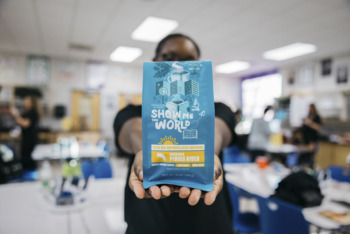
Tao and Lee’s children are currently working on building their own family legacy. After creating a community garden and growing 26 different types of peppers from all around the world, Naomi and Matthew are now rolling their passion into a business, making and bottling their own hot sauce brand, Winnebago Farms.
“They embody all the things that Peter and I deeply believe in,” Lee says. “They are committed to the food we love. We’re passionate about food. We’re passionate about design. (Naomi) is a graphic designer and we’re all passionate about the community.”
Many of the architectural projects Tao and Lee take on are direct reflections of their passions and commitment to the community. They recently partnered with national firm Ayers Saint Gross to design the Sassafras Restaurant inside the Missouri Botanical Garden’s new Jack C. Taylor Visitor Center — a project that was truly in Peter Tao’s blood.
William Tao was a close friend of Dr. Peter Raven, who headed the Botanical Garden for four decades, and through their involvement with OCA, William and Anne Tao got the Garden to start its first Chinese festival. The family’s legacy was incorporated into one of several biophilic design elements in the new restaurant — a series of botanical panels that visually separate the kitchen from the dining area.
“Each of these panels actually has a story that ties into (The Garden’s) own research,” Tao says. “One of the panels our family wound up sponsoring because it was very different from all the other panels in the composition of its design, almost like Van Gogh’s Starry Night. We chose that one as it seemed very spiritual to represent our parents.”
Another recent project and one of Tao’s favorites, is an impactful update of the Missouri History Museum’s North Plaza. “It was an inaccessible plaza with a lot of little steps,” he says. “The elderly were falling down, the ramps were non-compliant, and we came up with a scheme to make it simple, appropriate, and nice. It has been very much embraced by both the museum and the community.”
Large or small, Tao and Lee bring their unique approach to each project and continue to be fueled by their passion for the work.
“Every day is a different day. We might be working on a residence or a restaurant or some institutional or education work, so it keeps us engaged and challenged,” Lee says. “After 30 years in the business, that’s what you’re looking for. We’re not putting out cookie cutter things. Our most successful clients are the ones that are willing to give us full reign over what we’re doing.”
Adds Tao, “Clientele appreciate that we’re attacking the project from many different hats and I think that’s helped us and the people in the firm as well. It’s very important that we find the right people to work for us so we have this different way of looking at things.”
As Asian business owners, they are also acutely aware that they are still underrepresented. “It’s why it’s so important to us as Asian architects to be involved in the community,” Lee says.
Tao’s family’s history is part of St. Louis’ history, and he believes the choice to start and grow the business here was instrumental in its success. He continues to find inspiration in the city of his birth.
“I think one of the amazing things about St. Louis is it has such rich architecture of all styles, going back into the 1800s to modern architecture,” he says. “We have so many buildings that are still intact. We have neighborhoods that are relatively intact. I don’t think people appreciate that this doesn’t exist in a lot of places.”
For Lee, who grew up amid fruit trees in California and continued growing that family legacy in an orchard in Ferguson, the past three decades have cemented St. Louis as her home.
“After 30 years of working in this community, I would say that this is my home,” Lee says. “And I think once you think of it as your home, I think St. Louis embraces you.”