From the Ground Up
St. Louis startup HabiTerre uses cutting-edge geospatial technologies to pave the way for agricultural solutions to climate challenges.
Scholar and innovator Kaiyu Guan was given the first name “Kaiyu” by his grandfather, which means “explore and discover the universe.” Today, Guan’s work is closely tied to the land, and the Midwest in particular. However, he’s fulfilling his grandfather’s aspiration via geospatial technology. “I’m using satellites as my eyes to see the universe,” he says.
He holds numerous titles: Blue-Waters Professor in Supercomputing at the University of Illinois Urbana-Champaign; founder of the university’s Agroecosystem Sustainability Center (ASC); chief scientist for the NASA Acres program; and founder of the ag-tech and geospatial startup HabiTerre, based in St. Louis and Champaign, Illinois. However, Guan is perhaps best described as a pioneer — in the literal sense. In 2019, he broke new ground with HabiTerre, which integrates the latest in earth system modeling, remote sensing, geospatial technology, and artificial intelligence to precisely measure the environmental impact of sustainable farming practices at scale.
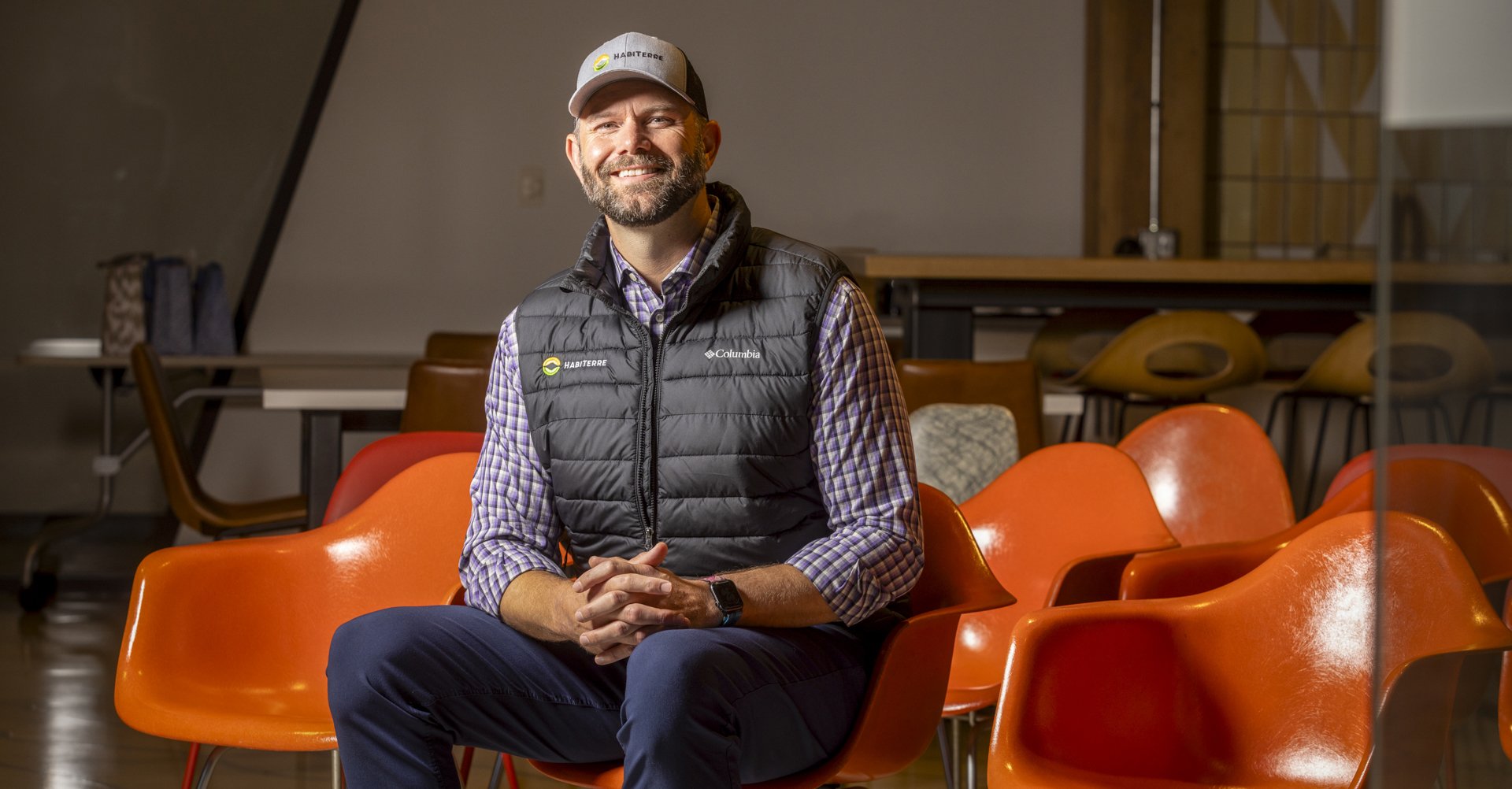
His partner in the commercial aspect of this endeavor is Nick Reinke, raised on a fourth-generation family farm in Lisbon, North Dakota. Reinke grew up conditioned to pursue less global ambitions. He still returns home every year during harvest season. But he, too, found an expansive path through agricultural technology. After a successful career in ag banking and crop insurance, he earned a master’s degree in business administration from Johns Hopkins University and joined the innovation team at Truterra LLC, the sustainability arm of Land O’ Lakes Inc. Now, as HabiTerre’s CEO — and a proud St. Louis resident — Reinke uses his firsthand knowledge of farming to promote agriculture as a key sustainability solution.
“The planet is on fire, and agriculture has a huge role to play,” he says. “In many ways, it’s viewed as either the potential savior or a major cause of climate challenges. If we do our job right, we can help to build a scalable marketplace for positive environmental outcomes in agriculture as a solution to a changing climate.”
Reinke is referring to the concept of ecosystem service markets and supply chain decarbonization, an economic model in which farmers are paid not only for the crops they produce but also for their positive environmental impact. For this model to work, however, farmers and corporations across the ag value chain must be able to quantify these outcomes — easily, cost-effectively, and accurately. Toward this end, HabiTerre is designed to operate like a utility of sorts, offering clients a vetted, intuitive, and highly accurate technology to capture these metrics. “We have the aspiration to become the global standard of quantifying agricultural greenhouse gas emissions and soil carbon change,” Guan says.
Currently, HabiTerre’s main customers are known as “CPGs,” aka consumer packaged goods businesses with large agricultural footprints. For these companies, many of whom are international, decarbonization through market mechanisms is not a lofty, abstract idea but rather a tangible business reality. “The pressure is coming from all angles,” Reinke says. “From investors, to consumers, to the global regulatory environment.”
Indeed, agriculture has tremendous potential to mitigate a changing climate. Currently, it accounts for about 22% of the world’s greenhouse gas emissions, as reported by the U.S. Environmental Protection Agency. But soil, when properly managed, can serve as a kind of carbon sink, absorbing large quantities of it from the atmosphere. “There’s twice as much carbon in that thin layer of soil on the planet than there is in the atmosphere,” Reinke says. “But the way we’ve been managing our lands, we’re turning it into an emissions source. Reversing the directions of emissions is what it’s all about.”
Case in point: HabiTerre recently launched a partnership with Tyson Foods as part of its Local Grain Services Sustain program, which seeks to reduce greenhouse gas emissions and enhance productivity among the farmers sourcing its grain. To do so, it pays farmers by the acre for implementing climate-smart farming practices. HabiTerre is engaged to reliably measure the impact of these changes. Meanwhile, the startup is collaborating with several other ag-tech and carbon-monitoring companies on a pilot project in Brazil. It is designed to serve as a proof of concept, examining how technology can create breakthroughs in tracking carbon sequestration where publicly available agricultural data is more scarce.
The goal of this technology is straightforward, but the underlying science required to measure decarbonization of the land is wildly complex. HabiTerre’s evolving technology is built upon work done by a large team of scientists at Guan’s university lab, which developed much of the underlying technology licensed by the startup and employs more than 30 doctoral researchers and students. They use a combination of highly sophisticated technologies — including the university’s world-class supercomputing resources — to build algorithms that accurately represent complex agricultural processes.
More specifically, they incorporate the latest public data from NASA satellites as well as extensive measurements captured hourly by the Ameriflux Network, a series of more than 100 structures that precisely track carbon, water, and energy fluxes in North, Central, and South America. The towers are currently managed by the U.S. Department of Energy and are widely considered to be one of its most important tools for climate and ecological study.
“We call it a ‘system of systems’ solution,” Guan says. “Solving the complicated problem of agricultural sustainability requires not just one particular solution or sensor or model but actually the very smart integration of different streams of data and models together, made possible through artificial intelligence.”
As Guan and Reinke work together to convert this rigorous science into a viable commercial product, they have chosen St. Louis very intentionally as HabiTerre’s home — seeking to capitalize on the city’s exceptional strengths in both geospatial technology and the agricultural industry.
“St. Louis is one of the biggest technology hubs and talent pools for the agriculture and geospatial industries,” Guan says. “We’re really excited to be part of it, and we believe St. Louis will be our long-term home.”
Reinke, who relocated to the city in 2022 when HabiTerre was selected as an Arch Grants recipient, is effusive about what the region already has offered them. “I cannot believe the way the St. Louis community has rallied around us,” he says. “I don’t think we’d get this level of support elsewhere.”
HabiTerre continues to strengthen its local network by developing collaborations with the Donald Danforth Plant Science Center and other major agriculture industry players in the region, while maintaining a co-working space in the T-REX building. Guan and Reinke are eager to explore additional opportunities for partnership, such as with the Taylor Geospatial Institute, founded in 2022 with the intention of becoming the nation’s leading geospatial research collaborative.
Meanwhile, HabiTerre’s financial support from the St. Louis business community and beyond is gaining momentum. This summer, the company closed its initial round of Series A funding, securing $10 million so far from investors including Catchlight Capital Partners and agricultural equipment manufacturer John Deere.
Despite these significant gains, Guan and Reinke both emphasize their vision of building something bigger and broader than any one technology solution. Indeed, their expressed purpose extends deeper than the success of the company itself, tapping into something more fundamental: a moral obligation to do the right thing for the health of the planet. And this requires building a second, human ecosystem of sorts — one that connects members of the local business and scientific communities around the shared goal of addressing big and complex environmental challenges.
“We want to be on the right side of history when we look back,” Guan says. “There’s a social responsibility that we have. I believe that ecosystem service markets will help farmers, companies, the climate, and society overall. This involves not just building a product but building a community. And we want to be a trusted thought leader in this community.”