Generation
Geospatial
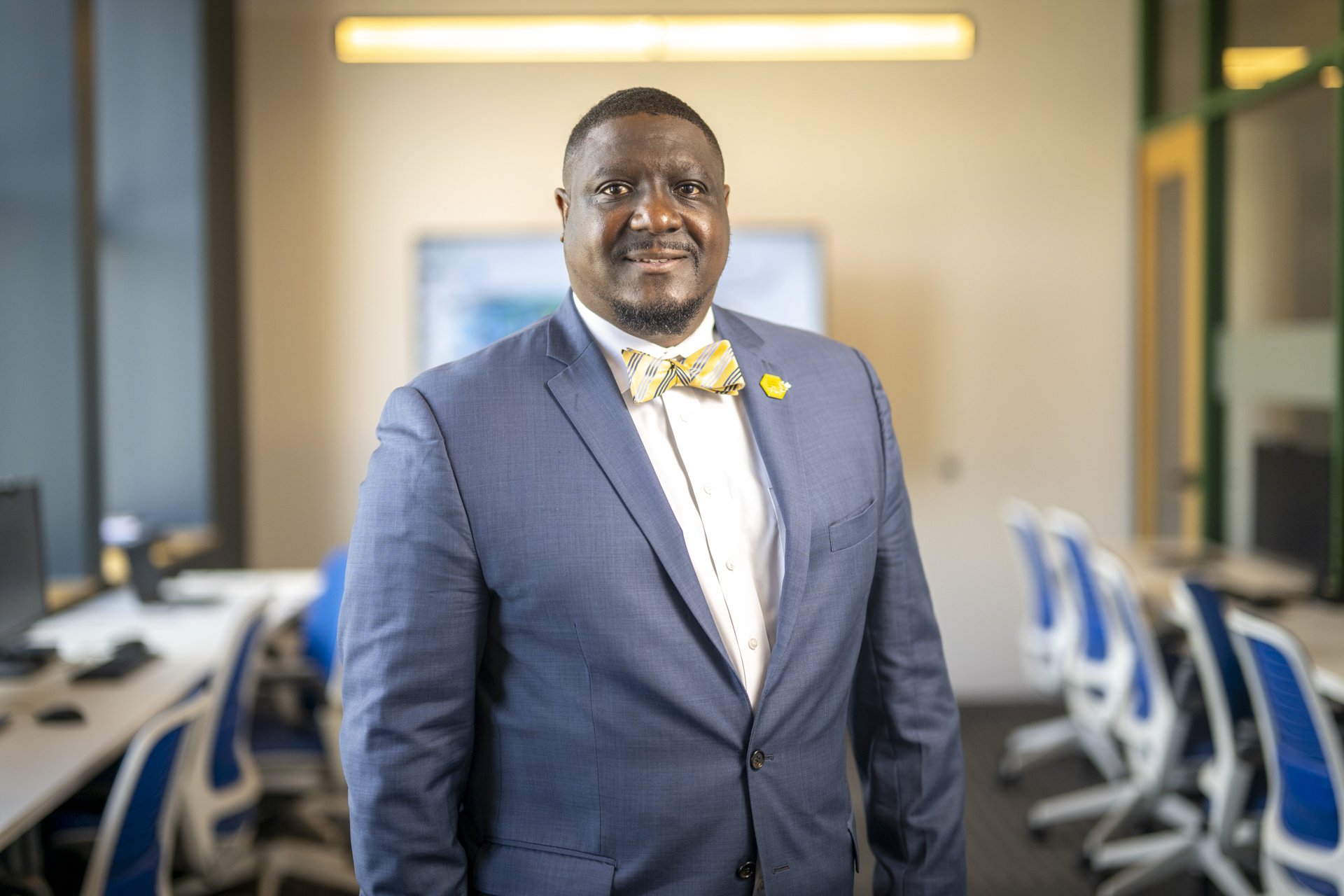
At Harris-Stowe State University, Dr. Freddie E. Wills, Jr., Ph.D., is training students from historically Black colleges and universities across the U.S. for futures in geospatial science.
When University of the Virgin Islands student Joleen Buchanan flew to St. Louis to take part in a four-week immersion program at Harris-Stowe State University (HSSU), with support from the National Geospatial-Intelligence Agency, earlier this summer, she wasn’t sure what to expect. As the plane descended toward St. Louis Lambert International Airport, she spotted the Gateway Arch.
“The first thing I asked was, what’s that thing?” Buchanan says with a laugh. During her final weekend in St. Louis, she visited the landmark and was delighted to learn you could ride to the top. So she did — just another way the Harris-Stowe program got her out of her comfort zone this summer.
Buchanan was one of 20 students from all over the country (some, like her, were even international students) who converged on St. Louis for four weeks this summer for the third cohort of the Historically Black Colleges and Universities (HBCU) Immersion in GEOINT program. The intensive sessions are designed to “develop geospatial intelligence interest and skills in students from the nation’s HBCUs,” according to the NGA.
Harris-Stowe State University Vice President for STEM Initiatives and Research Partnerships Dr. Freddie E. Wills, Jr., Ph.D., launched the immersion program in 2022 with just eight students. Last year, he brought 10 students to St. Louis. In 2024, the program has now grown to 20 students, and Wills thinks it’s hit the sweet spot between experts in the field and up-and-coming students.
“The students participating in the program (go) back to their institutions and spread the word, but then (we also get) more attention here in the city of St. Louis around our geospatial science efforts throughout the country,” Wills says. “We’ve definitely advanced this work in opening doors to other HBCUs to understand what’s happening here in St. Louis on that front and to introduce this field of study across different HBCUs as well.”
Wills has been instrumental in adding STEM studies to the curriculum at Harris-Stowe, a historically Black university founded in 1857 as a teachers’ college, located in Midtown St. Louis. Wills says HSSU only added STEM-related majors 12 years ago, including biology, math, and sustainability and ecology. His goal is to get ahead of the opening of the NGA St. Louis campus in 2026. By then, HSSU and the immersion program will have trained graduates who are ready to enter the emerging geospatial industry.
“We should be able to start seeing a critical mass of students from Harris-Stowe flow into this industry,” he says. “You gotta start while it’s hot. And for me, it’s important that we be a part of the conversation to help develop this space for St. Louis, versus coming to the table once it’s already developed. Because then you’re fighting for crowns, you know?”
The program is open to applicants from HBCUs across the U.S. and beyond — and prior geospatial study or experience is not required. Participant Abdourahim Sylla, a sophomore at Lincoln University in Pennsylvania, is studying computer science. He learned about the program from a flier emailed to his university’s computer science department.
“I had never learned anything about geospatial data or science before, so I thought this would be something interesting to learn about,” Sylla says. “I learned that geospatial science is not just using Google Maps — we use it in our lives, we use it in the military, we use it in the government, for healthcare. Learning how many fields and how many paths are (available) in geospatial science was really valuable for me.”
Buchanan agrees that the immersion program has essentially changed her career path. After a week in St. Louis, she was no longer unsure about her post-grad plans.
“I immediately went from, ‘I don’t know what I’m going to do; I don’t know what the future holds,’ to ‘I want to work for NGA — this is where I’m supposed to be,’” she says. “It shaped my entire thinking and approach to everything. It taught me a lot of valuable lessons about patience and communication.”
HSSU math major Lyana Wilks says another valuable lesson learned was the importance of leadership — something she’s previously shied away from.
“This program forced me into becoming the leader and putting the shine on myself. What I took away from this was getting out of my comfort zone,” Wilks says. “Being a part of something that’s growing is really special.”
Students in this year’s cohort continually emphasized the amount of support they felt from fellow attendees as well as instructors and mentors. They were drawn to being a part of something that is just now in development and continuing to grow here in St. Louis.
During the four-week sessions, students live on HSSU’s campus. They attend daily sessions at the university as well as at Cortex Innovation District and T-REX, where HSSU’s GeoHornet Lab and NGA’s Moonshot Labs are located. In addition to these participating organizations, additional partners include General Dynamics Information Technology, Maxar Intelligence & Maxar Space Systems, Environmental Systems Research Institute, the National Security Innovation Network, and the U.S. Geospatial Intelligence Foundation.
Wills believes it’s crucial to not only position St. Louis at the forefront of this emerging and growing industry, but to foster diverse talent within it. Growing Black tech talent is something he sees as “a must.”
“The (goal) is to grow St. Louis to be the global epicenter of geospatial science and technology, and we sit here with an HBCU in our community in St. Louis, and another one in Jeff City,” Wills says. “We have to cultivate all talent, and in order to cultivate that talent for an emergent field like geospatial science, you have to introduce it to (students). We’re not going to develop that talent with just the institutions that we have here in St. Louis (right now). We have to reach outside of our walls here in the state of Missouri and the city of St. Louis, and we have to attract talent from other places, just like other major cities have done.”
HSSU isn’t the only institution developing young talent in the geospatial sector ahead of NGA St. Louis’ 2026 opening. At Gateway Global American Youth and Business Alliance Academies, founder Zekita Armstrong Asuquo has worked since 2018 to train students to gain high-school level accreditation from the United States Geospatial Intelligence Foundation, alongside Saint Louis University and the University of Missouri. Gateway Global is also prepared for the arrival of NGA St. Louis, recently celebrating the opening of its own impressive campus nearby in the Hyde Park neighborhood of St. Louis.
At HSSU, Wills stresses that immersive programs like the one he hosts for students over the summer are key to introducing students to an industry that will only see growth in the coming years. And as an educator, he knows a simple truth well: Students won’t apply if they’ve never heard of it. With this in mind, he specifically approaches math and engineering students and encourages them to apply to the program.
For example, Wills approached HSSU math major Lyana Wilks about attending this year’s cohort even without prior geospatial experience. Wilks says that kind of push from someone she considers a mentor shifted her perspective.
“Dr. Wills is very motivated and dedicated to the students,” she says. “He was clearly invested in me and he knew it was something I wanted to do. The (program) mentors were just so focused on us; there was so much love poured into us.”
Wilks has changed her career aspirations a few times, she admits with a laugh, but after attending this summer’s cohort, she wants to go into the military and work with geospatial intelligence in some capacity.
For many students attending the program, St. Louis is not a familiar city. At first, Buchanan was hesitant to apply because she didn’t know how she’d get here from the U.S. Virgin Islands or where she would stay. However, the opportunity was too good to pass up, she says.
“When I saw that it was going to be in a place that I’ve never been to before, that made me extremely more eager to apply. I took it as an opportunity to expand my network,” she says. “Maybe if I come to this program, I’ll be able to be introduced to the right people who could get me into the right doors and further advance my career in geospatial science.”
Sylla agrees that the trip to St. Louis from Pennsylvania was well worth it, even if he didn’t have much time to explore beyond his training sessions.
“Being here is 100 percent working, and I’ll not trade (that) for anything else because I’ve learned so much and I’ve met so many people who are just willing to help,” he says. “The first thing is: reach out. Don’t forget to reach out, (don’t) hesitate to ask questions. (The mentors) are willing to help you all the time and I really like that about this program. I’m definitely going to recommend people at my school apply for this.”
St. Louis doesn’t have a worldwide reputation yet, Wills says, and that can be a challenge in attracting top talent. That’s one of the things he hopes to change in the minds of students through HSSU’s immersion program.
“Part of it is you still get some students like, ‘Where’s St. Louis?’ Then once they get here in this space with NGA, they start to understand the why here,” he says. “They start to see the importance of why diversity in this space is needed. It’s a major opportunity, I think, for St. Louis to not only support the transformation of Harris-Stowe in this space, but also to support the development of a diverse field of workers for the geospatial industry.”
Next year, Wills likely will keep the program’s cohort at 20 students to ensure they get enough individual attention from various industry mentors, but he wants its reputation to continue to grow as a breeding ground for young tech talent — with Harris-Stowe and St. Louis at the forefront.
“I see this program as being a pillar for the community in St. Louis, and a pillar in higher education in general, especially among the HBCU community. I see Harris-Stowe being the HBCU to be at for geospatial science,” he says. “When people around the world think of diversity in geospatial science, the first thing (I want them) to think about is Harris-Stowe. To have something where you have built a unique brand in it is special, and I would like to see Harris-Stowe be that brand, not only locally, but nationally as well.”
Join the Story
- Learn more about The Office of Stem Initiatives at Harris-Stowe State University on its website.
- Discover more about Harris-Stowe State University on its website.
- Connect with the university on Facebook, X, and Instagram.
- Explore the GEOINT Hub at T-REX in Downtown St. Louis.
- Read more stories of St. Louisans who are paving the way for geospatial careers for the next generation.