Set Up for Success
At the University of Missouri-St. Louis, Jonathan Lidgus and his team help students with disabilities thrive in college and land successful careers.
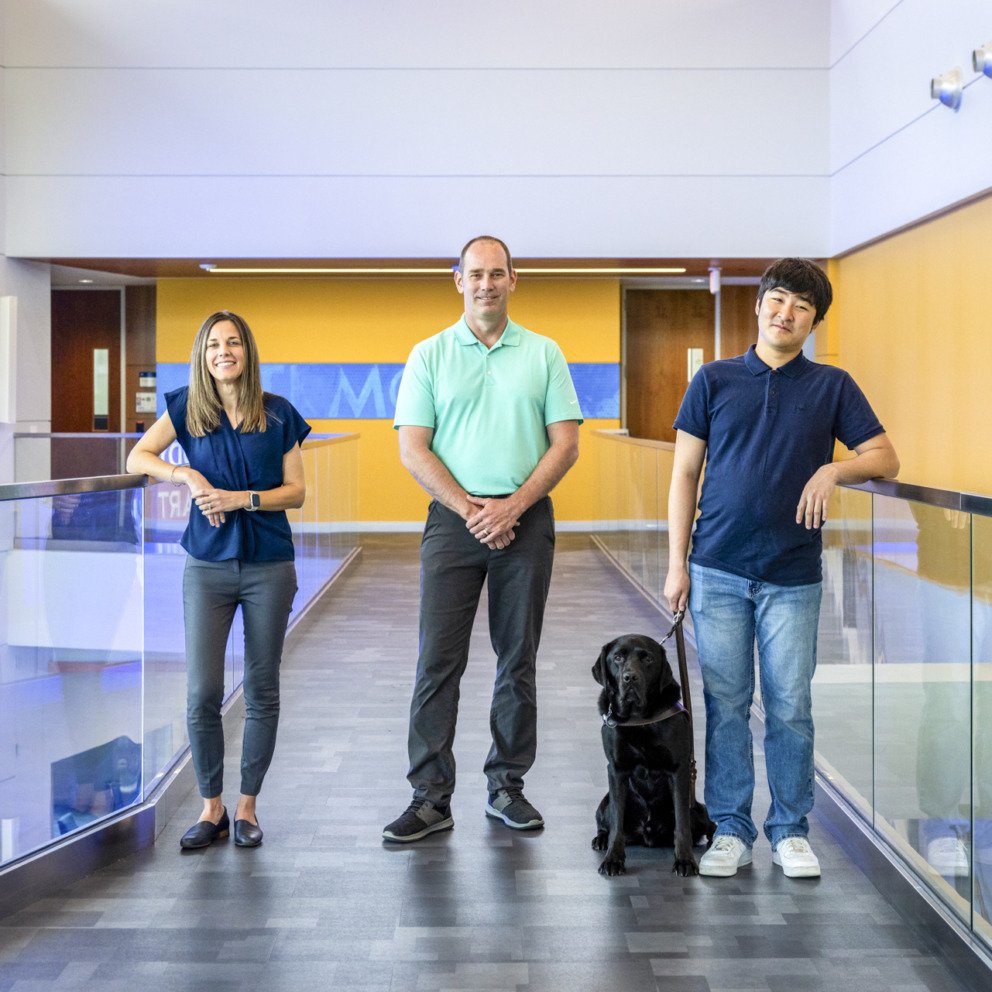
When Jonathan Lidgus, director of the University of Missouri-St. Louis’ Office of Inclusive Postsecondary Education (OIPE), talks about the unemployment crisis for individuals with intellectual disabilities, the numbers are staggering. When he notes the employment outcomes for graduates of the university’s OIPE program, they’re equally jaw-dropping — yet for a much better reason.
“The unemployment rate of individuals with intellectual or developmental disabilities following high school is upwards of 70 percent,” Lidgus says. “There are a lot of reasons for this. However, the employment rate for students exiting our program is between 75 and 80 percent. Getting gainful, supportive, and meaningful work is what we all want. By unlocking a student’s interest in what they want to do, giving them the opportunity to take courses in that area, and supporting them along the way, we feel we have really flipped the script.”
As Lidgus explains, OIPE, which is part of the university’s College of Education, began in 2013 as Succeed. The program continues today and gives its participants vocational experience, training, internship opportunities, and independent living skills. Those who complete the 44-credit hour program within two years are eligible to receive a Chancellor’s Certificate. However, it is no longer the only way students with intellectual or developmental disabilities can be a part of the UMSL community.
For the past decade, Lidgus has seen just how transformative UMSL’s OIPE program can be for both its students and the broader university community — first, as part of the team that launched it in 2013, and now, as its director and loudest champion. Its mission is simple: to give people with intellectual or developmental disabilities a chance to attend college and gain the skills and experiences needed to find meaningful employment and live independent and fulfilled lives.
OIPE has been recognized as a model in its field, including by the Comprehensive Transition and Postsecondary Program by the U.S. Department of Education. OIPE has received many grants and accolades over the past decade, including the Missouri Governor’s Council on Disability 22nd Inclusion Award and Focus St. Louis “What’s Right with the Region” Award in 2022.
OIPE has grown over the years to include two additional programs: Succeed+, which is a continuation of the Succeed program for those who wish to gain even more skills and education, and Link, which gives its students the chance to earn a certificate or degree through for-credit undergraduate classes. No matter which of the three programs students choose, they all give participants a supportive and empowering path and allow them to be immersed in university life.
Lidgus cannot help but marvel at how much OIPE has grown since its inception. As someone who has been instrumental in the program’s evolution, he admits it was not always a certainty that it would succeed — or even get off the ground. Back in 2011, when he was first approached about introducing an inclusive postsecondary program at the university in his capacity as director of student housing, his first response was that it might be too difficult to make a reality.
“I immediately said no, so I am technically credited with shutting down the program before it was started,” Lidgus admits with a laugh. “Fast forward a year later, and another group of faculty approached me with the idea, but this time they had funding that we used to explore other universities with programs like this. I came to one of the visits at the University of Central Missouri with a laundry list of questions for the housing people and realized that everything they were experiencing was nothing different than housing folks are already experiencing. (They were) the same issues, just with an extra layer of support added on. It was probably halfway through my visit that I realized this was something we could not only do, but do better.”
Lidgus and his colleagues came back to UMSL with a sense of mission that led to them launch Succeed in 2013. With just 13 students and an office of three staff members, the program saw both early successes and challenges that provided the learning experience necessary to make the program even stronger — something the university was a tremendous partner in achieving, Lidgus adds.
“What is amazing is how open and inclusive the university has been,” Lidgus says. “Working toward inclusion and also working with individuals with intellectual and developmental disabilities is hard work. It is rewarding work, but takes a lot of support, a lot of expertise, and the grace and openness of UMSL’s administration to allow our program to grow and become what it is today. We would not have been able to do that without the support of the university administration. No matter what bumps in the road we’ve hit, we always address them realistically and head-on and work to improve our program and inclusion at UMSL. It’s been really great to be a part of that.”
Lucy Salamon, a recent Succeed graduate, knows firsthand how transformative the program can be through the many doors it has opened for her. While in the Succeed program, she enjoyed and focused on a mix of vocational and independent living classes that helped prepare her for her current role in reception in an office setting.
“It’s a great place, a great school, where you can go to so many events, be social, meet new people, live in dorms, and have the ultimate package that UMSL provides,” Salamon says. “I got to join a sorority, and even got a scholarship so I could travel to different universities and talk about my experiences.”
Like Salamon, current Succeed student Cooper Howard has been happy to be a part of the UMSL community. A native of Bellingham, Washington, Howard was excited about the university’s archeology program and hopes to learn as much as he can about the field. He’s currently exploring study abroad options which can give him vital hands-on experience to pursue his dream of working in the field. However, the coursework is only one of the many reasons he would recommend participating in the program.
“I love it,” Howard says. “I love my classes, it’s easy to get around, there are a lot of events that we are able to go to, and I’ve met so many friends.”
Although OIPE has grown significantly over the past decade — the initial cohort of 13 students has grown to roughly 80 — Lidgus wishes there were even more opportunities for students like Howard and Salamon, whether at UMSL or other universities across the country.
There are now 318 similar programs at universities across the U.S. (up from 23 when Succeed first launched), yet only six percent of colleges and universities have an inclusive postsecondary program. Because of this, Lidgus likens getting into a program like OIPE with being accepted into an Ivy League university. He hopes that UMSL can be a model for higher education across the U.S. and provide best practices for other institutions.
Thanks to a recent grant OIPE received from Think College at the University of Massachusetts-Boston, he and his team were able to create the Midwest Inclusive Postsecondary Alliance that has brought together similar programs from across the region. The alliance works together to recruit students, offers best practices to other universities, and coordinates with state agencies on issues concerning educational and employment opportunities for people with intellectual or developmental disabilities.
“I want to be, and I want UMSL to be, a leader in supporting neurodiverse students so that they have access to higher education,” Lidgus says. “I think this makes us a model institution for supporting the needs of all students. That’s one of the things I think is so exciting about programs like ours: We are always innovating in terms of how you can support college students. I think any support you put in place for students with disabilities can be a support for everyone.”
Lidgus is emphatic that the university has been a vital partner in the growth of OIPE and has worked closely with him and his team over the past decade to provide the best opportunities for students. He also credits the larger St. Louis community with being instrumental in the program’s success, thanks to its robust support of people with disabilities. He sees nonprofits like St. Louis Arc, Easter Seals, and the Starkloff Disability Institute, and even institutions such as the Saint Louis Zoo, which is a notably inclusive employer, as creating an atmosphere of empowerment and possibility for all area residents. Lidgus has also been heartened by the collaborative spirit of other universities in the metro area, which have worked with OIPE in a variety of ways to bolster its programming.
After more than a decade of work building up OIPE here, Lidgus believes St. Louis should be seen as a model for other metro areas in the field of inclusivity and a champion for people with disabilities.
“One of the things that is great about St. Louis is the amount of support that individuals with disabilities have in the region,” Lidgus says. “There are several organizations that have been a huge help to our program through their expertise, and what they have taught us has helped us improve. There’s a willingness of everyone to work together. That’s just the culture here, and it’s really helped put St. Louis — and Missouri for that matter — at the forefront of the field of inclusive education.”
Join the Story
- Learn more about the University of Missouri-St. Louis’ Office of Inclusive Postsecondary Education on its website.
- Connect with the Office of Inclusive Postsecondary Education on Facebook, Instagram, and LinkedIn.
- Discover more about OIPE in this HEC-TV video.