Rising to the Occasion
At its North American headquarters in St. Louis, AB Mauri drives innovative baking and fermentation solutions for bakeries across the country.
The Midwest is traditionally known as America’s breadbasket, but today, that legacy extends far beyond the region’s rich history of grain production and milling. In the heart of St. Louis, one of the world’s largest producers of yeast is driving innovation at bakeries across the country through its cutting-edge baking and fermentation technology.
If the name AB Mauri doesn’t ring a bell, you’re more than likely familiar with its signature product, Fleischmann’s Yeast, which has been a baking staple in grocery stores across the country for generations. A division of Associated British Foods, AB Mauri is a global baking technology company that helps produce many of the baked goods we eat every day, from sandwich bread to tortillas to delivery pizza. Outside of the Fleischmann’s brand, AB Mauri — whose North American headquarters are located in St. Louis — is a primarily B2B company, manufacturing baking ingredients and technical solutions such as baking powders, baking sodas, dough conditioners, malts, syrups, mold inhibitors, and release agents for large-scale baking companies across the country.
“People may not know us by name, but they know us from our most visible product, which goes back to 1868, and we’re talking Fleischmann’s Yeast,” says Rick Oleshak, vice president of marketing at AB Mauri. “We make hundreds of products, including things that you don’t think about that go into your baked goods, whether you’re at the grocery store, the local Schnucks or Dierbergs, or you’re going to your favorite little coffee shop to pick up a baked good. We make baking powder, we make dough conditioners to make it easier for mixing, we make mold inhibition systems for preservation. Our yeast goes into everything from baked goods to beer, wine, and spirits to biofuel to animal nutrition and even human nutrition products.”
AB Mauri sells those products to smaller regional bakers and mom-and-pop-style bakeries (such as Companion Baking in St. Louis) as well as some of the biggest names in the business, including major players like Bimbo Bakeries, which makes Entenmann’s donuts, Thomas English muffins, Ball Park buns, and Sara Lee breads, as well as Flowers Foods, which makes Dave’s Killer Bread, Nature’s Own bread, and more. But AB Mauri does much more than just sell yeast and bakery ingredients; the company also offers hands-on expertise and technical support to help its customers solve challenges and improve their products.
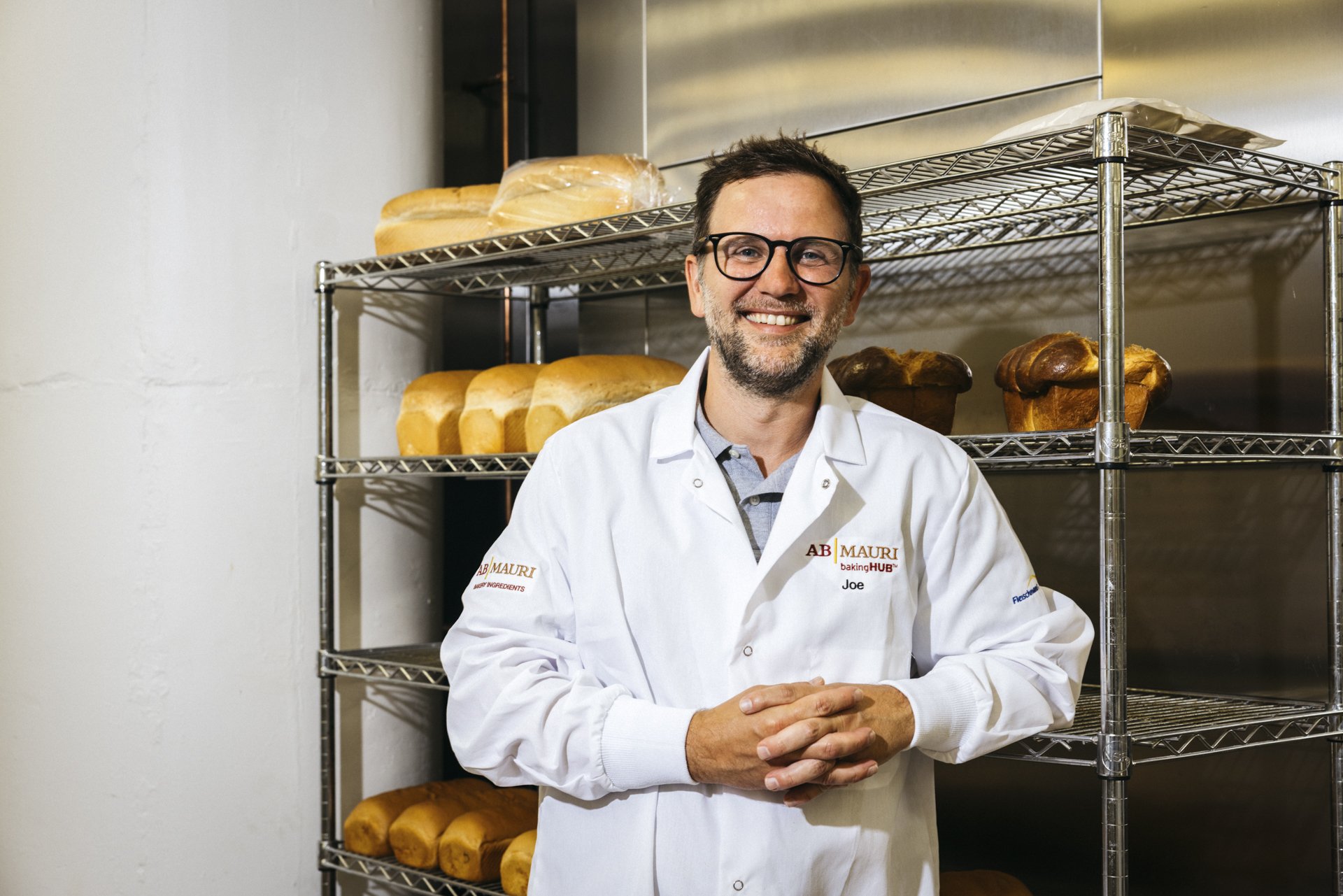
Much of that innovation happens at its St. Louis headquarters. AB Mauri has invested heavily in its campus at the Cortex Innovation District in the heart of the City of St. Louis, where the company relocated its headquarters in 2015. The current space, which expanded to occupy 33,000 square feet in 2019, was designed to accelerate testing, collaboration, and custom solutions for its partner bakeries across the country. It features the spacious bakingHUB — a pilot bakery where AB Mauri food scientists can test baked goods including breads, donuts, croissants, pizza dough, tortillas, and more — as well as a yeast-strain development lab and a 40-seat auditorium that can be used for training, product demonstrations, and live-streamed events.
“I think what’s really important for us is how we work with our bakeries,” Oleshak says. “We’ve got a technical baking team that thrives on going into a bakery and solving an issue — maybe they’re having a challenge with their dough or their oven isn’t heating right. Our team is really devout about trying to solve those challenges that a baker has. We just want to make sure the baker has a good outcome. That’s always been in our DNA, and I think that makes us a little bit different than some of the other folks in the market that make baking ingredients. A lot of people know baking, but we like to think we’ve got a little something extra in the gas tank, if you will. We’re passionate and curious and enjoy going out there to solve whatever issue that customer is fighting.”
The state-of-the-art 5,000-square-foot bakingHUB has allowed AB Mauri’s innovation team to accelerate research and development for its customers, whether in launching a new product or refining an existing one. Outfitted with commercial dough mixers, sheeters, and different styles of ovens (including rack, reel, convection, and deck ovens), the industrial kitchen replicates the conditions at any one of AB Mauri’s partner bakeries around the country, which may lack space of their own for experimentation.
When AB Mauri’s sales team goes out into the field to visit customers in cities across the U.S., they help identify any potential pain points or growth opportunities for bakeries big and small. One bakery might want to remove a certain ingredient from their bread to be more organic compliant, for instance, while another might be looking to add more protein to an existing tortilla recipe or incorporate label-friendly mold inhibitors like cultured wheat starch or dried vinegar to improve the shelf life of their hot dog buns. To figure out the best way to make that happen, they turn to AB Mauri’s innovation team of bakers and food scientists, who spend months — in some cases, up to a year — testing and fine-tuning different recipes and processes in the St. Louis bakingHUB.
Joseph Marchant, who worked as a baker at Whole Foods for 10 years before joining AB Mauri as an innovation technician, appreciates that the work allows him to constantly try new things rather than being confined to the same recipes and formulas each day. Driven by passion and energy for helping customers with their technical expertise, the innovation team is constantly coming up with new ideas, whether they’re developing a new enzyme that allows bakers to reduce the amount of sugar in their formulas or creating niche products like breads that are high in fiber and protein or low in carbs.
“It’s really cool to be on the cutting edge of new trends in baking, and to see the innovation of a recipe or formula take off is pretty cool,” Marchant says. “I love to collaborate with customers and colleagues, and I love seeing something that I developed in the lab go to the commercial phase. It’s just so interesting to me to see something that I test or develop using 1000 grams of flour scaled up to 1000 pounds and being produced in a large-scale commercial bakery. That never gets old.”
For large-scale bakeries that sell packaged bread and baked goods in grocery stores, shelf life is of particular concern, and AB Mauri’s bakingHUB can help ensure that a baguette tastes just as fresh on day 17 as it does on day one. On a given day, baker’s racks are lined with stacks of tortillas and loaves of sandwich bread labeled with dates and other testing notes. AB Mauri bakers carefully test how each sample ages, analyzing its softness and texture with each passing day, and can make recommendations, such as enzyme technology, to improve its shelf life.
“We really do our due diligence in testing product throughout shelf life,” Marchant says. “We’ll know what degree of softness to expect from day 1 through day 14 . We’ll know that the mold inhibition is keeping up and the product was able to stay mold-free in that time period. We’re always watching the product age and testing it as it ages so we can give that information to our customers and that added security.”
AB Mauri’s 150-year tradition in fermentation and its commitment to innovation led the company to launch a new division focused on fermentation science and yeast innovation in 2017. Where AB Mauri specializes in yeast and other bakery ingredients, AB Biotek focuses on specialty yeast solutions in other industries such as biofuel, alcoholic beverages (including distilled spirits, wine, and cider), and both animal and human nutrition. And in August 2024, AB Mauri further expanded its portfolio when it acquired Omega Yeast, which specializes in liquid yeast for craft beer.
Whether for beer, bread, or biofuel, AB Mauri’s innovative approach has kept the company at the forefront of bakery and fermentation science. And the company’s location in St. Louis — particularly within the buzzy Cortex Innovation District — has played a pivotal role in enabling AB Mauri to thrive from an innovation standpoint.
Oleshak says the company’s move to Cortex, a hub for innovation and inclusive economic growth in St. Louis, was driven by a desire to surround themselves with different thinkers. Over the years, AB Mauri has shared space with powerhouse local companies including Boeing, Purina, and Square, and the Cortex Innovation District has provided ample opportunity for collaboration and networking.
“Part of the thinking was that we needed to go into a place with people outside of our industry because you can pick up learnings from everybody,” Oleshak says. “It’s been really important for us to just be in this area where there are things happening and Cortex has had incredible growth. We like where we are with the innovation district. We like the mindset. We like being in a very creative area, so it’s been a really good home for us.”
AB Mauri has embraced the broader St. Louis community, too, particularly through partnerships with local nonprofit organizations such as Bridge Bread, Operation Food Search, and Ronald McDonald House. The company is passionate about leveraging its technical expertise and innovative technology to support organizations that use food as a force for good. For instance, AB Mauri bakers have worked closely with Bridge Bread, which provides baking work to people transitioning out of homelessness, to implement its enzyme technology to help its breads, bagels, rolls, and pastries stay fresh for longer.
Although the AB Mauri name might not be as widely known to the average consumer as their local bakery, the company has a significant impact on artisan bakers, industrial bakeries, and food manufacturers both in St. Louis and across the country. The next time you take a bite of a muffin or sandwich at your favorite St. Louis cafe, you just might be tasting the work of AB Mauri.
“It’s just this hidden gem in St. Louis,” Marchant says. “I really wish that more people knew about it, because I am a lifelong St. Louisan and was a baker for 10 years and had no idea that this company was here until somebody told me about this position. I just could not believe that I could secure a baking position that allowed me to work regular hours, and not only bake but be innovative and try new and different things.”
Join the Story
- Learn more about AB Mauri on its website.
- Keep up with the company on Facebook.
- Connect with AB Mauri on LinkedIn.
- Explore more stories about inspiring St. Louis companies and entrepreneurs who are contributing to the growth and success of the area’s innovation community.
- Learn more about AB Mauri in HEC-TV’s video.