

Scaling Up Startups
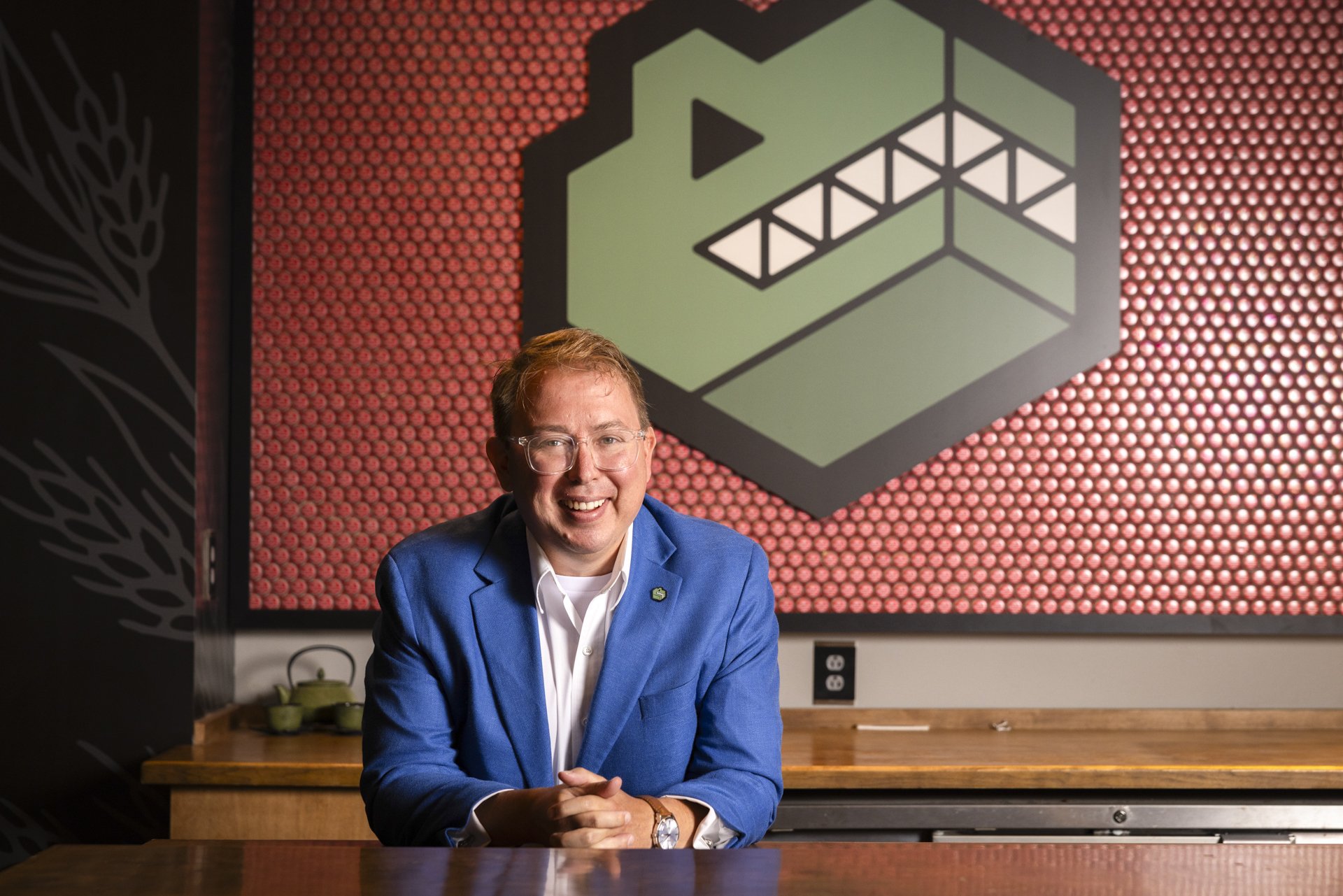
What about this role at T-REX most attracted you?
T-REX is such a fantastic place to make an impact in St. Louis. It sits at the intersection of economic development while still being able to help the individual. This is a place where, by helping founders and startup companies, we can have an outsized impact on St. Louis itself.
If we want to quickly drive up our economy, tech is the only way to do that. Because it’s more scalable. With tech, you can hire faster, you can bring in funding faster, you’re just able to develop a company in a much faster way.
How do some of your prior experiences set you up for this role?
Working with adults with intellectual disabilities at The Baddour Center (as director of advancement) gave me a bit of a different view on capabilities. We had some folks who were savants — people who couldn’t communicate in a traditional way but could play the violin in a very serious, phenomenal way.
You see these different abilities; you see the ways people can surprise you with what they can do. That has helped me better understand that not everyone walks in showing their cards. There’s this level of — we need to sit down and get to know people in order to understand what they can do.
Being able to grow the revenue at The Baddour Center, that’s a big part of what I do here at T-REX. We’re a nonprofit, so that development background is important.
What accomplishments are you most proud of since joining T-REX?
One thing is jumpstarting our Wednesday programming and developing a general plan forward for more programming. We’re looking to own Wednesdays from a programmatic standpoint — every Wednesday of the month, we’ve got something different going on.
First, we’ve got Morning Hatch, which is aimed at startup founders and early-stage entrepreneurs with a concept they want to move into a more viable product. The second and third Wednesdays, we have geospatial-specific activities. The fourth Wednesday, we’ve got something we call Strictly Social, which is just that — it’s a time where T-REXers, the Downtown community, really anyone in St. Louis is welcome to hang out. Our twist is that we have guest bartenders.
Looking forward, we’re leaning into programming in a heavier way.
Say more about that, and what’s next for the nonprofit.
We’re developing a cohort program for early-stage founders and entrepreneurs. I’m currently looking to hire an entrepreneur-in-residence to help formulate it, but we’ve got a baseline program that we’ll likely start by the beginning of next year.
It will offer training and mentoring in specific, relevant areas as well as opportunities to accelerate founders’ momentum through access to additional capital, pitch-deck review, and back-office support from experts in areas like finance, marketing, and HR.
At T-REX, founders have a safe place to fail. They can take risks, test ideas, and know they will be supported. That willingness to embrace risk is what sparks real growth and strengthens St. Louis as a place to start and scale companies.
We also really want to serve the entirety of St. Louis. So we’re looking into opportunities to work with youth, 16- to 20-year-olds, and we’re looking at bringing some of our programs out of T-REX and 911 Washington Ave and into different sections of the St. Louis community.
Tell us about how T-REX is advancing the geospatial industry.
With our Wednesday program Geosaurus Unleashed, we’re translating geospatial work into terms anyone can understand. It’s important for people to understand what geospatial is and how it can be utilized. We also want to make sure the folks who really use geospatial information day in and day out have a home. That’s why we created what we call GÜG, or Geospatial User Group, which meets the third Wednesday of the month.
At T-REX, we see ourselves as both a catalyst and a connector. The geospatial sector is one of the most important growth engines for St. Louis right now, it isn’t a one-industry lane — geospatial tools and data are going to fuel breakthroughs in agriculture, climate resilience, fintech, logistics, public safety, and a lot more.
If we want St. Louis’ economy to really take off, we’ve got to keep fueling the whole innovation ecosystem. Geospatial can spark explosive growth. Not just steady progress, but a real change in the trajectory of the city.
T-REX is right in the middle of that momentum. For example, there’s a company here, Omni Federal. It started at T-REX in 2017 with two guys. They provide technology solutions, including geospatial, for U.S. defense and intelligence agencies. They now employ something like 40 to 60 employees. That’s a big win for St. Louis, bringing fantastic, well-paying tech jobs into our city.
What do you find most rewarding and challenging about living and working in St. Louis?
St. Louis has this incredible sense of community to it. It’s one of the reasons we love being Downtown at T-REX. We’ve got all these fabulous partnerships, and people can always drop by.
For challenges, there’s an “aw-shucks-ness” to St. Louis and Missouri. St. Louis doesn’t like to be loud and proud about the great things that are happening here, so that can sometimes trip us up. I think if we could get a little louder about how great St. Louis is, we would do ourselves a favor.
On that note, I’m just going to put it out there — I’m really excited about where St. Louis can be in the next few years.
Join the Story
- Learn more about T-REX and its events and programming on its website.
- Connect with Jesse Winters and T-REX on LinkedIn.
- Follow T-REX on Instagram, Facebook, and X.
- Discover STLMade and T-REX success stories We Hear You, HabiTerre, and the Harris-Stowe State University GeoHornet Lab, and past success stories like MARSfarm, Gateway Global, Inclusively, and Flipstik.
- Read more stories of St. Louisans who are paving the way for geospatial careers in the metro.