Opening Doors
We Hear You makes spaces more accessible for people with disabilities — and with its Hero device, it’s literally opening doors across St. Louis and the U.S.
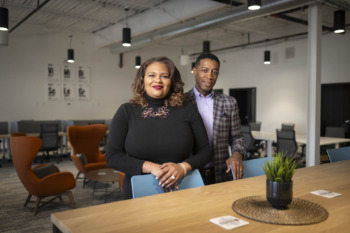
College is where many young people get their first taste of independence, but for Pierre Paul, Bethanie Couri, and Jamal Stevenson, focusing on the needs of others is what connected them as undergrad students at Bradley University in Peoria, Illinois.
The team, referred to by friends as PB&J, were all studying at the university in 2019 when Paul realized there was a gap in the market for American Sign Language (ASL) translation software. Paul and Couri knocked on doors at the university, spoke with mentors, and recruited a team of scientists to create translation software that showcases full gestures and offers finger-spelling capabilities.
“He had a literal dream one night about this technology that didn’t exist at the time,” Couri recalls. “He called me, and he was like, ‘Should we maybe do something?’ And so we started trying to get in contact with data scientists, professors — anybody who would listen.”
That early research and work laid the foundation for the initial software, We Hear You, which has now grown into a broader technology startup focused on developing accessibility solutions. The software, which uses artificial intelligence to provide ASL in public spaces, got its name during a phone call between Couri and Paul. The friends kept asking each other “why” questions about their goals for the software and why they wanted to create it, and the answers were always the same: because we hear you.
Today, the company is focused on its second offering, the Hero door opener, a portable, affordable device that automates any door without hardwiring it, making it ADA compliant. The device works in tandem with the company’s Push fob, which acts as a universal remote to open Hero-enabled doors. By making the door opener fob-enabled, users always have the ability to open doors in the palm of their hand. A separate device, the Push receiver, attaches to existing automatic doors to make them compatible with the Push fob, as well as the Push Door Opener app, available for iOS or Android devices.
The idea for the Hero and Push products came to Paul, the company’s chief executive officer, while he was enrolled in a diversity, equity, and inclusion certification program through Cornell University. There, he met Carden Wyckoff, who has muscular dystrophy and hosts the podcast “Freewheelin with Carden.” After joining Wyckoff on her podcast as a guest and learning about her story, Paul was inspired to create a device that could easily open doors remotely using just an app or a fob, making the lives of those with disabilities a bit easier.
“She told him that there’s nothing more embarrassing than being pinned between the door and the frame of the door in your wheelchair, and you can’t push it off of you, and you can’t reach (on) your own to press that button, so you’re just left relying on human kindness,” says Couri, the company’s chief operating officer.
The team, with the help of engineering students at Bradley University, set to work creating a prototype, which evolved into the Hero device. With the help of a Chicago-based manufacturer, what first began as an RF receiver duct taped to the top of a door hinge in 2021 became a tangible product ready for sale in about nine months. The technology has now been installed on Bradley’s campus in Peoria, in locations throughout the Chicagoland area, and in cities across Missouri, Oklahoma, California, and Washington.
“Our prototyping stage was a lot of trial and error and a lot of consulting with the community to then decide how to make the product better,” Paul says. “We bought a gate opener, duct tape, and a hinge off Amazon, and I rigged it to my apartment door. And that’s how I built the first working (device).”
In 2023, We Hear You received a $100,000 grant from Arch Grants, which brought the company to Downtown St. Louis, where they now work out of the T-REX co-working space on Washington Avenue. “We’d love to get our technology in so many locations in St. Louis (so the metro) becomes one of the most accessible cities in terms of ADA compliance with doors,” Paul says. “St. Louis has so much history, so many historic buildings it’s not as easy to hardwire into, and our technology is specifically for that historic kind of architecture.”
We Hear You has already found success in St. Louis, as well: In addition to installing Hero devices at the United Access facilities in Berkeley and Fenton, the technology is now available in one of the city’s most beloved destinations: Busch Stadium. The first Hero door opener was recently installed at the ballpark entrance near the Gate 2 elevator at the stadium, and Paul says the team hopes to bring more accessibility products to Busch and Ballpark Village in the near future.
“We want to keep growing in St. Louis,” Paul says. “We chose to stay because we love St. Louis. It’ll allow us to scale here and use St. Louis as a model for every other city, every other state, and every other country.”
The deal is one of the biggest the company has landed to date, but for Paul, the most meaningful part about it is bringing increased accessibility to a major stadium and local landmark.
“So many people love sports, and it’s not just people who don’t have disabilities, it’s everyone,” Paul says. “So being able to have an organization like that lead the way in terms of accessibility, that just showcases that the world is shifting in the right direction. It opens up the floodgates to a lot of really cool possibilities.”
Creating welcoming spaces for everyone is a personal mission for all of the company’s leaders. Paul was born in Brazil and raised for a time in Guyana before he and his family moved to the United States. Growing up in Ohio, his family struggled to make ends meet, and he experienced racism and bullying in school. As he describes it, these early experiences inspired his passion for advocating for people with disabilities and seeking accessibility and equity for all. Couri, who describes having relatives with disabilities, says she is similarly inspired to make the world a more welcoming and accessible place for everyone.
For Jamal Stevenson, chief sales officer at We Hear You, his passion for his work stems from his father, who started to lose his vision at 26 years old due to a disease called retinitis pigmentosa. After spending a few years in corporate sales and admissions counseling after college, Stevenson said he was left unfulfilled by his career and wanted to pursue work with more personal meaning. “When Pierre asked me to join the team, it was a no-brainer,” Stevenson recalls. “It was a way to really get back to my dad in a way of building and innovating for people with disabilities so they can live life easier.”
As the company grows its range of products and its footprint across the U.S., Paul says the team has always prioritized receiving constructive feedback, especially as people without disabilities. He says he’s never too prideful to hear how the team can improve its products.
“I think one nuance that bears importance is we’re working with a community that you’re not fully a part of, and you’re just being an ally,” Paul says. “You have to make sure that you don’t enter into a savior complex. Similarly in the Black community, Black individuals aren’t looking for white saviors, (but) allies who can give us a space at the table that we should have had in the first place. The same thing goes for people with disabilities, the largest minority group: They are not looking for one person to save the day or fix everything, they’re just looking for allies.”
With this perspective in mind, the team works with organizations such as the Wisconsin Special Olympics, Epic Peoria, and the St. Peters-based Disabled Athlete Sports Association, and they engage in conversations about their products with the people they serve to refine and improve their designs based on feedback.
As the team continues to evolve their products, they are also growing their business. In addition to commercial clients in four states, We Hear You has expanded its Push system into residential homes as well. Recently, Paul and Couri traveled to Texas to install the first Push receiver in a home for a child in a wheelchair. The boy was unable to open the backdoor in his home, stifling his ability to play in the backyard. Couri said she teared up, knowing the device helped the boy gain some independence at home.
“Seeing his face light up and the excitement and disbelief that our product gave to him, I think it made this mission so much more real to me,” Couri says. “It was this moment in this little boy’s childhood — we’re able to give him a little bit more of a childhood.”
Big things are in store for Wear Hear You throughout 2025. Although the team can’t comment more on it just yet, they auditioned on NBC’s “Shark Tank” last year. In March 2025, they will achieve another milestone when they present at South By Southwest (SXSW) in Austin, Texas. We Hear You is a finalist in the conference’s Innovative World Technology category at 2025 SXSW Pitch, which will put the founders in the same room as other powerhouse innovators, investors, and movers and shakers in the tech industry.
“The Innovative World Technology category has always been one of my favorites because these are companies that people believe have the capability to change the entire globe,” Paul says. “Not just one city, not just one state, but really every single nation. And so what this means is that some scholars in the business world have recognized the work that we’re doing, the same way that St. Louis has recognized the work that we’ve done. And (SXSW) is putting us at a global audience.”
The team is excited to present at SXSW, and they know that also means representing St. Louis and its growing innovation and startup ecosystem on an international stage. As they look toward the rest of 2025, they’re excited to continue expanding the footprint of the Hero and Push devices, and continue the mission that started We Hear You: to open doors for all.
“Some of the commentary (about) our work has helped people who did not realize accessibility was a problem open their eyes to the fact that we only know our perspective until we put ourselves in somebody else’s shoes,” Paul says. “Seeing more allies grow because of the work that we’ve done has been invaluable.”
Join the Story
- Learn more about We Hear You on its website.
- Follow We Hear You on Instagram and Facebook.
- Connect with We Hear You on LinkedIn.
- Explore more stories about inspiring St. Louis entrepreneurs who are contributing to the growth and success of the area’s startup community.