Getting Up to Kode
With roots in St. Louis, Karlie Kloss’ Kode With Klossy nonprofit celebrates 10 years of working to close the gender equity gap in tech.
Amy Ma didn’t have any plans for the summer of 2018, but the then-15-year-old knew her parents wouldn’t let her sit around on the couch. So she took a friend’s suggestion and signed up for Kode With Klossy, a two-week free coding camp for girls and gender-expansive teens in St. Louis.
Ma didn’t envision a future working in tech —for as long as she could remember, the Clayton High School student had dreamed of becoming a dermatologist after college — she just wanted to get her parents off her back. While she acknowledges that it may sound dramatic, Ma doesn’t hesitate to say that Kode With Klossy changed her life.
After her first camp, in which she built a Buzzfeed-style quiz to help people determine their next hobby, she returned twice more before becoming an instructor assistant and, most recently, an intern. Learning how to code helped her realize that her passion wasn’t actually in medicine, and in May 2025, she graduated from WashU with a bachelor’s degree in business and computer science and accepted a full-time job offer working in product management with Capital One in Washington, D.C. Kode With Klossy, Ma says, gave her permission to explore.
“I was definitely skeptical about coding or trying something so out of my wheelhouse,” she says. “But I think participating in camps made me realize that there is so much of the world I haven’t seen, so many jobs I haven’t heard of, and so many roles that I could do, but I just had no idea they even exist. Kode With Klossy isn’t just about coding. It’s about creating accessible opportunities for young people to explore, reshape, and redefine their own paths.”
Ma is just one of more than 11,000 scholars who have participated in Kode With Klossy camps since the 501(c)(3) nonprofit first launched a decade ago. St. Louis native Karlie Kloss, a world-famous supermodel, entrepreneur, and philanthropist who grew up in Webster Groves and attended Webster Groves High School, founded Kode With Klossy in 2015 to offer learning experiences in coding for young women and gender-expansive youth. A self-proclaimed math and science nerd who initially thought she’d become a doctor before launching a career in modeling, Kloss completed the two-week coding program at Flatiron School in New York City in 2014. The experience made her think about the ways that coding could be used to transform entire industries, from fashion to media, and she was soon inspired to help cultivate that skillset in others.
“(Coding) is a language like anything else,” Kloss says. “It’s a language that we communicate to the computers, and with that language, you can solve big problems, and at scale. Imagine if more young women in particular had these sorts of tools and this language. What kind of problems would they solve?
“The idea of, ‘If you can see it, you can be it’ is pretty cliché, but it’s true. I wanted to be a doctor because I saw my father in that line of work. There is a real under-representation in all aspects of women in tech and more broadly, women in STEM. I think it matters that young women know they absolutely can and they’re needed to participate in these spaces. Programs like ours are working to democratize access and be an entry point for people to take that first step.”
In order to help increase access and create more opportunities for women in tech, Kloss decided to fund 21 scholarships for girls between the ages of 13 and 18 with no prior coding experience to attend the same program she did. In 2016, she doubled down on the idea with Kode With Klossy, a two-week coding summer camp offering more than 80 scholarships in St. Louis, New York City, and Los Angeles. In 2020, the program pivoted to fully virtual programming amid the global health crisis and has since operated in a hybrid model, allowing it to reach students from nearly 100 countries across the world.
Since Kode With Klossy was founded, around 300 scholars from St. Louis have participated in its programs. The camps have moved around throughout the St. Louis area in the past decade, but for the past three years, including the summer of 2025, camp has been hosted at the Delmar DivINe near the Delmar Maker’s District.
At Kode With Klossy, 82 percent of scholars identify as people of color. While only about 20 percent of participants have any computer science experience prior to attending camp, 78 percent of past participants have pursued college majors or minors in computer science or engineering, eclipsing the national average. And many participants have gone on to careers at tech giants such as Capital One, Mastercard, and Microsoft. To lower the barrier to entry, scholarships are fully subsidized, covering laptops as well as food and transportation stipends.
“The unfortunate reality is that there is not representation still in these technical spaces at the highest levels or across engineering teams,” Kloss says. “There’s not gender parity. There’s not representation in the way that our world is reflected. And to me that matters, because the technology that is being built and transforming our world touches all of our lives. It’s now more than ever important that we do the work that we’re doing and continue to invest in the next generation of young people entering these spaces and continue to work to keep them there.”
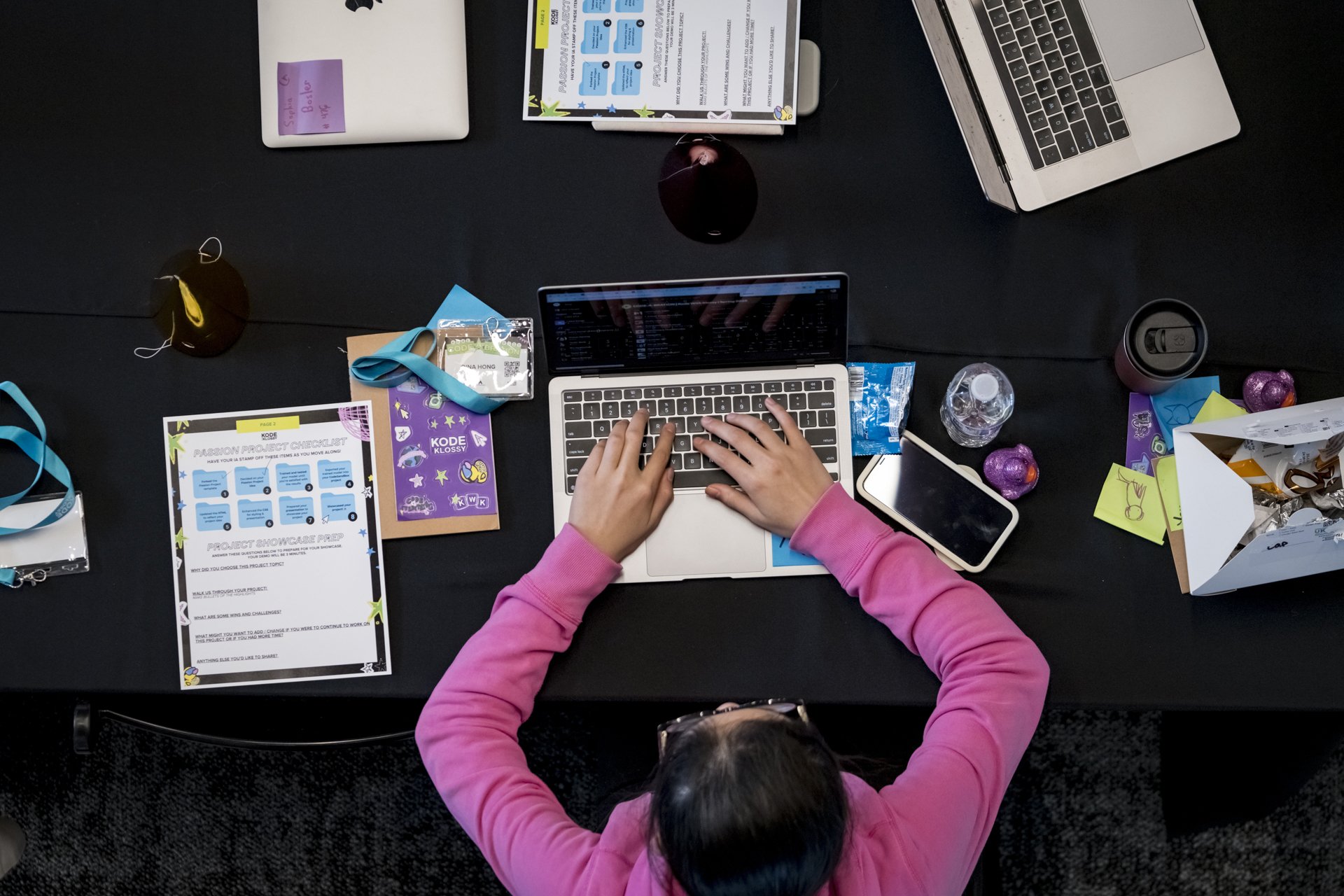
Offered both virtually and in person across the U.S., Kode With Klossy’s flagship coding camps give participants the opportunity to spend two weeks immersed in one of four custom curricula: artificial intelligence and machine learning, data science, web development, or mobile apps. They learn how to use programming languages such as JavaScript, HTML, CSS, and Python and, by the end of camp, deliver a project such as a fully functioning iOS-capable mobile app or a data visualization of a topic they are passionate about. But they’re not just learning how to code.
“Coding is not really just about typing things into the computer,” says Kode With Klossy CEO Osi Imeokparia, whose decades-long career in tech spans multiple sectors including for-profit, nonprofit, philanthropic, and political organizations. “What you learn when you learn to code is computational thinking. You learn to take a big problem and decompose it into smaller parts. You learn to look for patterns and find efficient ways to abstract those patterns. And you also learn the concept of algorithms.
“If we think about it, those are skills that can be applied in any discipline. How do I take a big problem, break it down, find the parts that are repeatable, find the easiest and shortest path to make it an algorithmic, repeatable process? You can think about applying those computational thinking skills to any job. And so even for the young people that take our programs and don’t end up becoming software engineers, they’ve taken away a key skill that can help them in other parts of their work life.”
In addition to learning hands-on problem-solving skills, participants also explore the culture of tech through conversations around representation, ethics, and bias to learn how they can play a role in shaping the industry. They can also return to camp in subsequent years to learn a different curriculum and broaden their knowledge.
While coding remains a chief focus, Kode With Klossy has evolved over the past decade to meet the ever-changing needs of the tech industry and prepare young women for the job landscape. Curriculum has advanced, shifting focus from languages like Ruby on Rails to Python and introducing emerging technology such as artificial intelligence (AI) and machine learning (ML). In addition to its signature two-week camps, Kode With Klossy has started offering year-round programming such as its Code-A-Bration, which are two-day workshops focused on AI and ML, and its Coaches Program, which focuses on AI literacy.
In its next decade, Kode With Klossy is also focused on growing along with its scholars, many of whom are entering college or starting their first jobs. The organization is continuing to build out the role that it plays in making its scholars successful in their careers, offering programming that can help them develop soft skills as well as networking, mentorship, and entry points into internships and job opportunities. Its Challenges Program, for instance, allows scholars to utilize real-life data to solve a problem for one of the organization’s corporate partners, such as Bloomberg, Estee Lauder, and Deloitte, and exercise their skills even further than they would at camp.

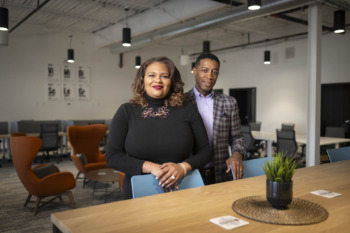
Founder Karlie Kloss and CEO Osi Imeokparia at Kode With Klossy’s 10-year anniversary party at Energizer Park in St. Louis. Photo by Sarah Carmody Photography for Kode With Klossy.
“All of these skill-building experiences stack on each other and really prepare young women to stay in the industry,” Imeokparia says. “It’s that supportive infrastructure along their education and career pathway that encourages them and helps them find these incremental skills that might not be taught within a traditional classroom.
“We’ve been talking about the gender gap in tech for so long and ultimately, we think there’s a cultural problem that needs to be solved, and so we model that culture in our programs. Here is what it could look like if people were intentional about building a space where they wanted you to succeed — it’s possible.”
As Kode With Klossy continues to grow its reach and expand across the country, St. Louis has remained a throughline of the organization, which has offered its signature coding camp in the city each year since its inception. In May 2025, Kode With Klossy announced that St. Louis would be the first recipient of its City of the Future initiative, a multi-year project to help cities invest in the next generation of local tech talent. In addition to the signature two-week coding camps and two-day Code-A-Bration workshops, Kode With Klossy will also introduce more programming aimed at young women ages 18 and up who are starting to enter the workforce.
“There are so many amazing leaders back home here in St. Louis who are working to create technical job opportunities here, such as World Wide Technology and Block,” Kloss says. “Generations of my family grew up here in St. Louis, and to me, it’s not just about the coastal cities where you have to go to access these jobs and these opportunities. Part of what’s so interesting about the tech industry is that you can have a great idea and build it anywhere.”
In addition to being a hub for both established tech companies and startups, Imeokparia points to St. Louis’ role as a locus of geospatial intelligence, spurred by the opening of the National Geospatial-Intelligence Agency’s new headquarters just north of Downtown St. Louis in 2025. Amid that thriving tech landscape, she hopes that Kode With Klossy can serve as an example to young girls and gender-expansive youth in St. Louis — many of whom may not see themselves in the tech industry — and show them what’s possible.
“There is some serious heavy-hitting technical power here,” Imeokparia says. “I think there’s an opportunity to show and demonstrate that in St. Louis, with all this great raw material of talent and ambition, you can really build a purposeful, meaningful tech career. You don’t have to be on the coasts; you can bloom where you’re planted and have that career in St. Louis. How are we helping young people who are from St. Louis at a very early age — 14, 15, 16 — see that that’s a path? And how do we as Kode With Klossy make that pathway possible?”
Join the Story
- Learn more about Kode With Klossy on its website.
- Follow Kode With Klossy on Instagram, Facebook, and X.
- Read more stories of St. Louisans who are paving the way for geospatial careers for the next generation.