Breaking the Ice
Based out of Maryland Heights, the St. Louis Blues’ Girls Development Program offers an accessible and affordable entry point into hockey for young girls.
Savannah Eggert never misses watching a St. Louis Blues game. Although she’s always loved hockey, now that she’s 12 years old, her parents worried they’d missed the boat in signing her up for a program where she could learn the game herself.
That is, until they found the Blues’ Girls Development Program. The low-cost Learn to Play program allows girls between the ages of 4 and 14 to experience hockey for the first time. Specifically designed for girls who have not participated in organized youth hockey before, the six-week program offers an accessible and affordable entry point into a sport that many young girls growing up in the U.S. don’t often have exposure to.
“I think it’s really important to offer girls an opportunity to play a sport like this,” says Brittany Koch, senior coordinator of community hockey with the St. Louis Blues and a former hockey player at McKendree University. “Hockey is a very male-dominated sport, even when I played (a few years ago), so to be able to give the girls the opportunity to see that we can also play the sport and that there’s no limitations is really important. Hockey helped me get into college, so I want to be able to provide that pathway to these girls in St. Louis.”
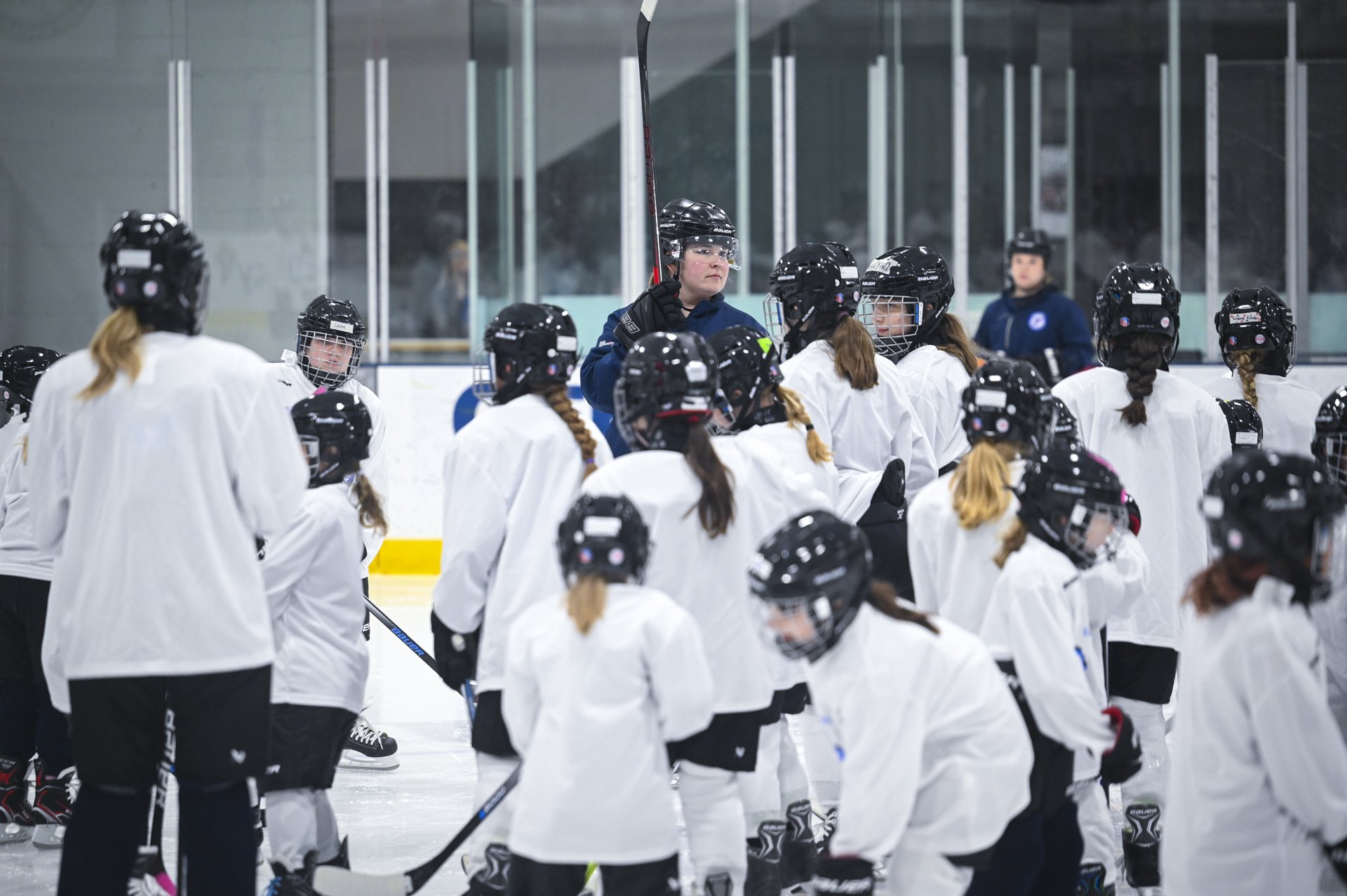
In the first weeks of the Girls Development Program, participants learn basic skating skills to get them feeling comfortable on the ice during practice, which is held at the Centene Community Ice Center, the official practice facility of the St. Louis Blues. The instructors then slowly add pucks in to get the girls to work on their stick-handling skills before progressing into passing, receiving, and shooting. The drills are meant to be fun — such as soccer on ice with giant bouncy balls — and to get the girls thinking about whether they’d like to continue playing hockey in the future. Special guests are also known to show up at practice, from Blues mascot Louie to Alex Cavallini, an Olympic gold medalist in ice hockey.
At a recent Saturday morning practice, the rink at the Centene Community Ice Center was filled with girls of all different ages running drills and practicing their skating by weaving in and out of brightly colored disc cones. Parents, some clad in “Hockey Mom” attire, watched from behind the glass and snapped photos as coaches methodically explained drills and mentored girls one-on-one. The passion among the girls was palpable, whether they were climbing back on their feet after slipping on the ice or skating into the center of the rink at the end of practice to raise their hockey sticks in the air together in celebration.
For Eggert, the program has helped her identify her passion for hockey, which she plans to continue playing long after this session of the program wraps up. She’s learned critical hockey skills and improved significantly in her skating; in particular, she was excited once she finally learned how to stop correctly on the ice. But just as importantly, her parents say the program has helped boost her confidence level tremendously.
Much like Eggert, Erika Muller, the program’s lead on-ice instructor, has always loved hockey and grew up going to Blues games. She didn’t start skating until she was 16, but as a coach has enjoyed seeing the girls — some of whom have never skated before signing up — get more confident on the ice and in their interactions with fellow participants. She hopes the program can encourage more girls to get involved with hockey, no matter their age or experience level.
“I would have loved this program as a kid,” Muller says. “I think it’s really cool for kids that are hockey fans already, just getting to wear your own Blues jersey, but even for kids that don’t know hockey as well, it’s cool to get exposed to a different sport and a whole different community in St. Louis. It’s very rewarding to see them grow and feel more confident in themselves. It’s definitely inspiring to me and I’m so grateful that I get to be a part of this program.”
Outside of the physical benefits of playing hockey, the program helps teach girls valuable life skills by building character, encouraging leadership behaviors, and teaching them the importance of teamwork. Koch says she’s seen the program help girls become more focused and determined and build lasting connections with other participants. Some, like former participants Giselle Oppelz, 13, and Lhotse Carrera, 14, have gone on to join all-girls hockey clubs such as the St. Louis Lady Cyclones and Lady Liberty, even winning the Blue Note Cup this year.
“I think the environment is a great place,” Carrera says. “It’s like one big happy family — all the girls know each other, all the coaches know all the kids.”
Whether or not they plan to pursue hockey, the program helps girls develop skills that will serve them both on and off the ice. When he signed his 8-year-old daughter Emeline up for the program, Aryan Weisenfeld hoped she’d learn fundamental hockey skills such as skating and stick-handling as well as essential life skills like teamwork. After just a few weeks, he’s seen her start to open up on the ice and get more comfortable lining up with her teammates to do drills and pass to each other.
“I think that hockey is a really good sport for everybody,” Weisenfeld says. “It teaches balance and teamwork — especially for her, she really likes to do stuff with her friends and help them. I always thought the point of hockey is more about passing and teamwork so I thought it would be a really good thing for her to do.”
Alexandria Halliday was also excited to find a way to get her 6-year-old daughter Holly involved in a sport that means a lot to their family. Her husband grew up in a hockey family in Canada and played from an early age, but opportunities to play hockey aren’t nearly as widespread for girls in the U.S. While Holly has tried out a few other sports in the past, none have captured her interest quite like hockey, and her mom has noticed a big difference in her level of commitment.
“We really believe in the sport,” Halliday says. “We wanted to get her involved in an all-girls sport where she can learn all the benefits that come from being on a team and the sport of hockey — independence, playing with other people, teamwork, following directions, having something that she can work on to get better at over time. We have a lot of people who say, ‘No way, your girl is doing hockey? That’s really cool.’ I really like that we have a girl that’s really interested in it showing that, ‘Hey, I can do what boys do.’”
In addition to the Girls Development Program, the Blues also offer Little Blues, a co-ed Learn to Play program for kids ages 4 to 9, but Koch says having an all-girls program has made families and parents much more comfortable getting their daughters involved in the sport. The program also lowers the barrier to entry into a sport that can be quite expensive for families. The cost to participate is $250 per child for six weeks of instruction and a full set of equipment, including a jersey, skates, shoulder pads, gloves, elbow pads, a helmet, shin guards, hockey pants, hockey socks, an equipment bag, and a hockey stick. Having the equipment provided — and sized correctly — also takes the guesswork out for parents who might be new to the sport.
“It’s a huge advantage to be able to get all their gear for their program without having to wonder how to do it,” says Bryan Christman, whose 9-year-old daughter Blake is currently participating in the program. “With (the Blues’) relationship with Pure Hockey, they were able to go in and get her size for everything. There can be a lot of guesswork in making sure that I’m getting the right size stuff that’s going to keep her safe. They had a really thorough checklist to make sure that everything was the right size and appropriate for her age, which made it really easy to get her set up.”
With the impact it’s had on its young participants, it’s perhaps no surprise that the Girls Development Program has grown exponentially in just a few short years. In 2022, the program had about 10 participants per session; in spring 2025, it hit a record high of 58 girls in one session. The growing interest in girls’ hockey in St. Louis mirrors a similar shift across the country — according to USA Hockey, girls’ hockey in the U.S. has seen a participation increase of 65 percent over the past 15 seasons.
Women are carving out more space at the professional level, too; the Professional Women’s Hockey League (PWHL), composed of six teams from the U.S. and Canada, played its first season in 2023-24.
From the Girls Development Program to all-girls hockey clubs and women’s rec leagues like the St. Louis Frenzy, St. Louis offers a robust network of programming and community initiatives designed to support female athletes from their first steps on the ice forward. And in March 2025, the city hosted two major women’s hockey events: the PWHL Takeover Tour, which featured a game between the Ottawa Charge and Boston Fleet on March 29 at Enterprise Center, and the ACHA Women’s Division 1 National Championships, which hosted its championship game at the Centene Community Ice Center on March 21.
St. Louis has long been known for its fiercely loyal Blues fanbase, and thanks to programming like the Girls Development Program, the city could also be poised to help nurture the next generation of women in hockey. Koch, who grew up in Michigan, is excited to play a part in growing hockey culture — particularly for young girls and women — in St. Louis as the program continues to offer an accessible entry point to hockey for young girls and expand its reach in the metro.
“From week one to week six, we see all the girls improve on not only their hockey skills, but their skating skills,” Koch says. “We’re seeing girls that have never wanted to step on the ice getting out there in the last weekend doing scrimmages and understanding how to score goals, how to pass, how to defend their own net. We’ve seen tremendous improvement from week one to week six, seeing their confidence and their enthusiasm for the sport grow.”
Join the Story
- Learn more about the St. Louis Blues’ Girls Development Program on its website.
- Follow the program on Instagram, Facebook, and X.
- Dig into more #STLMade Community stories.