Building Blocks
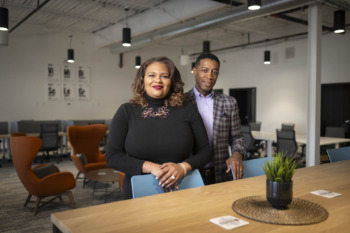
With the Economic Mobility Program at Annie Malone Children and Family Services, Keisha Lee is empowering and elevating young men in St. Louis.
St. Louis native Keisha Lee says people inspire her to help her community thrive.
As the CEO of Annie Malone Children and Family Services, when she heard from her peers and colleagues that the young men in her community needed help and structure in their lives, she wanted to answer the call — she just wasn’t sure how. The solution came to her one evening at a gala, when, amid the festivities, she found herself preoccupied and jotting down notes on a paper napkin.
The idea was simple enough: find young people where they are. She distributed tiny, discrete QR codes to youth on the street, urging them to sign up to receive help from services at Annie Malone.
Several teens used the code and reached out for help. That’s when Lee knew her idea could work. She was solving a problem using newer technology, yet staying true to Annie Malone’s core mission since its founding in 1888: offering youth and family support services to those who need it most.
That day, the organization’s Economic Mobility Program (EMP) was born.
The EMP, which Annie Malone also sometimes refers to as its Education, Mentorship, and Preparation Program, offers day and overnight programming. Young men ages 16 to 21 can participate Monday through Friday from 7 a.m. to 9 p.m. in the daytime program, while teens ages 16 to 18 can enroll in the overnight program Sunday night through Friday night. Both EMPs offer mental health resources and hard and soft skills training, and the overnight program allows teens to earn their high school diplomas.
The teens in the overnight program spend Sunday night through Friday night at a boarding school, which Lee designed herself, in a building next door to Annie Malone’s historic headquarters in The Ville neighborhood.
“I feel like kids need a space to be kids and not worry about adult problems,” she says. “There are so many kids that didn’t have that space when they were growing up, and you got to have somewhere safe to go. Safety impacts your mental health, your physical health, everything. And when you’re hungry, or you’re around people who don’t have your best well-being (in mind)… That’s a different type of feeling unsafe. As a child, you’re really powerless. And this feeling of being in survival mode all the time, and it could come out the wrong way.”
Part of the EMP’s success, Lee says, is the holistic approach it provides for not only the young men participating, but their families as well. Teenagers enrolled in the EMP must have some family involvement in order to join. To stay in the EMP, they must attend family therapy once a month. The program also pays a household bill for each teen’s family.
“I told them, ‘You’ve got to want to be here.’ (If) the kid doesn’t want to be here, I’m not accepting you. I think that’s the major piece to it, too,” Lee says.
The teenagers in the EMP also have access to weekly therapy sessions, with some of them working to heal from past traumas. “They deal with heavy things in this program,” Lee says. “We have to learn to maneuver through that and the emotions of it.”
On Saturdays, the boys spend time with their families. On Sundays, they come back to the boarding school for the week, where each month they have a new curriculum or trade they learn such as plumbing or landscaping. At the end of the month, the teens help someone in their community using the trade they learned.
“I want to show them the world is bigger than their block,” Lee says.
Building on a Legacy
The Annie Malone organization historically has helped at-risk youth for over 100 years. Its namesake, Annie Malone, was the founder of Poro College, a cosmetology school and beauty care center, and a manufacturer of cosmetic products. She served as the President of the Board of Directors of the St. Louis Colored Orphans’ Home from 1919 to 1943. In 1889, it was renamed the Annie Malone Children’s Home.
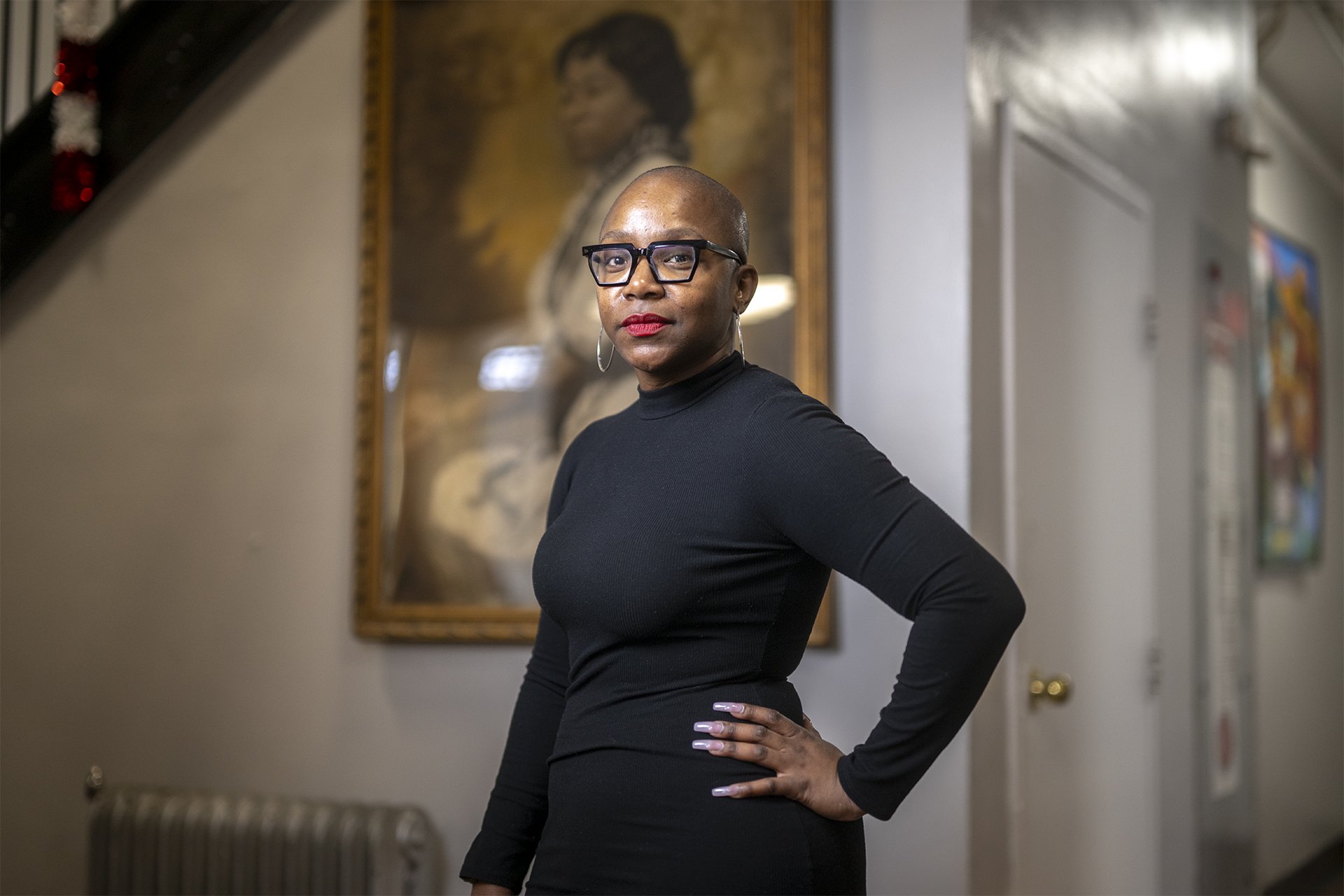
In 1922, the home moved to The Ville neighborhood, where Lee’s desk today sits against cheerful pink and light gray walls with her mother’s artwork hung around her office. Upholding the legacy of the Annie Malone agency is an honor, Lee says, yet something she never thought she would be doing. After serving on the Annie Malone board, Lee says she was trying to find a new purpose in her life.
Then, as she stepped into the role during the 2020 global health crisis, she was diagnosed with breast cancer. She recalls today how youth in Annie Malone programs reached out to her and brightened her day during a very difficult time. “These kids used to FaceTime me in the hospital, and they did a parade around my house,” she recalls.
As a child, Lee participated in annual activities through Annie Malone, initially getting involved with the nonprofit after watching the Annie Malone May Day Parade.
The parade is one of the oldest and largest in St. Louis. The first event was held in 1910, originally in north St. Louis. As it has grown over the years, now featuring more participants and larger audiences, it has shifted to Downtown St. Louis. It’s billed as the second-largest African-American parade in the country. Today, the event serves as the largest annual fundraiser for the organization. “It’s hard to get the world to see what this organization does and what it means beyond the parade,” Lee says.
Yet Lee says the parade can’t be the only revenue stream for the agency. She says the old buildings used by the organization cost a lot of money to maintain. For instance, recently, Lee opened her office door to see the entire space drenched in water after a pipe burst due to the building’s outdated plumbing system.
Lee is working hard to change that reality, however. In October 2023, the state of Missouri allocated $3 million to the agency. Lee said she is grateful to state legislators who were connected to St. Louis, in particular Lieutenant Governor Mike Kehoe. Lee says she and Kehoe had a long conversation about his ties with Walnut Park, a neighborhood Annie Malone heavily serves. The two discussed the purpose of the nonprofit, and eventually, Lee secured the funds from the 2024 state budget.
“I think it’s very important that you represent and have a voice for where you come from,” she says. “I’m very grateful for the legislators that assisted with this. They helped with this because they were connected to St. Louis, and they knew what was going on in their hometown.”
Making a Difference
Anthony is a teen in the overnight Economic Mobility Program. He says he wants to go to college to study math straight after he gets his GED. He wants to own a restaurant someday, where he hopes to fuse Indian and Jamaican cuisines.
“I like that there’s an infinite amount of different dishes to make,” he says. “You can make it anything you like.”
Anthony’s brother and sister saw him struggling at home and referred him to the program. They had participated in the Economic Mobility Program in years past. “They said, ‘Anthony you need this,’” he says.
The teens in the overnight EMP spend every day together and were excited to recently go to a Tennessee State University football game in Nashville. DaMonte, another teen in the program, says he comes back to the program every Sunday because he looks at it as an opportunity for growth.
“We get to go out to different places around the city,” he says. “I’m learning to be independent and self-disciplined.”
The boys enjoy baseball games, football games, and other activities around town, including community building and volunteer opportunities. Lee says she tries to get them to understand the city has more to offer than they previously knew.
“I want to instill in them that you’re a citizen in St. Louis, so you have a duty to be productive as a citizen and make sure everybody else is safe in the city too,” Lee says. “I want to rebuild self-esteem, empower them, and push into them, ‘I’m not afraid of you. I love you. I understand that you’ve been beat down. But let me tell you how I might empower you.’”
Although the teens enjoy the outings, the Annie Malone facility itself has a barbershop, a game room, and lounges with big reclining chairs, giving the teens safe and fun spaces to hang out together. The teens live in dorm-style housing.
“You gotta come see it, it’s so cool. You’ll be like, ‘I wanna live here,’” Lee says excitedly. “I want them to understand that you can do something good in life and still get this stuff.”
At this time, the EMP serves 28 teenagers, but Lee says she wants to expand to north St. Louis County, where she can provide services to the Castlewood Point area.
But that won’t come easy, she notes. Lee says it can sometimes be difficult to get funding and support for the program, but she hopes by sharing how positive and transformative it is for young people, it will underline the need for donations and support.
Although Lee is grateful for the opportunity to keep helping children, she says the weight of upholding a more than century-long legacy falls on her shoulders, and that responsibility can be challenging. Yet she stays motivated by the youth whose lives are changed by Annie Malone. She is excited to continue to run the organization, with ideas to expand with the help of local organizations including the Korey Johnson Foundation.
The organization is currently collecting donations for its $136 for Change campaign to celebrate Annie Malone’s 136th anniversary. If the nonprofit can raise $136 million, they can provide safe housing for children for another 136 years, Lee says. That’s the ultimate goal for Lee, but one she knows she can’t accomplish alone. She says it takes a village to run the EMP.
Everyone is capable of making a positive change in the lives of young people, Lee adds, whether it’s just making one child’s day brighter, or through supporting the life-changing work happening at Annie Malone.
“You don’t know where somebody’s coming from or what they’re coming out of and running to you with,” Lee says. “People have a power that they seldomly use: their superpower just to make somebody else’s day a little more pleasant.”