Fair Play
Unlimited Play founder Natalie Mackay designs and builds inclusive playgrounds for children across the St. Louis metro — and in cities across the country.
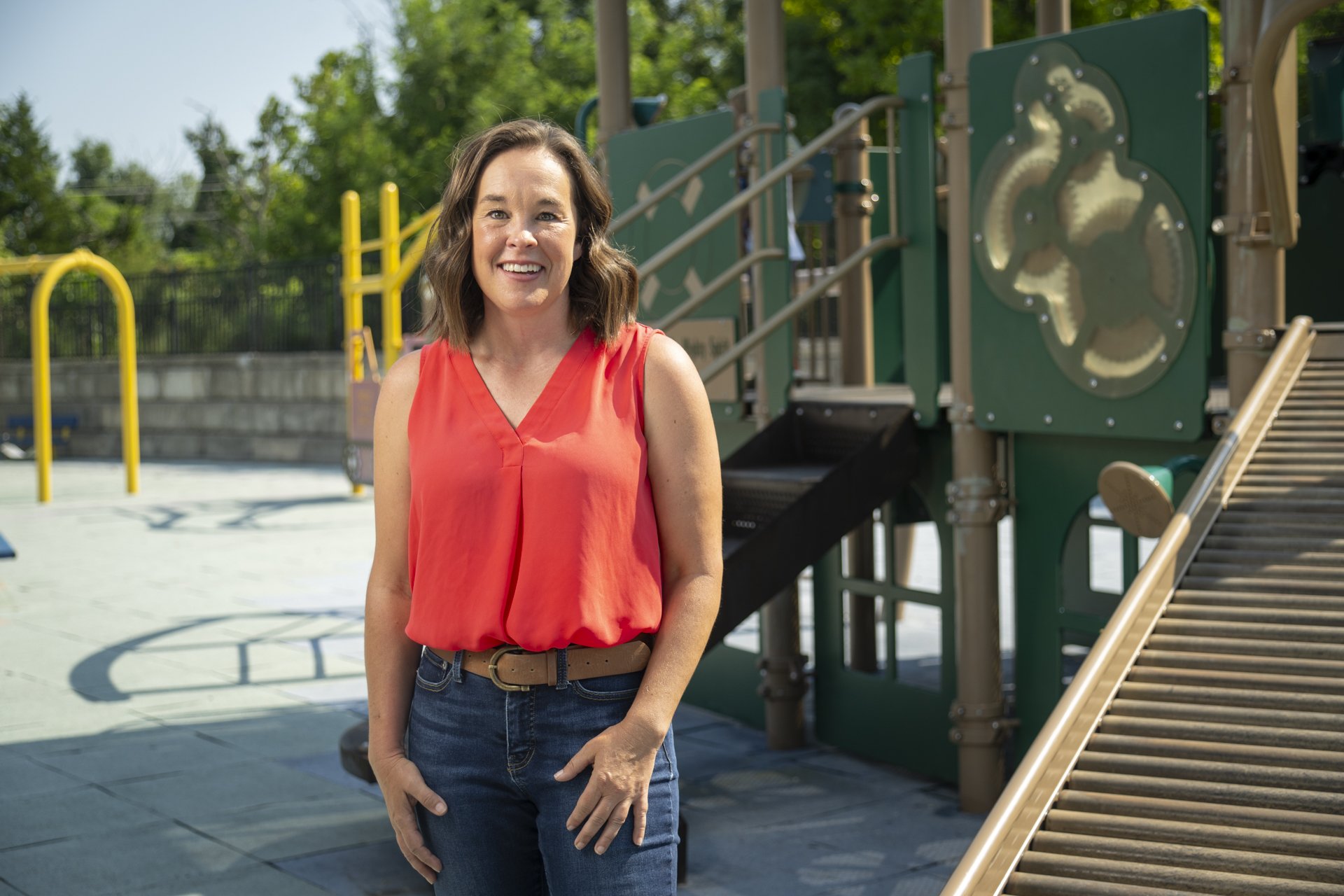
When you enter Hawk Ridge Park in Lake Saint Louis, Zachary’s Playground is impossible to miss. On your right, behind a picturesque lake with a fountain, you’ll find bright-colored slides and a magical castle. Even on a Monday morning in the heat of summer, it draws a crowd of children wearing matching T-shirts proclaiming, “In My Summer Camp Era.” Children of all ages, backgrounds, and abilities are pulled to Zachary’s castle-themed playground and splash pad. Upon first inspection, you wouldn’t know it’s an inclusive space, which is what makes it special. “It’s just the coolest playground a kid has ever seen,” says creator and Unlimited Play founder Natalie Mackay.
“One of the biggest questions I’m asked is if this is just for kids with disabilities, and really (what) they’re asking is will all kids be challenged at their own developmental level,” Mackay says. “And yes, we make sure to incorporate three different levels of challenge so that every child thinks this is the best playground they’ve ever been to — but it happens to be inclusive.”
Large bathroom changing tables, transition stations placed strategically near anti-static roller slides, and a flush-mounted merry-go-round are key to inclusion. The merry-go-round allows children in wheelchairs to wheel themselves on versus requiring their parents to pick them up. The transition station in front of the slide allows parents to sit down to hoist their child out of a wheelchair instead of having to lift from a standing position. Anti-static slides prevent children with cochlear implants from temporarily losing hearing due to static. Children with disabilities often struggle with temperature regulation, so Unlimited Play has included a splash pad which all children enjoy, especially on this particularly hot day in August.
All of these playground features are contained by a fence, which was designed for children with autism who are prone to elopement (to wander or struggle with boundaries). The fence is just outside of an elevated concrete sidewalk which encloses the playground as well as allows multiple access points to decrease overwhelm for children.
Zachary’s Playground opened in 2007 and is the first inclusive playground built by Natalie Mackay. She was inspired to create inclusive playgrounds for her son, Zachary, who was born with a rare, progressive disease which required him to use a wheelchair. Mackay first got the idea for Unlimited Play after a trip to the East Coast showed her the power of inclusive playgrounds. For the first time, Zachary could play on his own with little to no assistance from Mackay. He was part of the play, which increased both his and his playmates’ social and emotional development. Both he and Mackay’s worlds opened. Zachary saw a world where he could play with other children, and his mother saw the same world — but also one where she could connect with other parents of children with disabilities. Mother and son’s community widened.
“When I started Unlimited Play, I felt extremely alone,” Mackay says. “Nobody knows what it’s like to have a child with a progressive disease. And then I started Unlimited Play and met (other) parents, and I suddenly realized, I’m not alone. That counts as much as your kids playing. To have a community.”
Mackay wanted to share this gift with other parents and children, so she brought the idea home with her to the St. Louis area. Working with Zachary’s pediatric speech therapist, she founded Unlimited Play in 2003. After designing and opening Zachary’s Playground four years later, she was encouraged to design and build other playgrounds across the metro area and eventually across the U.S., even though she found — and continues to find — support for non-profits to be tough.
“For a moment at Zachary’s Playground, he truly did forget (his disabilities),” Mackay recalls.
And that reality is what’s kept her going — and kept Unlimited Play growing. She wanted other children to have the same experience Zachary did when he reached the top of the castle, located on the playground named in his honor, in his wheelchair.
“Kids like Zachary are never at the top. Ever. So, he would sit and just enjoy being all the way up at the top,” Mackay says.
Today, in partnership with Little Tikes Commercial, Mackay has opened over 100 inclusive playground locations across the U.S. and Canada. In addition to Zachary’s Playground in Lake Saint Louis, Unlimited Play has also opened a handful of inclusive playgrounds in the metro area, including Angie’s Inclusive Playground at Manion Park in Florissant and Kennedy’s Playground in St. Peters.
As a parent of a child with disabilities, Mackay encourages us to ask questions. For instance, she loved when children asked her how Zachary got to the top of the playground castle in his wheelchair.
“I sat there one day at the picnic table, and I had two little boys run over to me and they said ‘How did he get up there? He’s not supposed to be up there, and we don’t even know how you’re going to get him down!’ But for me, it’s the dream of those two boys who go on and make a difference,” Mackay says.
The boys’ questions gave her a chance to teach other kids about disabilities and create a way for them to connect with him. That’s why Mackay has partnered with Dr. Robert Dillon, Ed.D., to bring Unlimited Play principles to the classroom in the form of a curriculum that meets national standards. Dillon’s background is as an educator, including working as the Director of Innovative Learning for the School District of University City for over seven years. In 2020, he founded Sustainable Education Solutions, Inc., and since November 2022, he’s been the Chief School Designer for Intentional School Designs. With his background and expertise, he understands the logistics of trying to layer a curriculum. “It’s in my soul,” he says.
The curriculum, which is typically taught to students by their classroom teachers on the playground, is based on the Collaborative for Academic, Social, and Emotional Learning (CASEL) framework, which highlights self-awareness, self-management, social awareness, relationship skills, and responsible decision-making. The curriculum does not take away from recess or unguided outdoor playtime; instead, it scaffolds on top of those free play experiences. By having these lessons on a playground, students see the inclusive designs of playground equipment (or the lack of it) up close.
“All of the sudden, a student goes to the park and says, ‘hey, at school I learned that piece of equipment is used for this because we want to make sure that our friends that have visual impairments, or friends with autism can play as well,” Dillon says of the results in classrooms.
Dillon works to share the curriculum, written by teachers for teachers, with educators who have never taught kids while they’re on the playground. In sessions that span three hours to half a day, he brings lesson plans directly to the teacher (in person or virtually) with the appropriate level of support and training. The lesson plan focuses on an aspect of social and emotional learning targeted at a specific grade range and often includes group meeting circles, physical activity, and reflection.
“We know from research that active learning is sticky learning, and so if we can get kids moving, if we can get kids experiencing, there’s a better chance that whatever we’re teaching is going to stick from the youngest learners to the oldest learners,” Dillon says. “Playgrounds provide a unique opportunity to do that. Kids know how to be on the playground. It’s a place where they love to go, and it provides us an opportunity to get some of these really essential lessons about inclusion. That’s the premise.”
Regardless of the resources available to individual teachers, the lessons will set any educator up for success as they unpack the sometimes hard conversations around inclusion.
“While an inclusive playground is ideal,” Dillon says of the environment for the curriculum, “we’ve made it to where any teacher anywhere can teach these essential lessons.”
In addition to meeting teachers where they are, Dillon has also created the curriculum to meet the playgrounds where they are. The lessons are designed to be flexible and range from an extensively inclusive playground to a playground that’s 30 years old and not designed to be inclusive, depending on a teacher or school’s resources. St. Louis, luckily, has a lot of community playgrounds available — and thanks to Mackay, that includes many inclusive ones.
“Working in St. Louis is deeply personal to me; it’s where I call home and where I have the privilege to build inclusive playgrounds that ensure every child feels a sense of belonging,” Mackay says. “Through this work, I aim to create spaces that reflect the heart of our community, celebrating diversity and connection.”
In a world where video games and cell phones can reign supreme, Unlimited Play playgrounds and Dillon’s curriculum help to bring kids together outside to explore the boundaries of their imagination and enrich their social, emotional, cognitive, and physical development.
“We have a great opportunity to use this amazing place where kids want to be, can be active, and can also learn,” Dillon says.
Today, Unlimited Play is less than $100,000 away from a $3.2 million fundraising goal to open a new location in Ballwin. Teddy & Friends Inclusive Playground, a game-board themed playground inspired by Teddy Gooch, who was born with a form of dwarfism called achondroplasia, will be located in Queeny Park, where an outdated but well-loved playground currently resides near the Greensfelder Recreation Complex. Due to issues with balance that some people with dwarfism experience, there will be tunnel slides to help Teddy and all children safely slide.
“It’s the fun part of what Unlimited Play does — look at what somebody needs that has a disability and make it fun and inclusive for everyone,” Mackay says.
Mackay has made St. Louis a more inclusive and fun place for all children to come together and play. She is proud of her work and Unlimited Play’s legacy here and across the country. Yet amid its success, she’s also experienced unimaginable tragedy. Sadly, in 2021, Zachary passed away. Mackay treasures that she was able to give Zachary the gift of play for the last 14 years of his life, and she continues to work in his memory. Through that work, Zachary lives on in the play of all children who visit an Unlimited Play playground.
“People asked me before Zachary passed if I would continue, and I thought, ‘I have no idea how to answer that,’” Mackay recalls. “Every time we cut a ribbon, or today, watching kids play and laugh, that’s his laughter right here — and his legacy that continues to give back. A short, beautiful life that continues to give.”
Join the Story
- Learn more about Unlimited Play and find its St. Louis area playgrounds on its website.
- Follow Unlimited Play on Facebook, X, and Instagram, and subscribe to the nonprofit’s YouTube channel.
- Connect with Unlimited Play on LinkedIn.
- Support Unlimited Play at its annual gala, Dracula’s Ball, on Saturday, October 26.