The Best in the Game
Rawlings Sporting Goods has called St. Louis home since 1887. Today, with an interactive fan experience, and custom gloves and wood bats made in the metro, it’s still batting a thousand.
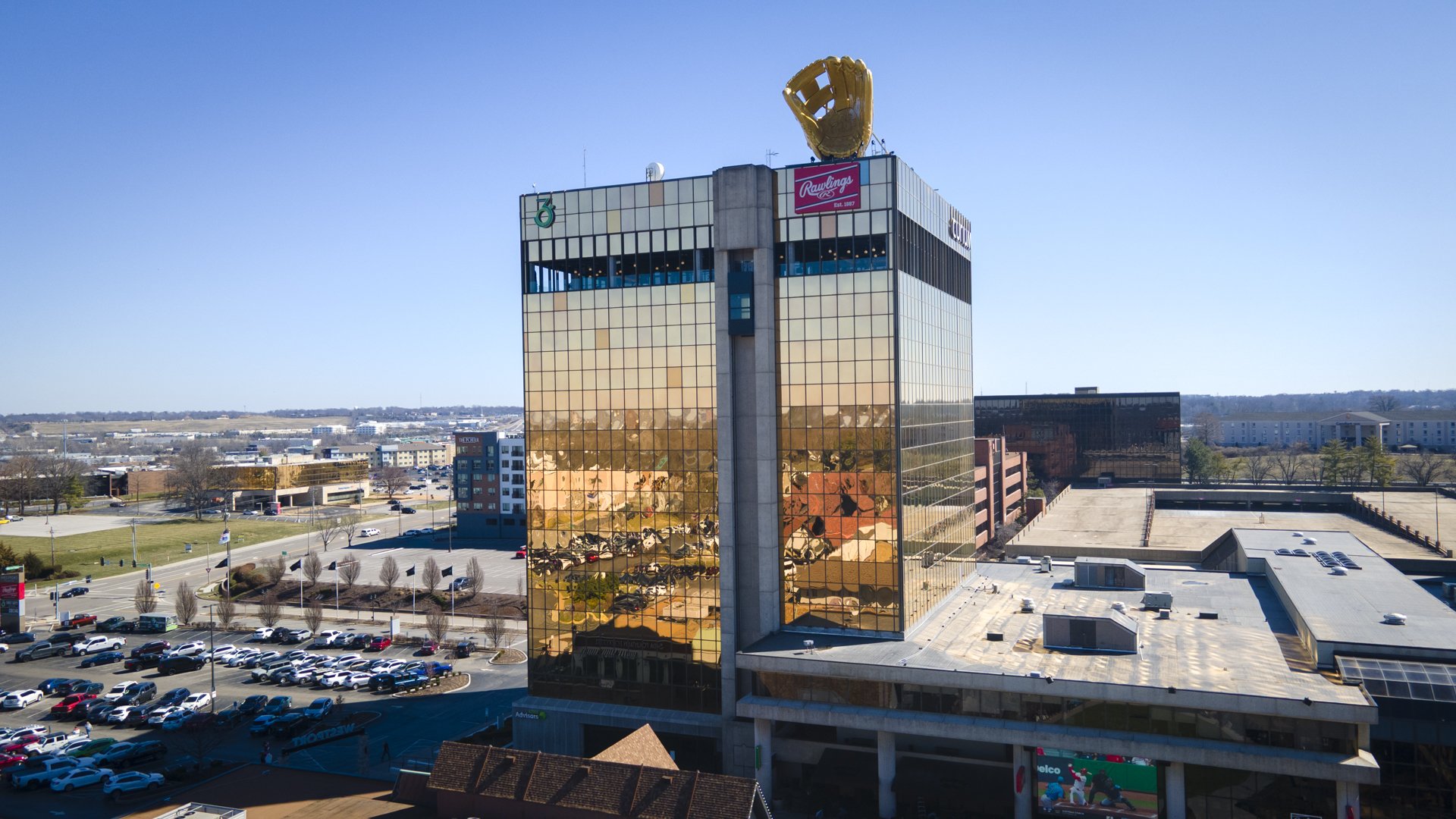
It isn’t every day that a 30,000 pound, 50-foot wide, 30 foot-tall gold glove is lowered onto a building like the cap of an Egyptian pyramid. On November 20, 2025, the mammoth finishing touch was carefully placed via crane onto the roof of the Rawlings Experience St. Louis building in Maryland Heights.
The gargantuan glove has already become an iconic symbol for Rawlings Sporting Goods’s new headquarters at Westport Plaza, which officially opened in April 2024. The free attraction boasts a glove vault, hit lab, custom glove design, a museum, and extensive retail offerings.
One of the reasons Rawlings decided to relocate its headquarters within the region and add an interactive attraction and retail store was to better promote its past and present in St. Louis. The company realized that many people didn’t know the iconic sporting goods company was not only still based in St. Louis, but that its global headquarters are located here.
“We wanted to make sure people knew we were here,” says Rawlings President and CEO Ron Ostrowski. “It was important for us to get into new offices, and test what the ‘experience’ is — a 15,000-square-foot experience for fans and kids.”
Swinging for the Fences
Rawlings was founded in St. Louis in 1887 by brothers George and Alfred Rawlings. They originally offered athletic gear and fishing tackle at Eighth and Chestnut streets in Downtown St. Louis and by mail-order catalog. Rawlings introduced the first football pads in 1902, and in 1906 began outfitting the St. Louis Cardinals with baseball gloves.
In 1920, Cardinals pitcher Bill Doak developed and patented a glove with a pocket between the thumb and index finger; after he sold the patent to Rawlings, the design became standard for baseball gloves. Chicago’s Horween Leather Co. began supplying Rawlings with leather in 1929 and still does today. (The story of Doak’s innovation and the evolution of baseball gloves is detailed in a new coffee table book, The Finest in the Field by Ed Wheatley, which debuted March 24.)
Today the company’s facility in Washington, Missouri, produces wood bats for Major League Baseball players and finishes bases, certain runs of baseballs, and MLB helmets with team logos and colorways after they’re molded in Minnesota.
Over the years, Rawlings has been owned by a variety of entities — including Spalding for several decades — but after Seidler Equity Partners took over in 2018, the company was able to refocus on baseball and softball equipment. Today, the company operates out of three locations in the region — in Westport, Washington, and Dardenne Prairie — and employs 550 team members.
Chief Marketing Officer Mike Thompson says company leadership had been working on the concept of the Rawlings Experience St. Louis for about a decade, and looked at several locations, including Ballpark Village, but it just couldn’t get off the ground. Then Westport Plaza became available.
“Boom! It’s a bit of a Field of Dreams scenario, if you will,” says Thompson, who’s been with Rawlings for 42 years. “Build it and they will come. St. Louis is a generational baseball town. I’ve lived here with my family for 32 years, and when we arrived, we quickly understood baseball is king. It was just a matter of connecting generational baseball fans with a generational brand, and in doing so, we created the Rawlings Experience, which gives not only young fans but their grandparents a perspective on the brand.”
Where the Pros Go
Of course, more than just the massive gold glove atop Westport, the Rawlings glove is the cornerstone of the company. Rawlings supplies about half of all MLB players: Former Cardinal Brendan Donovan famously had a rotation of four Rawlings gloves, depending on what position he was playing. Star Cardinals shortstop Masyn Winn uses one, too — now adorned with a gold Rawlings patch after he won the prestigious Rawlings Gold Glove Award, which honors defensive performance, for the first time last year.
“Our R&D and product teams are out on the field with players, kids, parents, and coaches, getting feedback on what’s working, from both a technology standpoint and on look, feel, and sizing,” Ostrowski says.
Many Rawlings employees are former players themselves, so they understand the nuances of the equipment. There are about 30 employees whose full-time job is to be out on the field — literally — with players and coaches, from 12-year-old softball players to Masyn Winn himself.
“We have teams at spring training in Florida and Arizona,” Thompson says. “Because we’ve been doing well we’ve reinvested into the business — engineers, resources, everything — to improve products, even down to categories people don’t think about, like bags (bases). We have engineers dedicated to that. We eat it, drink it, sleep it. That’s what we do.”
Ostrowski agrees that Rawlings’ commitment to technical excellence is a large part of its longevity.
“We’re really the only ones in the space with that level of engineering support,” he says. “We have more engineers than our three closest competitors combined.”
Blake Campshure, a Rawlings product engineer based at the Washington facility, and his team spend their days making wood bats for pros — and on R&D in pursuit of building better bats. Here, wood billets — cylindrical wood blanks made of ash, maple, or birch — are used to make custom MLB baseball bats. Based on the specs for a given order, Campshure and his colleagues transform the billets on an automatic CNC wood-turning lathe machine.
“When we draw the CNC program, we can control how fast it’s spinning on the spindle, how fast it’s feeding up and down the length to get cuts as smooth as we can make it. The CNC sander knows exactly what shape (any given bat) is, so as the knives follow the contour, the sand paper belt follows it also. It’s going to sand off the exact dimensions we expect it to.”
Best Gloves in Baseball
While Rawlings produces other baseball and softball equipment like bats, catcher’s masks, batting gloves, balls, sliding mitts, and umpire gear, gloves tend to be the item most personal to players.
The best illustration of this is the glove vault at the Rawlings Experience St. Louis, which includes the Rawlings Gold Glove Hall of Fame, and the glove wall, which features dozens of different gloves for different positions.
“A retailer will buy a certain amount from you and a certain amount from your competitors, but they just can’t show the full (Rawlings) range,” Thompson says. “We can show 20 different shortstop gloves in 20 different colors and really give the true baseball fan a look at how deep the brand really goes. It gives a really cool perspective on the heritage of the brand and products people otherwise wouldn’t see.”
Anyone can create a custom glove at the Rawlings Experience, just like the pros, or get real-time data on your swing to pick out the best bat to improve your game in the Hit Lab.
“It starts with building the best glove for the player,” Ostrowski says. “We’re the official glove of Major League Baseball, so we’re getting direct feedback from players, and that influence cascades down.”
Josh Beier, a product engineer who works at the Rawlings Tech Center in Dardenne Prairie, creates custom, or “one of one” baseball gloves for pros. The facility, which opened in February 2026, includes a workshop outfitted with original Rawlings equipment from its long history, such as industrial sewing machines made to stitch thick leather and a custom branding machine. The workshop stocks every color of glove laces you could imagine, and produces singular Rawlings gloves right here in the St. Louis region.
Thompson feels the 100 years of know-how gives Rawlings an edge when it comes to gloves.
“Glove are tricky. They’re craftsmanship, not just engineering. A first baseman uses a different glove than a shortstop or an outfielder,” Thompson says. “There are variations in size, leather, patterning, so it’s hard to get into the glove business and do it well. We’re deeply rooted in the sport and have built trust with players at every level — we believe we do it better than anyone.”
A Whole New Ballgame
As St. Louis gears up for another season of baseball at Busch Stadium — Cardinals Opening Day is Thursday, March 26, 2026 — things will look different on the field. The 2026 season is largely viewed by management, fans, and commentators as a “rebuild” year.
“There’s a lot of young talent coming up,” Thompson says.
Ostrowski adds: “Young teams can surprise you.”
As for the Best Fans in Baseball, Thompson and Ostrowski believe they’re ready to hit the ground running. Thompson stresses how knowledgeable the fans are — making the Rawlings Experience perfectly situated in St. Louis.
“You could meet someone at the grocery store and they know the (Cardinals) pitching rotation,” he says. “If you define fans by knowledge, St. Louis has the best fans.”
Ostrowski agrees, adding that he realized the importance of baseball even before he arrived in St. Louis six years ago.
“There’s a level of dedication and Midwest passion that’s unique,” Ostrowski says. “Fans stick with the team through the entire season.”